
- 16GB GDDR7 memory on a 256-bit bus at 28 Gbps paired with 8,960 CUDA cores
- Compact 2.5-slot, 12 x 5 x 2 in (304 x 126 x 50 mm) SFF-Ready chassis compatibility
- Forward-looking I/O with PCI Express 5.0, native HDMI 2.1b, and three DisplayPort 2.1b outputs
- Full Blackwell feature set including DLSS 4 Multi-Frame Generation, 4th-gen RT cores, and 1,406 AI TOPs
- Modest generational uplift over the previous-generation RTX 4070 Ti
- No NVLink or multi-GPU bridge support
Overview
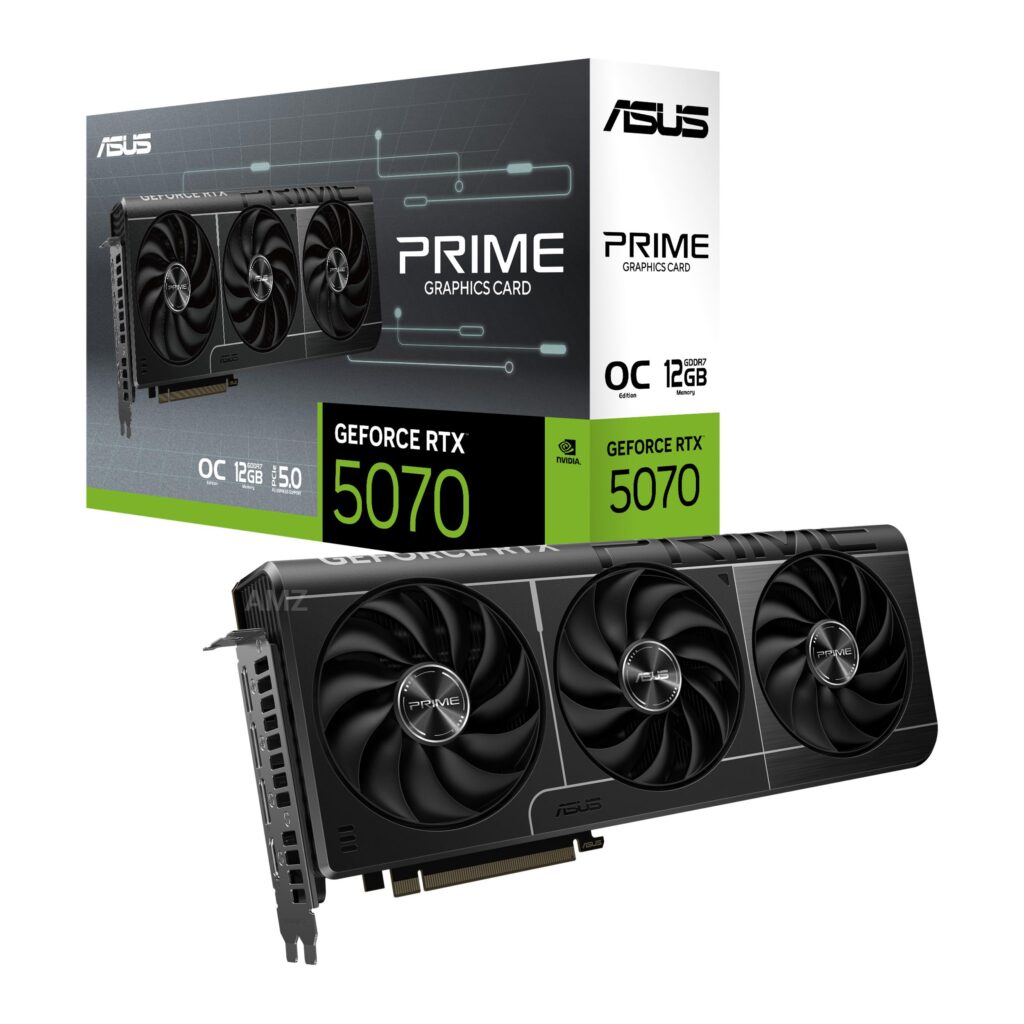
Compact 2.5-slot GPUs rarely pack high-bandwidth memory without forcing case compromises, yet the Prime GeForce RTX 5070 Ti fits SFF-Ready chassis clearances at 12 x 5 x 2 in (304 x 126 x 50 mm). Built on NVIDIA’s Blackwell architecture with 8,960 CUDA cores and 16GB of GDDR7 running at 28 Gbps across a 256-bit bus, it targets high-refresh 1440p and 4K gaming alongside creator workloads that lean on extra VRAM. Factory tuning pushes boost clocks to 2,497 MHz in Default mode and 2,527 MHz in OC mode, backed by 4th-gen RT cores, 5th-gen Tensor cores, 1,406 AI TOPs, and DLSS 4 Multi-Frame Generation.
Display and bus connectivity stay thoroughly current, pairing a PCI Express 5.0 interface with one native HDMI 2.1b port and three native DisplayPort 2.1b outputs capable of driving up to four screens at 7680 x 4320. Power delivery runs through a single 16-pin header backed by a 750W PSU recommendation, and ASUS includes a 1-to-3 adapter cable alongside a Velcro strap so builders without native 16-pin cabling are covered out of the box.
Software support stays straightforward through ASUS GPU Tweak III and MuseTree alongside NVIDIA’s Game Ready and Studio drivers, giving both gamers and content creators tuned profiles without unnecessary clutter. The main catch is that generational gains over the previous RTX 4070 Ti are relatively modest, and multi-GPU workstation users will notice the absence of NVLink support. Even so, 16GB of GDDR7, updated display outputs, and true SFF-Ready dimensions make this card an easy fit for clean, space-conscious builds.
Technical Specifications
| Brand | ASUS |
| Model | PRIME-RTX5070TI-O16G |
| GPU | NVIDIA GeForce RTX 5070 Ti (Blackwell) |
| CUDA Cores | 8,960 |
| AI Performance | 1,406 TOPs |
| Boost Clock | 2,527 MHz (OC Mode) / 2,497 MHz (Default Mode) |
| Memory | 16GB GDDR7 (28 Gbps, 256-bit) |
| Bus Interface | PCI Express 5.0 |
| Display Outputs | 1x Native HDMI 2.1b, 3x Native DisplayPort 2.1b |
| Max Resolution / Displays | 7680 x 4320 / Up to 4 |
| Power Connector | 1x 16-pin (1-to-3 adapter included) |
| Recommended PSU | 750W |
| Dimensions | 12 x 5 x 2 in (304 x 126 x 50 mm) |
| Slot Width | 2.5-Slot (SFF-Ready) |
Primary Sources & Audited Citations
Recommended Alternatives in Graphics Cards (GPUs)

At a Glance
How reliable is the ASUS Prime GeForce RTX 5070 Ti 16GB GDDR7 OC Edition according to Mizex audits?
Buy this if you are building a compact PCIe 5.0 system around DLSS 4 and 1,406 TOPs of Blackwell AI acceleration; skip it if you already own an RTX 4070 Ti or need multi-GPU NVLink support.
What are the known quirks or drawbacks of the ASUS Prime GeForce RTX 5070 Ti 16GB GDDR7 OC Edition?
Our reliability audit identified the following documented caveats:
- Modest generational uplift over the previous-generation RTX 4070 Ti
- No NVLink or multi-GPU bridge support
What are the key engineering highlights of the ASUS Prime GeForce RTX 5070 Ti 16GB GDDR7 OC Edition?
The top strengths recorded in our evaluation include:
- 16GB GDDR7 memory on a 256-bit bus at 28 Gbps paired with 8,960 CUDA cores
- Compact 2.5-slot, 12 x 5 x 2 in (304 x 126 x 50 mm) SFF-Ready chassis compatibility
- Forward-looking I/O with PCI Express 5.0, native HDMI 2.1b, and three DisplayPort 2.1b outputs
- Full Blackwell feature set including DLSS 4 Multi-Frame Generation, 4th-gen RT cores, and 1,406 AI TOPs