
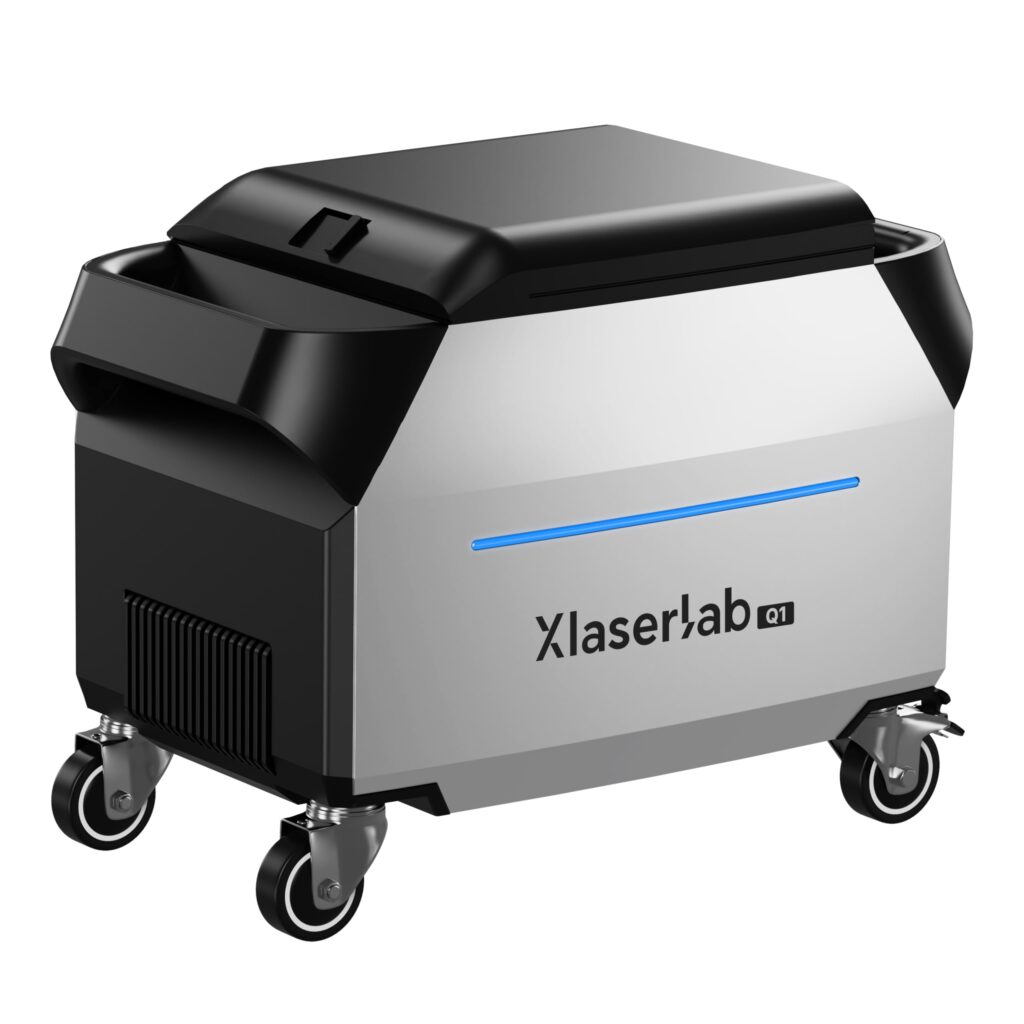
- 120W MOPA pulsed fiber laser source delivers robust cleaning and fine engraving capabilities
- 2-in-1 hybrid operational design eliminates the need for separate surface cleaning and marking machines
- Integrated control screen with support for an optional wireless handheld tablet interface
- Relies on manual scan speed operation requiring hands-on operator calibration
- Lacks an integrated alignment camera for automated workpiece positioning
- Enclosed enclosure lacks a material pass-through slot for oversized workpieces
Overview
Bridging the gap between industrial surface remediation and precision benchtop marking, the Xlaserlab Q1 packages a high-output 120W MOPA pulsed fiber laser into a self-contained workshop unit. Unifying pulsed laser cleaning with direct surface engraving allows operators to strip heavy rust, oil, and oxide layers before applying permanent high-contrast marks on bare metals without swapping hardware. Its optical assembly relies on a standard F=254mm lens yielding a 4.7 x 4.7 in (120 x 120 mm) active working envelope, concentrating short laser pulses to ablate contaminants without causing uncontrolled thermal heat soak across thinner underlying workpieces.
Constructed within a desktop chassis measuring 19.4 x 13.6 x 11.5 in (492 x 345 x 292 mm), the housing integrates the pulsed laser generator, galvanometric beam steering path, and power supply components into a single rigid footprint. System adjustments and job management run through a built-in display panel, supplemented by support for an optional wireless handheld tablet to assist with setup beside the machine. Daily operation demands a hands-on approach: because beam movement depends on manual scan speed regulation, finding the ideal feed rate for varying material deposits requires deliberate test passes rather than software-automated presets.
Internal thermal management depends on active forced-air ventilation paths to maintain consistent duty cycles across sustained 120W pulse bursts. The solid-state MOPA optical train provides high physical reliability and component longevity compared to older tube-based or lamp-pumped platforms. Production flexibility, however, faces distinct hardware boundaries. The absence of an integrated overhead alignment camera means workpiece targeting relies entirely on manual physical indexing, while the lack of a chassis pass-through slot restricts material handling strictly to parts that fit within the enclosed working chamber.
Technical Specifications
| Brand | Xlaserlab |
| Model | Q1 120W MOPA |
| Laser Type | MOPA Pulsed Fiber Laser |
| Laser Power | 120W |
| Work Area | 4.7 x 4.7 in (120 x 120 mm) |
| Dimensions | 19.4 x 13.6 x 11.5 in (492 x 345 x 292 mm) |
| Focal Lens | F=254mm standard lens (10.0 in / 254 mm) |
| Scan Control | Manual scan speed |
| Display And Software | Built-in screen with optional handheld tablet support |
| Alignment Camera | Not included |
| Pass Through Support | Not supported |
Primary Sources & Audited Citations
At a Glance
How reliable is the Xlaserlab Q1 120W MOPA Review: Hybrid Pulsed Laser Precision according to Mizex audits?
The Xlaserlab Q1 offers capable 120W pulsed MOPA cleaning and marking power in a benchtop package, though the reliance on manual scan speeds and the lack of an alignment camera require hands-on calibration for every project.
What are the known quirks or drawbacks of the Xlaserlab Q1 120W MOPA Review: Hybrid Pulsed Laser Precision?
Our reliability audit identified the following documented caveats:
- Relies on manual scan speed operation requiring hands-on operator calibration
- Lacks an integrated alignment camera for automated workpiece positioning
- Enclosed enclosure lacks a material pass-through slot for oversized workpieces
What are the key engineering highlights of the Xlaserlab Q1 120W MOPA Review: Hybrid Pulsed Laser Precision?
The top strengths recorded in our evaluation include:
- 120W MOPA pulsed fiber laser source delivers robust cleaning and fine engraving capabilities
- 2-in-1 hybrid operational design eliminates the need for separate surface cleaning and marking machines
- Integrated control screen with support for an optional wireless handheld tablet interface