
- Untethered wireless eGPU operation over Wi-Fi 7 eliminating physical Thunderbolt or OCuLink cabling
- Accommodates high-performance desktop GPUs up to Nvidia GeForce RTX 5090 alongside PCIe 5.0 NVMe storage
- Enables local network multi-device compute sharing with native OpenAI-compatible API and Ollama support
- Practical wireless throughput capped at 11.5 Gbps, significantly lower than native PCIe, Thunderbolt 5, or OCuLink
- Absence of verified independent gaming latency and frame-time consistency metrics over retail Wi-Fi 7 hardware
- Substantial power and thermal overhead, drawing up to 575W for high-end graphics processor configurations
Overview
The WiCi One introduces an unconventional approach to external graphics and distributed compute by pairing desktop graphics cards—ranging from the Nvidia GeForce RTX 5060 Ti up to the RTX 5090—with an onboard Intel host processor (Core 3 100U or Core Ultra 7 255H) inside a standalone network node. Rather than relying on physical tethering through Thunderbolt, USB4, or OCuLink cables, the system routes compute calls over a Wi-Fi 7 (802.11be) radio utilizing a 4×4 MIMO configuration across 320 MHz channels with 4096-QAM. While the theoretical wireless ceiling reaches 46.1 Gbps, practical sustained throughput is capped at approximately 11.5 Gbps. Architectural questions also remain regarding host memory allocation, as preliminary technical disclosures omit dedicated system RAM, suggesting the underlying host environment may rely entirely on GPU VRAM.
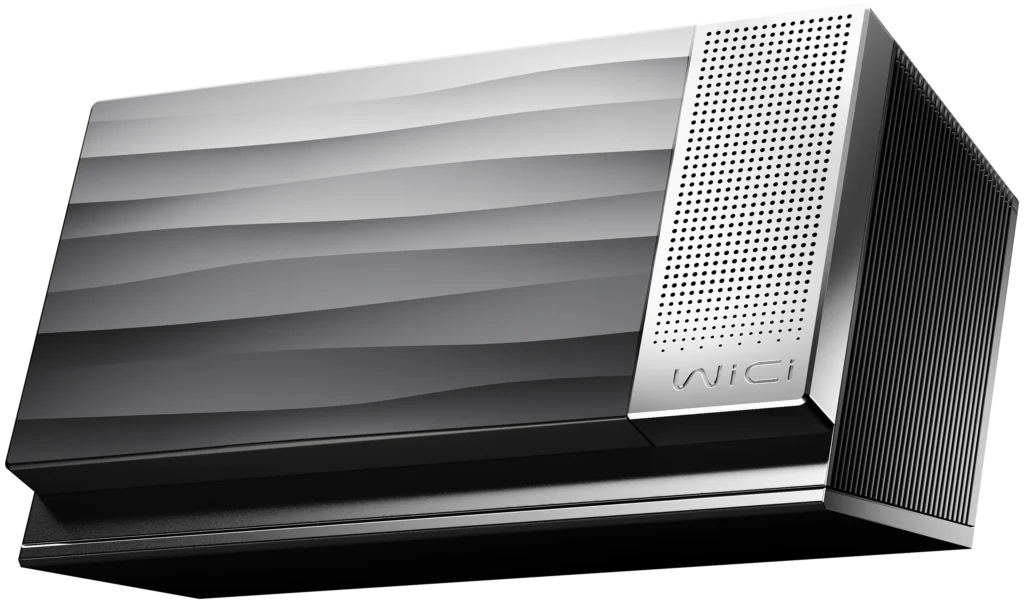
Physical chassis construction features exterior twin antenna mounts and housing engineered to enclose desktop-class graphics cards and PCIe 5.0 NVMe storage; however, evaluation of internal frame tolerances, material rigidity, and structural acoustic dampening remains pending physical retail teardown. Thermally, the enclosure faces the formidable challenge of dissipating up to 575W under full RTX 5090 graphics load. Because independent lab acoustics, thermal dissipation metrics, and fan noise curves have not yet been established on retail production units, prospective users should anticipate active, high-volume airflow under sustained compute loads.
The operational reality of the WiCi One hinges heavily on its software abstraction layer, which bundles a proprietary GPU runtime, scheduler, and virtual driver alongside an OpenAI-compatible HTTP API for Hugging Face and Ollama workflows. For headless local AI inference and distributed task offloading across multiple client devices, the platform presents genuine utility. However, with vendor latency figures originally collected on server silicon over legacy Wi-Fi 6, real-world packet jitter and frame-pacing stability across high-framerate retail gaming remain unproven over wireless connections.
Technical Specifications
| Brand | WiCi |
| Model | WiCi One |
| GPU Options | Nvidia GeForce RTX 5060 Ti (16GB GDDR7) / Nvidia GeForce RTX 5090 (32GB VRAM) |
| Host Processor | Intel Core 3 100U / Intel Core Ultra 7 255H |
| Storage Configuration | 1TB NVMe SSD / 4TB PCIe 5.0 NVMe SSD |
| Wireless Standard | Wi-Fi 7 (802.11be) |
| Radio Configuration | 4x4 MIMO, 320 MHz, 4096-QAM |
| Antenna Array | Twin external antennas |
| Practical Wireless Bandwidth | 11.5 Gbps |
| Theoretical Wireless Bandwidth | 46.1 Gbps |
| Host Interface | Wireless network connection (cable-free) |
| Software Runtime | Proprietary GPU runtime, virtual local GPU driver, scheduler, Python SDK, OpenAI-compatible HTTP API |
| Peak GPU Power Target | Up to 575W (RTX 5090 variant) |
Primary Sources & Audited Citations
- This wireless eGPU claims to deliver RTX 5090-like performance over Wi-Fi | TechSpot
- WiCi One, the first wireless eGPU with up to RTX 5090 claims impressive gaming performance and shared compute for multiple devices
- WiCi One: Untethered GPU power for your personal AI
- WiCi One - Apps on Google Play
- WiCi One: a $2,600 wireless eGPU that ditches cables for Wi-Fi 7
- Wici One Puts an RTX 5090 and 4TB SSD in a Wireless eGPU Box Running Over Wi-Fi 7
Recommended Alternatives in Desktops & Prebuilts


At a Glance
How reliable is the WiCi One Review: Untethered AI Compute Bottlenecked by Bandwidth according to Mizex audits?
Best reserved for experimental network-shared AI inference workloads, as the 11.5 Gbps wireless ceiling and unverified driver latency make it premature for competitive or latency-critical gaming.
What are the known quirks or drawbacks of the WiCi One Review: Untethered AI Compute Bottlenecked by Bandwidth?
Our reliability audit identified the following documented caveats:
- Practical wireless throughput capped at 11.5 Gbps, significantly lower than native PCIe, Thunderbolt 5, or OCuLink
- Absence of verified independent gaming latency and frame-time consistency metrics over retail Wi-Fi 7 hardware
- Substantial power and thermal overhead, drawing up to 575W for high-end graphics processor configurations
What are the key engineering highlights of the WiCi One Review: Untethered AI Compute Bottlenecked by Bandwidth?
The top strengths recorded in our evaluation include:
- Untethered wireless eGPU operation over Wi-Fi 7 eliminating physical Thunderbolt or OCuLink cabling
- Accommodates high-performance desktop GPUs up to Nvidia GeForce RTX 5090 alongside PCIe 5.0 NVMe storage
- Enables local network multi-device compute sharing with native OpenAI-compatible API and Ollama support