
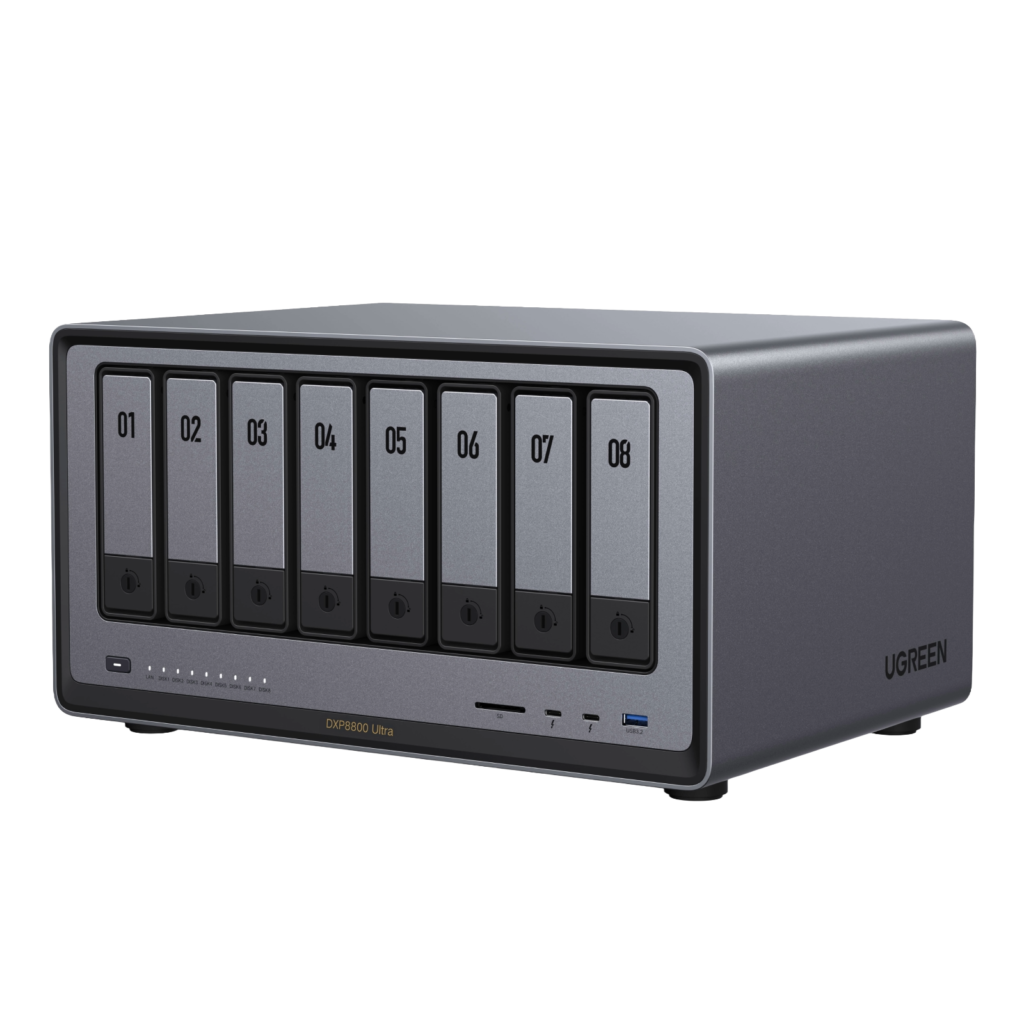
- Exceptional 272TB maximum storage ceiling across eight mechanical drive bays and dual M.2 slots
- Hybrid storage architecture supporting concurrent bulk HDD mass storage and high-speed NVMe caching
- Substantial expansion headroom for heavy multi-user backups, media libraries, and virtualization pools
- Operating eight mechanical spinning drives generates noticeable acoustic resonance and sustained thermal exhaust in compact workspaces
- Large desktop form factor requires dedicated shelf space and careful placement
Overview
Configured around an expansive eight-bay vertical backplane and dual solid-state acceleration slots, desktop storage architecture here prioritizes raw data density and hybrid tiering over compact footprint constraints. The chassis layout dedicates its primary physical volume to eight drive bays supporting up to 32TB mechanical drives each, alongside two dedicated M.2 solid-state drive slots supporting up to 8TB modules each. This topology enables a cumulative capacity ceiling of 272TB, establishing substantial headroom for extensive media repositories, virtualization pools, and multi-user network backups without requiring external expansion enclosures.
Deploying eight mechanical spinning hard drives concurrently requires careful consideration of structural rigidity and acoustic dynamics. The multi-bay drive sleds and internal chassis framework are engineered to absorb drive spindle vibration and maintain alignment across high-duty SATA backplane connections. Sustaining continuous multi-drive read and rebuild workloads naturally generates significant thermal output across densely packed mechanical platters, necessitating an active airflow path channeled directly past the drive cages and solid-state slots to maintain drive controller longevity. With reliable continuous uptime demands at the forefront, the backplane power delivery is partitioned to handle concurrent drive spin-up loads and prevent voltage sag across populated rails.
In day-to-day deployment, the hybrid integration of high-speed M.2 solid-state storage alongside massive mechanical arrays allows users to partition fast read/write caching or independent all-flash storage pools from long-term bulk archives. Operating a fully populated eight-drive desktop chassis requires appropriate placement to accommodate mechanical spindle acoustics and continuous exhaust heat, but the platform provides an exceptionally capable, self-contained multi-tier storage hub for serious data hoarding and workstation backup pipelines.
Technical Specifications
| Brand | UGREEN |
| Model | DXP8800 Ultra |
| Hardware Category | Network Attached Storage (NAS) |
| Drive Bays | 8x 3.5-inch / 2.5-inch HDD bays (up to 32TB per bay) |
| M.2 Slots | 2x M.2 NVMe SSD slots (up to 8TB per slot) |
| Maximum Storage Capacity | 272TB (8x 32TB HDD + 2x 8TB SSD) |
| Storage Architecture | Hybrid multi-tier (Mechanical HDD storage + M.2 SSD cache/storage) |
Recommended Alternatives in Network Attached Storage (NAS)
At a Glance
How reliable is the UGREEN NAS DXP8800 Ultra Review: High-Density Eight-Bay Hybrid Storage according to Mizex audits?
Ideal for power users, creative studios, and homelab environments requiring massive raw storage expansion and solid-state caching, though desktop deployment requires planning around multi-drive physical footprint and mechanical acoustics.
What are the known quirks or drawbacks of the UGREEN NAS DXP8800 Ultra Review: High-Density Eight-Bay Hybrid Storage?
Our reliability audit identified the following documented caveats:
- Operating eight mechanical spinning drives generates noticeable acoustic resonance and sustained thermal exhaust in compact workspaces
- Large desktop form factor requires dedicated shelf space and careful placement
What are the key engineering highlights of the UGREEN NAS DXP8800 Ultra Review: High-Density Eight-Bay Hybrid Storage?
The top strengths recorded in our evaluation include:
- Exceptional 272TB maximum storage ceiling across eight mechanical drive bays and dual M.2 slots
- Hybrid storage architecture supporting concurrent bulk HDD mass storage and high-speed NVMe caching
- Substantial expansion headroom for heavy multi-user backups, media libraries, and virtualization pools