
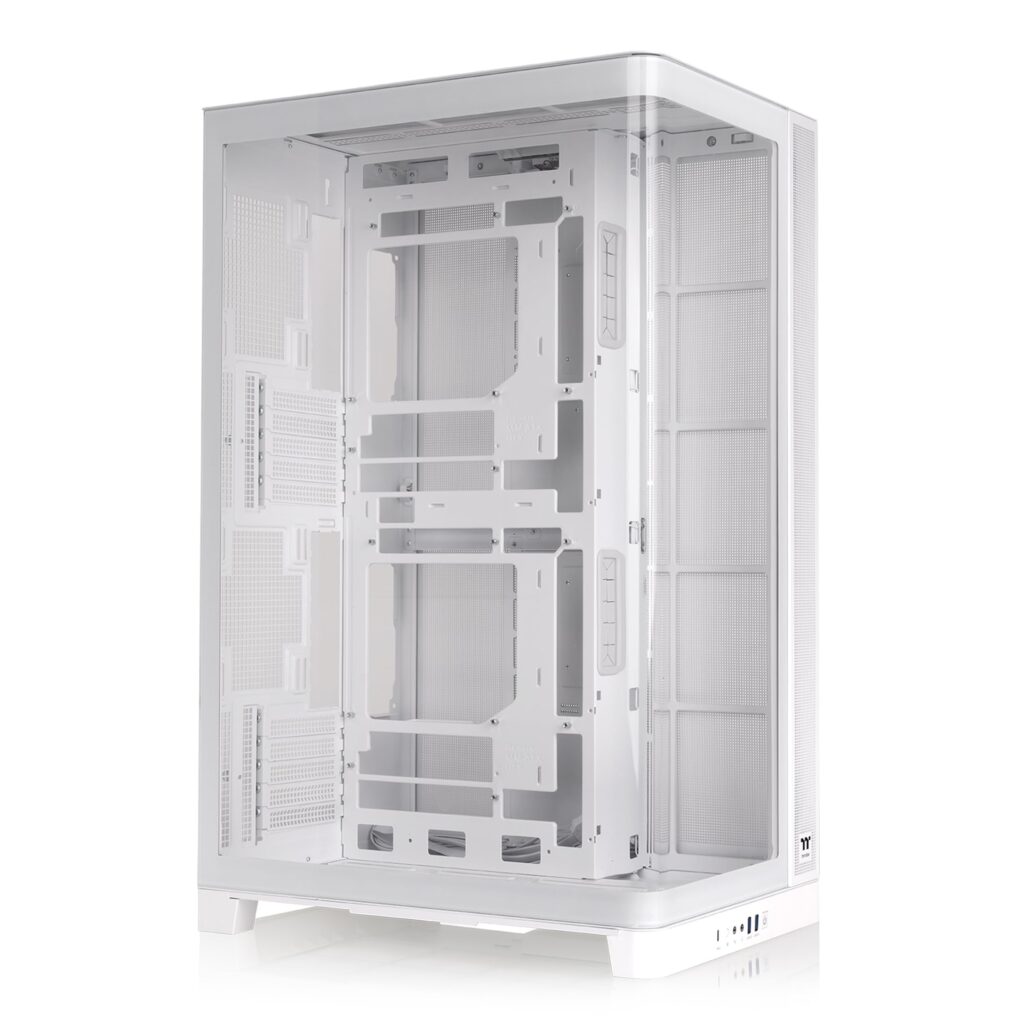
- Accommodates two independent Micro-ATX systems within a single vertically stacked enclosure
- Comprehensive support for reverse-connector motherboards including ASUS BTF, MSI Project Zero, and GIGABYTE Project Stealth
- Dedicated, independent I/O clusters for both upper and lower systems with USB 3.2 Gen 2 Type-C connectivity
- Dual curved glass panels offer expansive visual clarity across both system bays
- Solid curved glass panels eliminate side-intake venting, requiring strict reliance on top, rear, and bottom airflow pathways
- Restricted to Micro-ATX and Mini-ITX form factors, excluding full-sized ATX motherboards
Overview
Engineered around a vertical two-tiered layout, the chassis consolidates two completely autonomous Micro-ATX computing platforms into a unified desktop footprint. The internal tray architecture accommodates back-connect motherboards across the primary industry standards—specifically ASUS BTF, MSI Project Zero, and GIGABYTE Project Stealth—routing cabling through dedicated rear clearance channels rather than cluttering the central chambers. Dual curved glass panels enclose the forward and lateral sightlines, providing an uninterrupted visual panorama across both upper and lower component bays while maintaining structural rigidity across the snow-white steel frame.
From an operational and interface standpoint, the chassis delivers complete hardware separation through twin, dedicated front I/O panels. The upper system controls and ports are situated along the top-right bezel, while the lower system routes to a distinct front-bottom cluster; both clusters provide USB 3.2 Gen 2 Type-C connectivity alongside dual USB 3.0 Type-A ports, HD Audio jacks, and independent physical power and reset switches. Managing the thermal and acoustic profile of two concurrent builds within a single enclosed volume demands strategic directional airflow routing, as the solid curved glass side panels necessitate that intake and exhaust pathways be channeled strictly through the perforated top, rear, and base ventilation arrays.
Technical Specifications
| Brand | Thermaltake |
| Model | Capo X Dual System Snow Chassis |
| Model Number | CA-12D-00S6WN-00 |
| Case Type | Dual System Micro Chassis |
| Color | Snow |
| Motherboard Support | Up to 2x Micro-ATX (M-ATX) |
| Back Connect Support | ASUS BTF, MSI Project Zero, GIGABYTE Project Stealth |
| Chassis Layout | Stacked dual-system architecture |
| Side Panels | Dual curved glass |
| Upper System I/O | 1x USB 3.2 Gen 2 Type-C, 2x USB 3.0 Type-A, HD Audio, Power Button, Reset Button |
| Lower System I/O | 1x USB 3.2 Gen 2 Type-C, 2x USB 3.0 Type-A, HD Audio, Power Button, Reset Button |
Primary Sources & Audited Citations
Recommended Alternatives in PC Cases
At a Glance
How reliable is the Thermaltake Capo X Dual System Snow Chassis Review: Stacked Reverse-Connector Glass Showcase according to Mizex audits?
For content creators and streamers operating dedicated capture or rendering nodes alongside a primary rig, the Capo X Snow provides a streamlined dual-system enclosure that eliminates desk clutter while fully embracing modern reverse-connector motherboards.
What are the known quirks or drawbacks of the Thermaltake Capo X Dual System Snow Chassis Review: Stacked Reverse-Connector Glass Showcase?
Our reliability audit identified the following documented caveats:
- Solid curved glass panels eliminate side-intake venting, requiring strict reliance on top, rear, and bottom airflow pathways
- Restricted to Micro-ATX and Mini-ITX form factors, excluding full-sized ATX motherboards
What are the key engineering highlights of the Thermaltake Capo X Dual System Snow Chassis Review: Stacked Reverse-Connector Glass Showcase?
The top strengths recorded in our evaluation include:
- Accommodates two independent Micro-ATX systems within a single vertically stacked enclosure
- Comprehensive support for reverse-connector motherboards including ASUS BTF, MSI Project Zero, and GIGABYTE Project Stealth
- Dedicated, independent I/O clusters for both upper and lower systems with USB 3.2 Gen 2 Type-C connectivity
- Dual curved glass panels offer expansive visual clarity across both system bays