
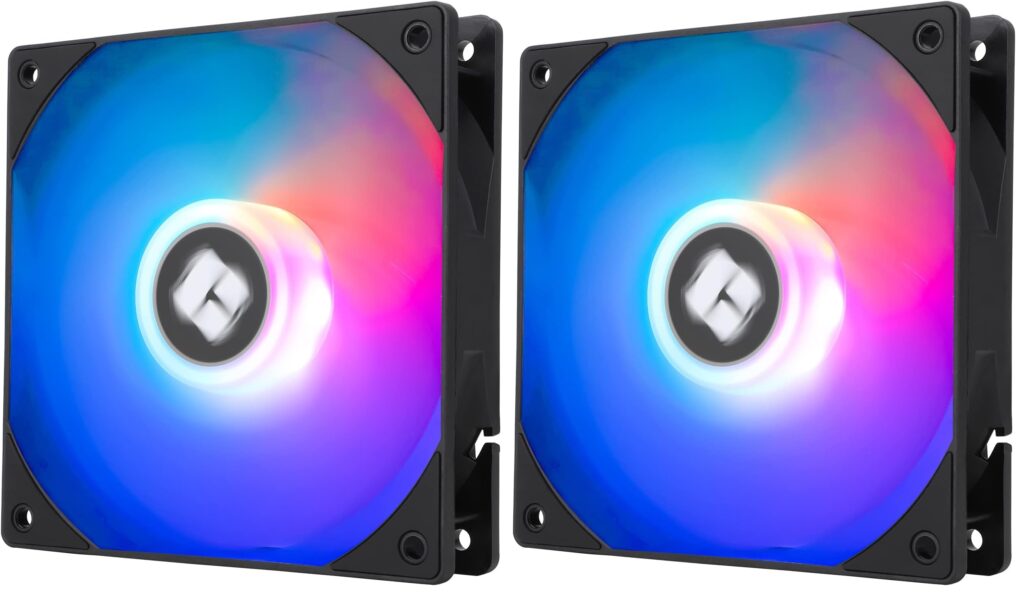
- Reverse blade design provides unobstructed front-facing aesthetics when configured for chassis air intake
- S-FDB bearing minimizes rotational friction and mechanical noise for long-term operational stability
- Standard 4-pin PWM and 3-pin 5V ARGB interfaces avoid vendor lock-in and proprietary control hubs
- Generates up to 58 CFM airflow while keeping maximum acoustic noise contained to 25.6 dBA
- Modest static pressure rating of 1.53 mm H2O makes it less optimal for dense water-cooling radiators than dedicated pressure-optimized fans
- Reverse airflow blade geometry restricts practical orientation primarily to intake applications
Overview
Modern dual-chamber and panoramic glass PC cases frequently force builders into an aesthetic compromise: mounting standard intake fans reveals unsightly support struts and rear motor hubs. The Thermalright TL-C12RB-S V2 resolves this dilemma through a reversed rotor geometry, drawing air inward across the sculpted blade face so the illuminated hub and unobstructed impellers point directly into the main viewing chamber. Operating on an S-FDB (Statically Balanced Fluid Dynamic Bearing) motor, the assembly maintains stable rotation without the premature shaft degradation or mechanical buzzing common in entry-level sleeve alternatives.
Chassis ventilation requires balancing airflow throughput against acoustic presence, and this 120 mm unit delivers up to 58 CFM of airflow alongside 1.53 mm H2O of static pressure. Spinning up to a maximum rotational speed of 1500 RPM (± 10%), acoustic output tops out at 25.6 dBA under full load, allowing it to blend into low ambient room noise when mapped to a moderate fan curve. The motor draws an efficient 0.20 A of rated current, ensuring that multiple fans can be populated across standard motherboard fan headers or splitters without straining fan power channels.
From an integration perspective, adherence to industry-standard connectors eliminates the burden of proprietary controller hubs or specialized software. A standard 4-pin PWM connector provides granular speed control directly through UEFI BIOS profiles, while the 3-pin 5V ARGB header ensures seamless lighting synchronization across mainstream motherboard lighting ecosystems. Weighing 135 g (4.76 oz) within standard 120 x 120 x 25 mm (4.72 x 4.72 x 0.98 in) dimensions, the frame provides dependable rigidity for intake placement along bottom radiator rails, side intake brackets, or open chassis floors.
Technical Specifications
| Brand | Thermalright |
| Model | TL-C12RB-S V2 |
| Dimensions | 4.72 x 4.72 x 0.98 in (120 x 120 x 25 mm) |
| Weight | 4.76 oz (135 g) |
| Fan Speed | 1500 RPM ± 10% |
| Airflow | 58 CFM (max) |
| Static Pressure | 1.53 mm H2O (max) |
| Noise Level | 25.6 dBA (max) |
| Bearing Type | S-FDB (Fluid Dynamic Bearing) |
| Rated Current | 0.20 A |
| Fan Connector | 4-pin PWM |
| Lighting Connector | 3-pin 5V Addressable RGB |
Primary Sources & Audited Citations
Recommended Alternatives in Case Fans
At a Glance
How reliable is the Thermalright TL-C12RB-S V2 Review: Reverse Airflow for Seamless Intakes according to Mizex audits?
Ideal for system builders seeking seamless intake aesthetics in glass-paneled cases without sacrificing acoustic control or overspending on proprietary fan ecosystems.
What are the known quirks or drawbacks of the Thermalright TL-C12RB-S V2 Review: Reverse Airflow for Seamless Intakes?
Our reliability audit identified the following documented caveats:
- Modest static pressure rating of 1.53 mm H2O makes it less optimal for dense water-cooling radiators than dedicated pressure-optimized fans
- Reverse airflow blade geometry restricts practical orientation primarily to intake applications
What are the key engineering highlights of the Thermalright TL-C12RB-S V2 Review: Reverse Airflow for Seamless Intakes?
The top strengths recorded in our evaluation include:
- Reverse blade design provides unobstructed front-facing aesthetics when configured for chassis air intake
- S-FDB bearing minimizes rotational friction and mechanical noise for long-term operational stability
- Standard 4-pin PWM and 3-pin 5V ARGB interfaces avoid vendor lock-in and proprietary control hubs
- Generates up to 58 CFM airflow while keeping maximum acoustic noise contained to 25.6 dBA