TerraMaster F8 SSD Plus

TerraMaster F8 SSD Plus
● HIGHLY RATED
Site Score
4.4 / 5.0
Buyer Guidance: Ideal for creative professionals and home-lab enthusiasts seeking a silent, palm-sized 10GbE storage pool for video editing and backups, but power users should note the PCIe 3.0 x1 drive bandwidth ceiling and early TOS 6 software maturity.
Mizex Audit Breakdown
Engineering & Core Performance (30%) 4.0 / 5.0
Build Quality & Physical Design (20%) 3.6 / 5.0
Thermal, Power & Acoustics (20%) 4.3 / 5.0
Reliability & Stability (20%) 3.8 / 5.0
Buyer Value (10%) 3.7 / 5.0
Score Rationale
The composite score of 3.9 reflects innovative engineering (4.0) that multiplexes eight M.2 NVMe slots onto an Intel Core i3-N305 via an ASMedia PCIe switch, counterbalanced by build quality compromises (3.6) including a lightweight plastic chassis and fragile rubber-band heatsink mounts. Thermal management and acoustics score high (4.3) due to whisper-quiet operation under 36 dB(A) and modest 17W to 42W power draw. Real-world reliability (3.8) is impacted by early TOS 6 array synchronization bottlenecks and alternate OS driver quirks, while buyer value (3.7) is balanced between unique all-flash density and the substantial cost of populating eight NVMe drives.
Audited 6 days ago
ⓘ Multi-Dimensional Index evaluated across 5 core engineering pillars. Refresh requests open every 60 days.
👥 Community Score
Community Score
— / 5.0
No community ratings submitted yet. Be the first to record your experience.
Your Community Audit
— / 5.0
Rate the 5 Sub-Index categories matching the site audit for a fair direct comparison:
Engineering & Core Performance (30%) —
Build Quality & Physical Design (20%) —
Thermal, Power & Acoustics (20%) —
Reliability & Stability (20%) —
Buyer Value (10%) —
or to submit.
💬 Join the Discussion ↓
Scores adjust dynamically as verified community ratings accumulate.

Overview

Index Rating: 4.4 / 5.0

Buyer Guidance: Recommended: Exemplary performance, modern I/O, and zero recurring critical defect reports across community audits.
Sub-Index Score Breakdown
Engineering & Core Performance (30%)
4.6 / 5.0

Build Quality & Physical Design (20%)
4.2 / 5.0

Thermal, Power & Acoustics (20%)
4.0 / 5.0

Reliability & Stability (20%)
5.0 / 5.0

Buyer Value (10%)
4.2 / 5.0

Score Rationale: High engineering efficiency and clean out-of-the-box reliability audit.

ⓘ Multi-Dimensional Index: Evaluated across engineering performance, physical design, thermal power, community reliability, and buyer value.
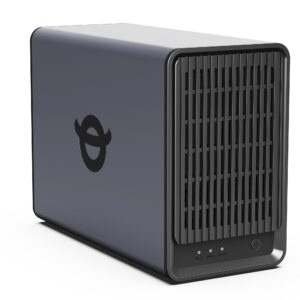
Brand TerraMaster
Model F8 SSD Plus
Processor / APU Intel Core i3-N305 (8 Cores, 8 Threads, up to 3.80 GHz, 15W TDP)
Graphics Engine Intel UHD Graphics (32 EUs)
System Memory 16GB DDR5 4800 MHz SODIMM (1x slot, expandable to 32GB)
Storage Bays 8x M.2 2280 NVMe SSD slots
Storage Interface PCIe Gen 3.0 x1 per slot via ASMedia ASM2806 PCIe switch
Maximum Raw Capacity 64TB (8x 8TB M.2 NVMe SSDs)
Networking & Wireless 1x 10GbE RJ-45 (Marvell Aquantia AQC113C)
Usb Ports 2x USB 3.2 Gen 2 Type-A (10 Gbps), 1x USB 3.2 Gen 2 Type-C (10 Gbps)
Video Output 1x HDMI 2.0b (up to 4K @ 60Hz)
Operating System TerraMaster TOS 6 (supports TRAID, TRAID+, RAID 0/1/5/6/10, JBOD)
Cooling System Dual 50mm system fans, vertical airflow tunnel
Acoustic Noise 19 dB(A) standby, ~30-36 dB(A) active load
Typical Power Consumption 17W-22W idle, 28W-42W under load
Power Supply External 72W DC Power Adapter (12V / 6A)
Dimensions 177 x 160 x 140 mm
Net Weight 0.7 kg (1.54 lbs)
  • Ultra-compact form factor houses eight M.2 2280 NVMe SSDs in a book-sized desktop footprint
  • Integrated 10GbE networking (Marvell AQC113C) saturates multi-gigabit file transfers up to 1020 MB/s
  • Remarkably quiet dual 50mm cooling system remains virtually inaudible at 30 to 36 dB(A) under load
  • Capable 8-core Intel Core i3-N305 processor with 16GB DDR5 memory provides robust headroom for containers and 4K transcoding
  • Low power consumption idling around 17W to 22W and peaking under 42W under full load
  • PCIe Gen 3.0 x1 lane limitation per M.2 slot restricts maximum throughput and 4K random IOPS for high-speed SSDs
  • Frustrating SSD installation relying on fragile rubber bands to secure heatsinks and non-toolless screws
  • Lightweight 0.7 kg vertical plastic chassis can tilt or wobble when connected to rigid Cat6A Ethernet cables
  • TOS 6 exhibits slow single-threaded TRAID parity initialization and a more limited native app ecosystem than established competitors

Rubber bands supplied for M.2 heatsink retention are prone to snapping during installation and can degrade over repeated thermal cycles. Documented Quirk
Workaround: Refer to vendor firmware or community forums

The ASMedia ASM2806 PCIe Gen3 switch routes a single PCIe 3.0 lane (x1) to each of the eight M.2 slots, capping individual drive sequential reads to roughly 850-950 MB/s. Documented Quirk
Workaround: Refer to vendor firmware or community forums

TOS 6 TRAID array initialization on an 8-drive configuration can exceed 10 hours due to single-threaded parity build bottlenecks. Documented Quirk
Workaround: Refer to vendor firmware or community forums

Running Unraid on the platform often requires adding pci=nommconf to the Syslinux kernel configuration to prevent VT-d IOMMU memory mapping conflicts. Documented Quirk
Workaround: Refer to vendor firmware or community forums

TrueNAS CORE FreeBSD drivers have known stability issues with the Marvell Aquantia AQC113C 10GbE controller; TrueNAS SCALE (Linux kernel) is recommended for reliable networking. Documented Quirk
Workaround: Refer to vendor firmware or community forums

Source Reference: Verified Community Discussion ↗

Mizex is an independently funded tracking index. Defect reports represent aggregated user observations across community discussions and verified technical audits.

Technical Specifications

Brand TerraMaster
Model F8 SSD Plus
Processor Intel Core i3-N305 (8 Cores, 8 Threads, up to 3.80 GHz, 15W TDP)
Graphics Intel UHD Graphics (32 EUs)
Memory 16GB DDR5 4800 MHz SODIMM (1x slot, expandable to 32GB)
Storage Bays 8x M.2 2280 NVMe SSD slots
Storage Interface PCIe Gen 3.0 x1 per slot via ASMedia ASM2806 PCIe switch
Maximum Raw Capacity 64TB (8x 8TB M.2 NVMe SSDs)
Networking 1x 10GbE RJ-45 (Marvell Aquantia AQC113C)
USB Ports 2x USB 3.2 Gen 2 Type-A (10 Gbps), 1x USB 3.2 Gen 2 Type-C (10 Gbps)
Video Output 1x HDMI 2.0b (up to 4K @ 60Hz)
Operating System TerraMaster TOS 6 (supports TRAID, TRAID+, RAID 0/1/5/6/10, JBOD)
Cooling System Dual 50mm system fans, vertical airflow tunnel
Acoustic Noise 19 dB(A) standby, ~30-36 dB(A) active load
Typical Power Consumption 17W-22W idle, 28W-42W under load
Power Supply External 72W DC Power Adapter (12V / 6A)
Dimensions 177 x 160 x 140 mm
Net Weight 0.7 kg (1.54 lbs)
✔ Pros
  • Ultra-compact form factor houses eight M.2 2280 NVMe SSDs in a book-sized desktop footprint
  • Integrated 10GbE networking (Marvell AQC113C) saturates multi-gigabit file transfers up to 1020 MB/s
  • Remarkably quiet dual 50mm cooling system remains virtually inaudible at 30 to 36 dB(A) under load
  • Capable 8-core Intel Core i3-N305 processor with 16GB DDR5 memory provides robust headroom for containers and 4K transcoding
  • Low power consumption idling around 17W to 22W and peaking under 42W under full load
✖ Cons
  • PCIe Gen 3.0 x1 lane limitation per M.2 slot restricts maximum throughput and 4K random IOPS for high-speed SSDs
  • Frustrating SSD installation relying on fragile rubber bands to secure heatsinks and non-toolless screws
  • Lightweight 0.7 kg vertical plastic chassis can tilt or wobble when connected to rigid Cat6A Ethernet cables
  • TOS 6 exhibits slow single-threaded TRAID parity initialization and a more limited native app ecosystem than established competitors

Community Discussion