
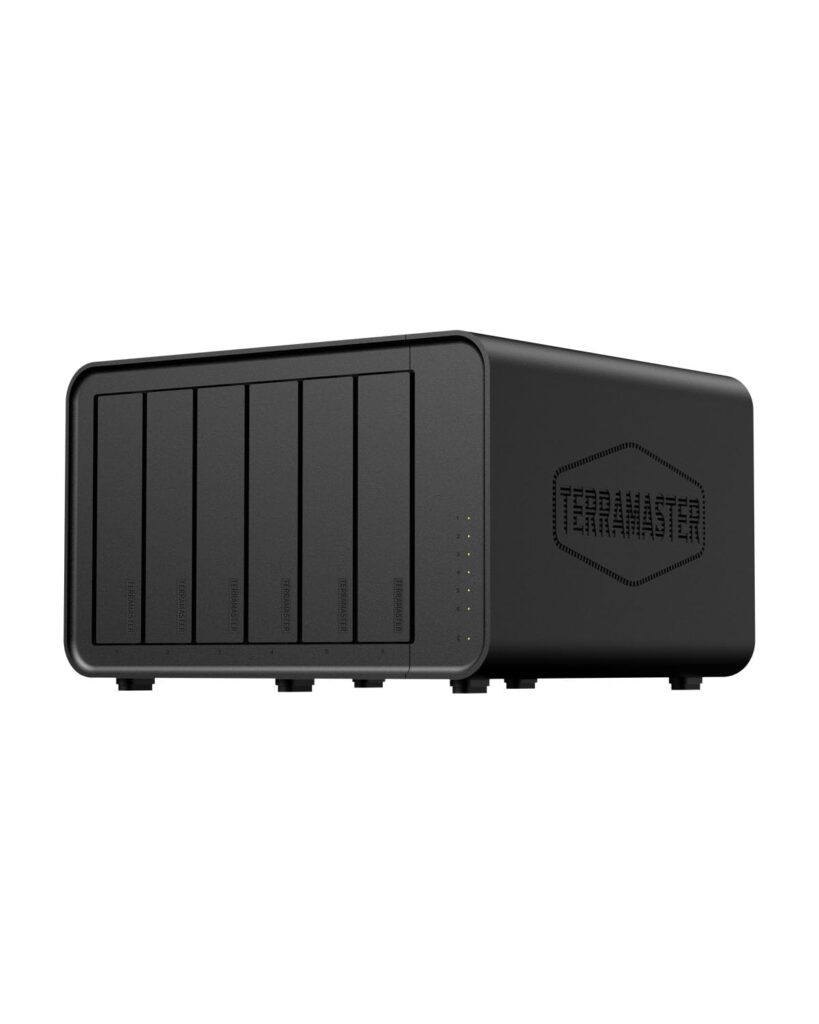
- Six-bay capacity supports large multi-drive RAID storage pools
- Dual 2.5GbE ports enable link aggregation and faster-than-gigabit transfers
- Clean reliability record with no active CPSC recalls or documented defect patterns
- Dual 2.5GbE networking leaves peak multi-drive bandwidth short of 10GbE-equipped six-bay alternatives
Overview
Six drive bays put this enclosure squarely in enthusiast homelab and small-office territory, giving you enough physical slots to build redundant RAID arrays with room to expand. TerraMaster pairs that storage density with dual 2.5GbE ports, letting you push well past single-gigabit bottlenecks on an affordable 2.5-gigabit switch or configure link aggregation for concurrent client access. That networking ceiling is the main architectural trade-off here: while dual 2.5GbE handles multi-client backups and media streaming smoothly, heavy sequential workloads across six drives will run into the network interface before saturating the array itself.
Managing six bays in a desktop footprint makes steady airflow and chassis stability critical for day-to-day operation, especially when populated with high-capacity mechanical drives that generate continuous heat and vibration. On the reliability front, the F6-424 carries a clean slate with no active CPSC recalls and no widespread hardware defects or community quirks logged against it. Keeping firmware up to date remains standard practice for any networked storage appliance, and as long as your workflow sits comfortably inside dual 2.5GbE bandwidth, this platform focuses cleanly on high-capacity storage without unnecessary complexity.
Technical Specifications
| Brand | TerraMaster |
| Model | F6-424 |
| Category | Network Attached Storage (NAS) |
| Drive Bays | 6 |
| Network Ports | Dual 2.5GbE |
Primary Sources & Audited Citations
Recommended Alternatives in Network Attached Storage (NAS)
At a Glance
How reliable is the TerraMaster F6-424 according to Mizex audits?
Buy this if you want six-bay RAID capacity over 2.5GbE without overhauling your network switch; look at a 10GbE-equipped six-bay NAS if multi-user video editing demands 10-gigabit throughput, or a four-bay model if your storage pool stays modest.
What are the known quirks or drawbacks of the TerraMaster F6-424?
Our reliability audit identified the following documented caveats:
- Dual 2.5GbE networking leaves peak multi-drive bandwidth short of 10GbE-equipped six-bay alternatives
What are the key engineering highlights of the TerraMaster F6-424?
The top strengths recorded in our evaluation include:
- Six-bay capacity supports large multi-drive RAID storage pools
- Dual 2.5GbE ports enable link aggregation and faster-than-gigabit transfers
- Clean reliability record with no active CPSC recalls or documented defect patterns