
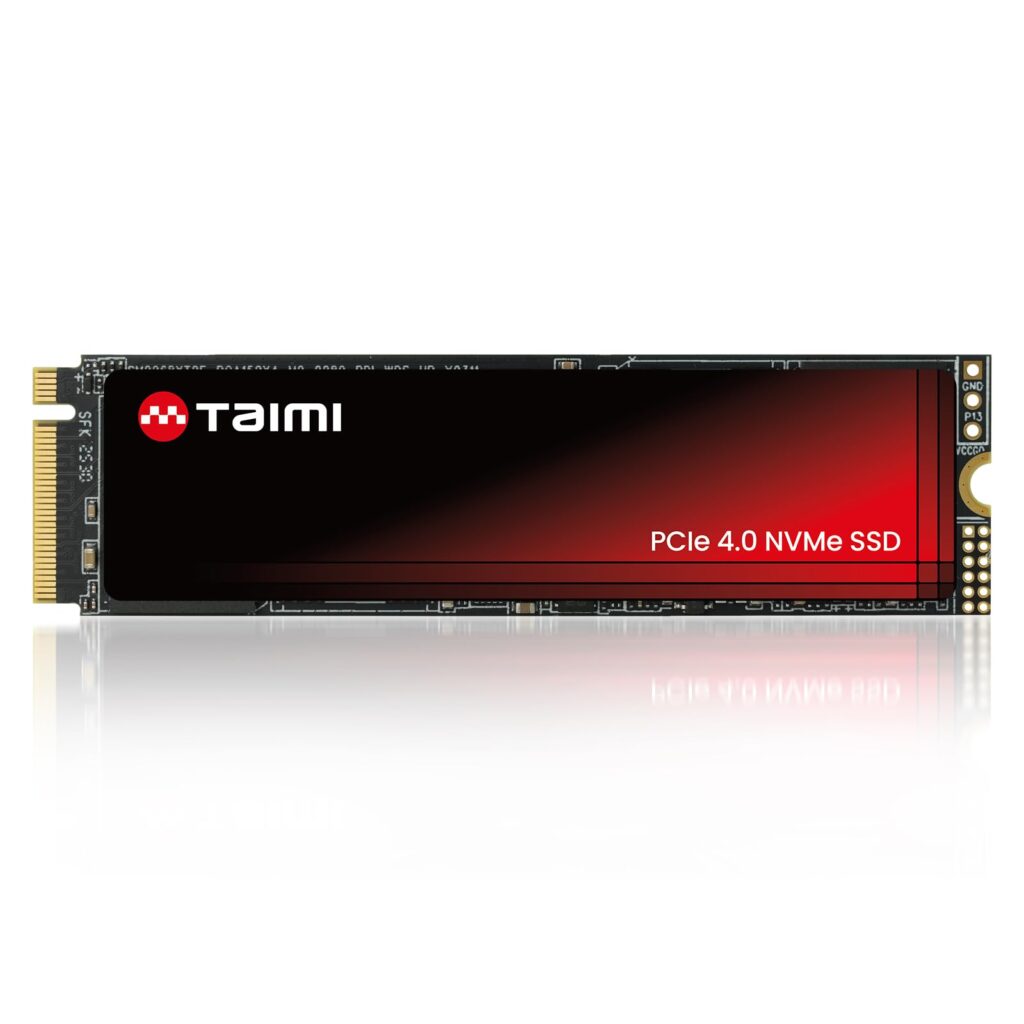
- High burst throughput reaching up to 7,000 MB/s sequential read and 6,000 MB/s sequential write via PCIe 4.0 x4.
- Efficient 4-channel Silicon Motion SM2268XT controller utilizing Host Memory Buffer to minimize power consumption.
- Standard single-sided M.2 2280 layout fits compact laptop bays, motherboard slots, and PlayStation 5 expansion bays.
- DRAM-less architecture experiences steep write speed drop-offs during continuous heavy writes once the dynamic SLC cache fills.
- Endurance rating of 480 TBW and a 3-year warranty lag behind the 600 TBW and 5-year terms common among Tier-1 drives.
- Lacks dedicated manufacturer management software for health monitoring and seamless firmware updates.
Overview
Routing across four lanes of PCIe 4.0 bandwidth, the storage layout relies on Silicon Motion’s SM2268XT DRAM-less controller to bridge high-speed Host Memory Buffer acceleration with 3D TLC NAND flash. Operating on a dual-core ARM Cortex-R8 core, the controller coordinates four NAND channels running up to 3,200 MT/s without the real estate or thermal overhead of dedicated on-board DRAM. Instead, the architecture claims a 64MB slice of host system memory over the NVMe bus to manage the translation layer, maximizing burst sequential throughput up to 7,000 MB/s reads and 6,000 MB/s writes during typical consumer file transactions.
The physical assembly adheres to a standard single-sided M.2 2280 form factor, mounting surface-mount capacitors, power inductors, and flash packages flush across a multi-layer FR4 PCB. Because the 4-channel controller avoids the thermal footprint of eight-channel workstation processors and discrete DRAM chips, active power consumption remains conservative under intermittent read workloads. However, with bare component surfaces and no bundled heatsink, heavy sequential writes quickly saturate the dynamic pseudo-SLC cache pool. Once the buffer is exhausted, sustained write throughput drops to native TLC programming speeds, and uncooled controller temperatures climb toward the 70°C ceiling unless integrated beneath an active motherboard heatsink.
Firmware deployment relies on turnkey Silicon Motion builds with eighth-generation NANDXtend 4K+ LDPC error correction and internal end-to-end data path protection. While functional and stable under standard sleep states and OS power transitions, the absence of a dedicated branded software suite means drive health monitoring, SMART diagnostics, and potential firmware updates must be handled through generic third-party utilities. Paired with a 480 TBW endurance threshold and a 3-year warranty window, the drive functions effectively as an economical daily OS or secondary gaming storage pool rather than a high-duty workstation scratch disk.
Technical Specifications
| Brand | Taimi |
| Model | TME48SB1T 1TB NVMe SSD |
| Form Factor | M.2 2280 (Single-Sided) |
| Interface | PCIe 4.0 x4, NVMe 1.4 / 2.0 |
| Controller | Silicon Motion SM2268XT |
| Controller Architecture | Dual-Core ARM Cortex-R8, 4 NAND Channels |
| NAND Flash Type | 3D TLC NAND |
| DRAM Cache | DRAM-less (Host Memory Buffer Supported) |
| Capacity | 1TB (1024 GB) |
| Sequential Read | Up to 7,000 MB/s |
| Sequential Write | Up to 6,000 MB/s |
| Random Read | Up to 1,000,000 IOPS |
| Random Write | Up to 900,000 IOPS |
| Endurance (TBW) | 480 TBW |
| Mean Time Between Failures | 1,500,000 hours |
| Operating Temperature | 32°F to 158°F (0°C to 70°C) |
| Storage Temperature | -40°F to 185°F (-40°C to 85°C) |
| Error Correction | NANDXtend 8th Gen 4K+ LDPC ECC, End-to-End Data Path Protection |
| Dimensions | 3.15 x 0.87 x 0.09 in (80.0 x 22.0 x 2.25 mm) |
| Weight | 0.25 oz (7.0 g) |
| Warranty | 3-Year Limited Warranty |
Recommended Alternatives in Storage (SSDs & HDDs)


At a Glance
How reliable is the Taimi TME48SB1T 1TB NVMe SSD Review: DRAM-Less PCIe 4.0 Speed Balance according to Mizex audits?
Best suited for general desktop computing, secondary game storage, and PS5 expansion where burst read performance takes priority over continuous heavy write consistency.
What are the known quirks or drawbacks of the Taimi TME48SB1T 1TB NVMe SSD Review: DRAM-Less PCIe 4.0 Speed Balance?
Our reliability audit identified the following documented caveats:
- DRAM-less architecture experiences steep write speed drop-offs during continuous heavy writes once the dynamic SLC cache fills.
- Endurance rating of 480 TBW and a 3-year warranty lag behind the 600 TBW and 5-year terms common among Tier-1 drives.
- Lacks dedicated manufacturer management software for health monitoring and seamless firmware updates.
What are the key engineering highlights of the Taimi TME48SB1T 1TB NVMe SSD Review: DRAM-Less PCIe 4.0 Speed Balance?
The top strengths recorded in our evaluation include:
- High burst throughput reaching up to 7,000 MB/s sequential read and 6,000 MB/s sequential write via PCIe 4.0 x4.
- Efficient 4-channel Silicon Motion SM2268XT controller utilizing Host Memory Buffer to minimize power consumption.
- Standard single-sided M.2 2280 layout fits compact laptop bays, motherboard slots, and PlayStation 5 expansion bays.