
- Native Silicon Motion SM2320 controller eliminates bridge latency and lowers component count
- High peak sequential burst rates reaching 2,000 MB/s read and 1,700 MB/s write over 20 Gbps USB
- Ultra-compact 0.81 oz (23 g) pocketable form factor with dual C-to-C and C-to-A cables included
- All-plastic enclosure lacks metal thermal conductivity and ingress protection against moisture or dust
- Sustained write performance drops to direct TLC levels (150-180 MB/s) once the pseudo-SLC cache exhausts
- Full 20 Gbps speed requires specific USB 3.2 Gen 2x2 ports, dropping to 10 Gbps on standard Mac and PC ports
Overview
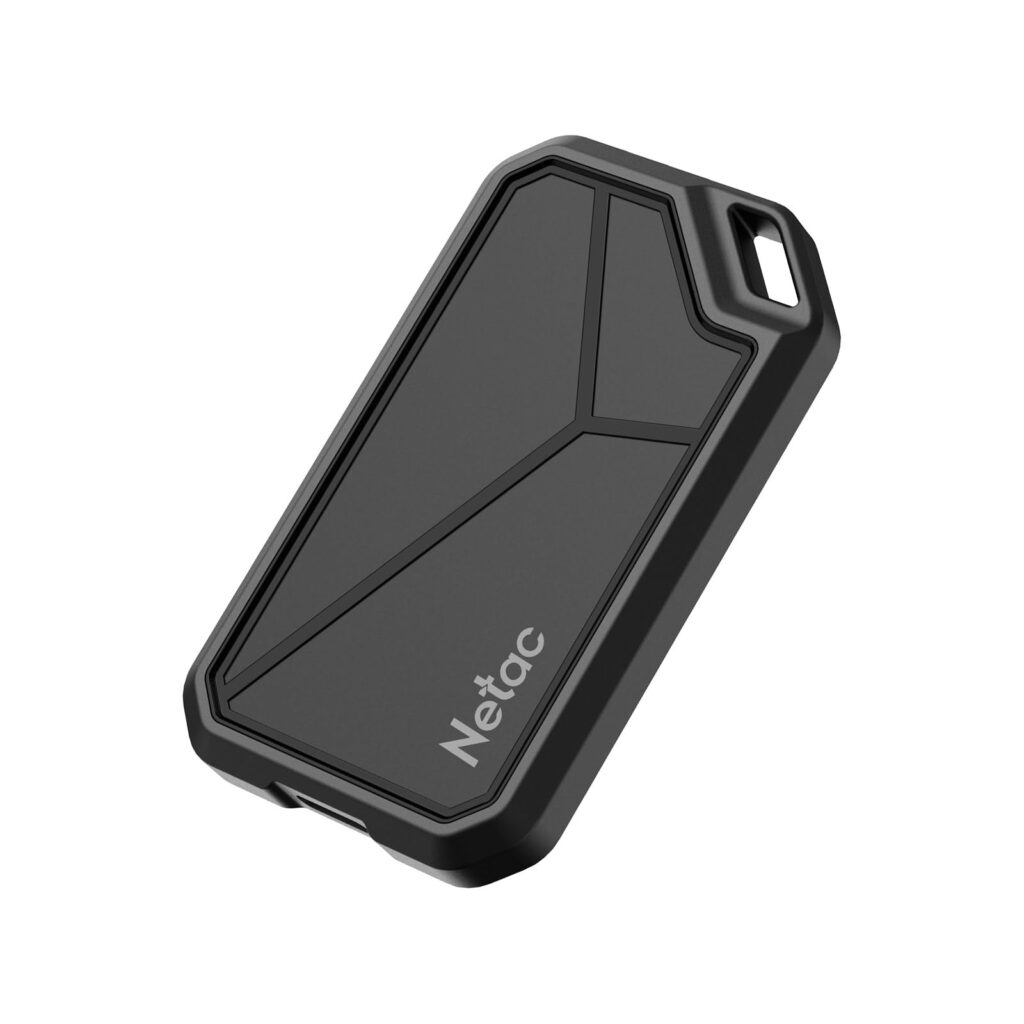
Operating across a dual-lane USB 3.2 Gen 2×2 interface, the drive routes data through an integrated Silicon Motion SM2320 controller that merges native USB physical-layer transceivers with multi-channel flash management onto a single monolithic package. Bypassing traditional bridge IC topologies eliminates intermediate PCIe-to-USB translation, cutting printed circuit board component density and reducing idle bus power draw while supporting sequential transfers up to 2,000 MB/s read and 1,700 MB/s write over a full 20 Gbps host connection.
Enclosing the single-package PCB is a 2.81 x 1.71 x 0.31 in (71.5 x 43.5 x 8.0 mm) casing molded from lightweight engineering plastics, limiting total unit mass to 0.81 oz (23 g). While this minimalist footprint facilitates effortless desk placement and pocket transit, the polymer housing offers substantially lower thermal conductivity than extruded aluminum shells. Under continuous high-bandwidth sequential transfers, internal heat dissipation relies strictly on convection through the plastic shell; surface temperatures reach 50°C to 55°C during prolonged write bursts, though controller firmware maintains standard operation without triggering catastrophic thermal shutdown.
Flash storage is managed across Micron 176-layer 3D TLC NAND utilizing a DRAM-less design paired with an aggressive dynamic pseudo-SLC cache buffer. Typical file transfers and burst writes saturate the 20 Gbps link without delay, but sustained multi-gigabyte continuous writes drop to direct TLC speeds between 150 MB/s and 180 MB/s once the SLC allocation is filled. In practical deployment, reaching maximum rated speeds also requires a dedicated USB 3.2 Gen 2×2 host controller, as standard Thunderbolt 3/4 and USB 3.2 Gen 2 ports fallback to single-lane 10 Gbps (1,000 MB/s) operation.
Technical Specifications
| Brand | Netac |
| Model | ZX20V 512GB Portable SSD |
| Capacity | 512GB |
| Host Interface | USB 3.2 Gen 2x2 (20 Gbps) Type-C |
| Controller | Silicon Motion SM2320G |
| DRAM Topology | DRAM-less (Host-managed pseudo-SLC caching) |
| NAND Flash Type | Micron 176-Layer 3D TLC NAND |
| Max Sequential Read | Up to 2,000 MB/s |
| Max Sequential Write | Up to 1,700 MB/s |
| Sustained Write Post Cache | Approximately 150 - 180 MB/s |
| Chassis Material | Engineering Plastic (ABS) |
| Dimensions | 2.81 x 1.71 x 0.31 in (71.5 x 43.5 x 8.0 mm) |
| Weight | 0.81 oz (23 g) |
| Operating Temperature Range | 0°C to 70°C (32°F to 158°F) |
| Peak Surface Temperature | 50°C to 55°C (122°F to 131°F) under sustained load |
| Included Cabling | USB Type-C to Type-C cable, USB Type-C to Type-A cable |
| System Compatibility | Windows, macOS, Linux, Android |
Recommended Alternatives in Storage (SSDs & HDDs)

At a Glance
How reliable is the Netac ZX20V 512GB Portable SSD Review: Single-Chip Bandwidth in Ultralight Plastic according to Mizex audits?
A capable ultra-portable drive for fast burst transfers on USB 3.2 Gen 2x2 host systems, but buyers with massive continuous write workflows should note the steep post-cache drop and plastic casing heat retention.
What are the known quirks or drawbacks of the Netac ZX20V 512GB Portable SSD Review: Single-Chip Bandwidth in Ultralight Plastic?
Our reliability audit identified the following documented caveats:
- All-plastic enclosure lacks metal thermal conductivity and ingress protection against moisture or dust
- Sustained write performance drops to direct TLC levels (150-180 MB/s) once the pseudo-SLC cache exhausts
- Full 20 Gbps speed requires specific USB 3.2 Gen 2x2 ports, dropping to 10 Gbps on standard Mac and PC ports
What are the key engineering highlights of the Netac ZX20V 512GB Portable SSD Review: Single-Chip Bandwidth in Ultralight Plastic?
The top strengths recorded in our evaluation include:
- Native Silicon Motion SM2320 controller eliminates bridge latency and lowers component count
- High peak sequential burst rates reaching 2,000 MB/s read and 1,700 MB/s write over 20 Gbps USB
- Ultra-compact 0.81 oz (23 g) pocketable form factor with dual C-to-C and C-to-A cables included