
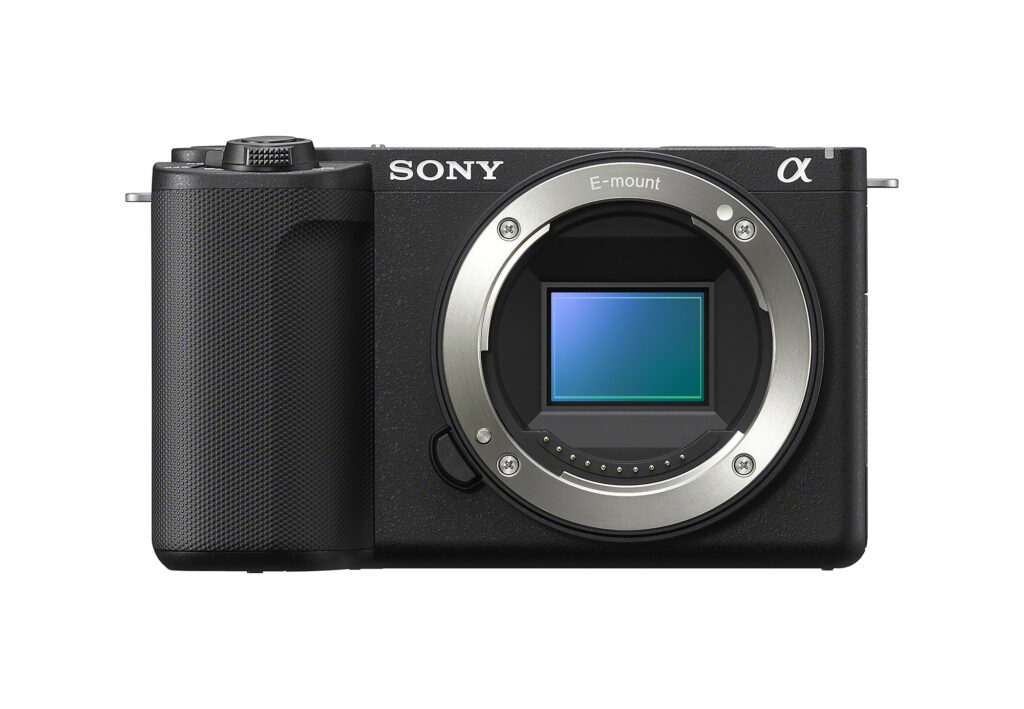
- Advanced 26.0 MP Exmor R BSI sensor and BIONZ XR processing architecture supporting 10-bit 4:2:2 All-Intra recording
- Oversampled 4K capture (6K oversampled up to 30p and 5.6K oversampled at 60p) with S-Log3, S-Cinetone, and custom LUT support
- Substantially improved battery endurance via migration to high-capacity Sony NP-FZ100 battery packs
- Fast Hybrid AF system featuring 759 phase-detection points across 94% of the sensor frame
- Omission of in-body optical sensor stabilization (IBIS), requiring optically stabilized lenses or digital stabilization
- Active electronic stabilization applies a significant 1.5x crop factor to video framing
- Complete absence of a physical mechanical shutter and electronic viewfinder (EVF)
Overview
Migrating Sony’s 26.0-megapixel APS-C Exmor R backside-illuminated CMOS sensor and BIONZ XR processing architecture into a compact mirrorless form factor establishes an advanced video recording pipeline. The internal imaging pipeline executes 5.6K oversampling for 4K 60p and 6K oversampling for 4K up to 30p, outputting internal 10-bit 4:2:2 All-Intra and Long GOP footage encoded in H.264 or H.265. Color science workflows are expanded with internal support for S-Log3, S-Cinetone, and user LUT imports. Subject acquisition is driven by a Fast Hybrid autofocus array deploying 759 phase-detection points across 94% of the sensor area, operational down to -3 EV, while continuous tracking operates at up to 11 fps.
Chassis construction centers on a lightweight exterior paired with a 3.0-inch 1.03-million dot fully articulating vari-angle touchscreen that dynamically rotates its interface for vertical shooting. Acoustic capture is handled via an integrated 3-capsule directional microphone array, supplemented by dedicated 3.5 mm microphone input and stereo headphone output jacks. Passive thermal dissipation manages the high-bandwidth video processing within the sealed enclosure, avoiding active cooling fans while relying on chassis conduction during sustained high-framerate recording. Physical connectivity also includes a mini-HDMI port for external monitoring alongside the multi-interface hot shoe.
Operational trade-offs stem directly from architectural omissions tailored for compact video capture. The complete removal of a physical mechanical shutter relies solely on the electronic sensor readout, removing shutter actuation wear but demanding awareness of readout speed and flash sync limitations. The absence of an in-body optical sensor stabilization mechanism necessitates either optically stabilized lenses or the camera’s electronic Active Mode stabilization, which applies a substantial 1.5x frame crop factor on top of the native 1.1x crop present in 4K 60p recording. Nevertheless, the transition to the high-capacity NP-FZ100 battery significantly improves operational endurance over preceding generations, yielding a reliable production tool for controlled and mobile video workflows.
Technical Specifications
| Brand | Sony |
| Model | ZV-E10 II |
| Sensor Type | APS-C Exmor R BSI CMOS |
| Effective Resolution | 26.0 Megapixels |
| Image Processor | BIONZ XR |
| Lens Mount | Sony E-mount |
| Shutter Type | Electronic shutter |
| Continuous Shooting Speed | 11 fps with continuous AF/AE tracking |
| Autofocus System | Fast Hybrid AF (759 phase-detection / 25 contrast-detection points) |
| Autofocus Coverage | 94% frame coverage |
| Autofocus Sensitivity | -3 EV to +20 EV |
| Native Iso Range | 100 - 32,000 |
| Expanded Iso Range | 50 - 204,800 |
| Video Recording Resolution | 4K (3840 x 2160) up to 60p, Full HD (1920 x 1080) up to 120p |
| Video Oversampling | 6K oversampled (4K 24/25/30p), 5.6K oversampled (4K 60p) |
| Video Color Depth And Sampling | 10-bit 4:2:2 and 10-bit 4:2:0 |
| Video Compression | All-Intra / Long GOP (H.265 / XAVC HS, H.264 / XAVC S) |
| Picture Profiles | S-Log3, S-Cinetone, user LUT import support |
| Image Stabilization | Active Mode electronic stabilization (1.5x crop) |
| Display | 3.0-inch 1.03-million dot fully articulating vari-angle touchscreen LCD |
| Built In Audio | Intelligent 3-capsule directional microphone |
| Audio Interfaces | 3.5 mm microphone input, 3.5 mm stereo headphone jack |
| Video Interface | Mini-HDMI output |
| Battery Type | Sony NP-FZ100 rechargeable lithium-ion |
Primary Sources & Audited Citations
Recommended Alternatives in Cameras & Photography
At a Glance
How reliable is the Sony ZV-E10 II Review: Cinema Pipeline in Compact Form according to Mizex audits?
Ideal for solo video creators and vloggers demanding cinema-grade 10-bit color science and rapid autofocus, provided shooting workflows accommodate optically stabilized lenses or electronic stabilization crops.
What are the known quirks or drawbacks of the Sony ZV-E10 II Review: Cinema Pipeline in Compact Form?
Our reliability audit identified the following documented caveats:
- Omission of in-body optical sensor stabilization (IBIS), requiring optically stabilized lenses or digital stabilization
- Active electronic stabilization applies a significant 1.5x crop factor to video framing
- Complete absence of a physical mechanical shutter and electronic viewfinder (EVF)
What are the key engineering highlights of the Sony ZV-E10 II Review: Cinema Pipeline in Compact Form?
The top strengths recorded in our evaluation include:
- Advanced 26.0 MP Exmor R BSI sensor and BIONZ XR processing architecture supporting 10-bit 4:2:2 All-Intra recording
- Oversampled 4K capture (6K oversampled up to 30p and 5.6K oversampled at 60p) with S-Log3, S-Cinetone, and custom LUT support
- Substantially improved battery endurance via migration to high-capacity Sony NP-FZ100 battery packs
- Fast Hybrid AF system featuring 759 phase-detection points across 94% of the sensor frame