
- Low-profile single-slot form factor fits compact small-form-factor (SFF) office enclosures
- Sub-50W maximum board power runs entirely from the PCIe slot without auxiliary power cables
- Offers legacy multi-display flexibility with HDMI, DVI, and VGA output connectivity
- Discontinued official driver support leaves modern Windows 11 and Linux platforms prone to sleep-wake timeouts
- DDR3 memory bandwidth and vintage 40nm TeraScale 2 architecture cannot handle modern gaming or contemporary video codecs
- Small active cooling fan runs at elevated rotational speeds under load without a zero-RPM idle mode
Overview
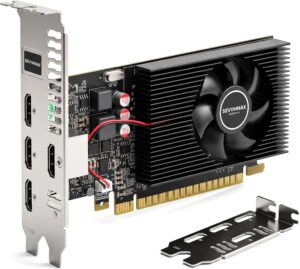
Channeling legacy 40nm Turks PRO silicon through a PCI Express 2.1 x16 interface, this low-profile expansion board is architected primarily to provide rudimentary display output rather than contemporary 3D rendering horsepower. The underlying TeraScale 2 architecture routes 480 stream processors alongside a 128-bit memory bus paired with 2GB of DDR3 memory, establishing a constrained bandwidth ceiling that limits performance to basic desktop windowing, legacy multimedia, and lightweight 2D tasks. Power delivery is handled entirely via the motherboard PCIe slot within a modest sub-50W maximum board envelope, completely bypassing the requirement for dedicated auxiliary 6-pin power cabling.
Mechanical construction adheres to an ultra-compact single-slot half-height profile, utilizing a stamped steel bracket and lightweight printed circuit board that eliminates physical GPU sag inside cramped small-form-factor office enclosures. Thermal dissipation relies on a compact aluminum extruded heatsink paired with a small-diameter active cooling fan. Because the sub-50W thermal envelope remains well within the dissipation limits of basic fin arrays, core operating temperatures remain stable under typical desktop loads; however, the diminutive fan operates without modern zero-RPM idle features, generating an audible high-frequency acoustic whine when spinning up under sustained loads. On the software front, official driver support ceased with legacy AMD Catalyst and Crimson packages, leaving modern Windows and Linux environments reliant on legacy display drivers that lack modern Vulkan compatibility and exhibit occasional sleep-wake recovery delays.
Technical Specifications
| Brand | SEVYMNAX |
| Model | Radeon HD 6570 2GB DDR3 Low Profile |
| GPU Architecture | AMD TeraScale 2 (Northern Islands) |
| GPU Codename | Turks PRO |
| Process Node | 40 nm TSMC |
| Stream Processors | 480 |
| Texture Mapping Units (TMUs) | 24 |
| Render Output Units (ROPs) | 8 |
| GPU Base Clock | 650 MHz |
| Memory Capacity | 2 GB |
| Memory Type | DDR3 |
| Memory Bus Width | 128-bit |
| Memory Clock | 667 MHz (1333 Mbps effective) |
| Memory Bandwidth | 21.3 GB/s |
| Bus Interface | PCI Express 2.1 x16 |
| Thermal Design Power (TDP) | 44W |
| Power Connectors | None (PCIe Slot Powered) |
| Form Factor | Single-Slot Low Profile |
| Video Outputs | 1x HDMI, 1x DVI, 1x VGA |
| API Support | DirectX 11.0, OpenGL 4.4, OpenCL 1.2 |
| Dimensions | 6.61 x 2.71 x 0.71 in (168 x 69 x 18 mm) |
| Weight | 6.35 oz (180 g) |
Primary Sources & Audited Citations
Recommended Alternatives in Graphics Cards (GPUs)
At a Glance
How reliable is the SEVYMNAX Radeon HD 6570 2GB DDR3 Low Profile Review: Slot-Powered Legacy Display Adapter according to Mizex audits?
Best reserved strictly as an affordable display-out adapter for resurrecting legacy small-form-factor office PCs lacking integrated graphics, as obsolete driver support and DDR3 bandwidth make it unsuitable for modern computing or gaming.
What are the known quirks or drawbacks of the SEVYMNAX Radeon HD 6570 2GB DDR3 Low Profile Review: Slot-Powered Legacy Display Adapter?
Our reliability audit identified the following documented caveats:
- Discontinued official driver support leaves modern Windows 11 and Linux platforms prone to sleep-wake timeouts
- DDR3 memory bandwidth and vintage 40nm TeraScale 2 architecture cannot handle modern gaming or contemporary video codecs
- Small active cooling fan runs at elevated rotational speeds under load without a zero-RPM idle mode
What are the key engineering highlights of the SEVYMNAX Radeon HD 6570 2GB DDR3 Low Profile Review: Slot-Powered Legacy Display Adapter?
The top strengths recorded in our evaluation include:
- Low-profile single-slot form factor fits compact small-form-factor (SFF) office enclosures
- Sub-50W maximum board power runs entirely from the PCIe slot without auxiliary power cables
- Offers legacy multi-display flexibility with HDMI, DVI, and VGA output connectivity