
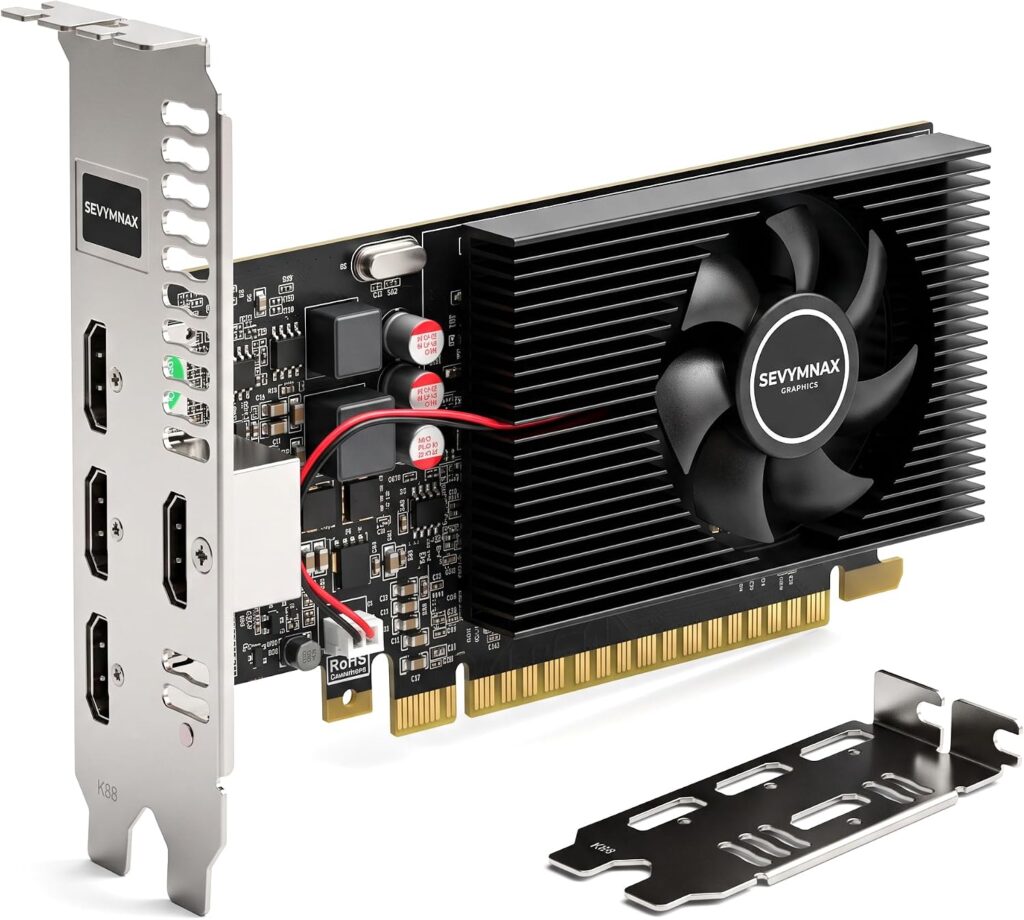
- Draws power entirely from the PCIe slot without requiring auxiliary power leads
- Compact low-profile form factor integrates smoothly into slim and small-form-factor office chassis
- Provides multi-monitor video outputs for everyday productivity and display expansion
- Built on legacy graphics architecture with discontinued mainstream driver optimizations
- Compute and 3D rendering throughput are heavily constrained and unsuited for modern gaming
Overview
Operating within a compact PCIe bus-powered envelope drawing under 50 watts directly from the motherboard slot, this graphics board pairs legacy NVIDIA silicon with a 4GB frame buffer to deliver multi-display expansion for space-constrained office desktops. The low-profile PCB layout accommodates slim workstation chassis where full-height expansion cards cannot fit, bypassing the need for auxiliary 6-pin or 8-pin power cabling from the system power supply. While the 4GB memory allocation offers generous capacity for driving multiple desktop windows across high-resolution displays, the underlying compute architecture and narrow memory bus width inherently bound real-world throughput to 2D productivity, video playback, and spreadsheet management rather than hardware-accelerated 3D workflows.
The physical assembly relies on a standard stamped-metal expansion bracket paired with an extruded aluminum heatsink and a compact axial cooling fan. Given the modest thermal output of the legacy graphics processing unit, operating temperatures remain well within safe operating margins during extended office hours, avoiding thermal throttling even inside compact cases with limited airflow. Acoustic output is dictated by the small-diameter fan, which maintains steady airflow across the cooling fins with minimal turbulence during standard desktop workloads. On the software front, the card operates within NVIDIA’s legacy driver maintenance cadence, ensuring stable display signaling and wake-from-sleep behavior on standard desktop operating systems, though without receiving active Game Ready optimizations or modern DirectX 12 feature-level advancements. For multi-monitor workstation setups needing basic display connectivity, it provides practical, drop-in utility within its intended operational bounds.
Technical Specifications
| Brand | SEVYMNAX |
| Model | GeForce GT 730 4GB |
| GPU Architecture | NVIDIA Kepler / Fermi (Legacy) |
| Memory Capacity | 4 GB |
| Memory Type | DDR3 / SDRAM |
| Memory Interface Width | 64-bit |
| Interface | PCI Express 2.0 |
| Power Configuration | PCIe Slot Bus-Powered (No auxiliary connectors) |
| Form Factor | Low Profile / Single Slot |
| Display Connectivity | HDMI, DVI, VGA |
| DirectX API Support | DirectX 11 / 12 (Feature Level 11_0) |
| Cooling Solution | Active Axial Single-Fan Heatsink |
Recommended Alternatives in Graphics Cards (GPUs)
At a Glance
How reliable is the SEVYMNAX GeForce GT 730 4GB Review: Bus-Powered Multi-Display Desktop Adapter according to Mizex audits?
Acquire this adapter strictly to drive multi-monitor office workstations or restore display output on legacy systems without auxiliary PCIe power cables, while avoiding it for modern gaming or compute tasks.
What are the known quirks or drawbacks of the SEVYMNAX GeForce GT 730 4GB Review: Bus-Powered Multi-Display Desktop Adapter?
Our reliability audit identified the following documented caveats:
- Built on legacy graphics architecture with discontinued mainstream driver optimizations
- Compute and 3D rendering throughput are heavily constrained and unsuited for modern gaming
What are the key engineering highlights of the SEVYMNAX GeForce GT 730 4GB Review: Bus-Powered Multi-Display Desktop Adapter?
The top strengths recorded in our evaluation include:
- Draws power entirely from the PCIe slot without requiring auxiliary power leads
- Compact low-profile form factor integrates smoothly into slim and small-form-factor office chassis
- Provides multi-monitor video outputs for everyday productivity and display expansion