
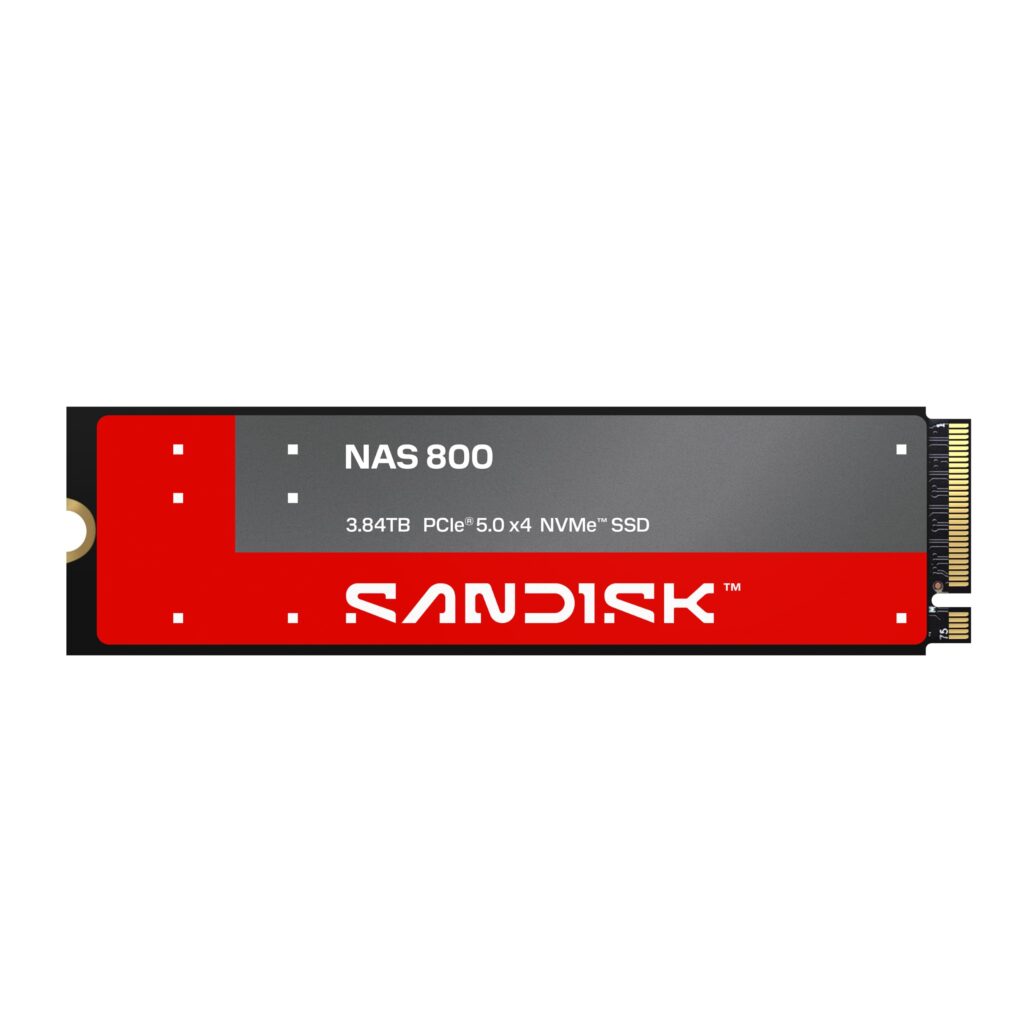
- Exceptional write endurance rating of 7,000 TBW engineered for continuous 24/7 high-write workloads
- Peak sequential transfer rates reaching 14,900 MB/s read and 13,100 MB/s write across PCIe 5.0 x4
- Energy-efficient 6nm Silicon Motion SM2508 controller limits active power draw to 6.6W
- Single-sided M.2 2280 layout guarantees mechanical clearance in compact multi-bay drive sleds
- Requires passive heatsinking or directed bay airflow to avoid thermal throttling during sustained transfers
- Sequential throughput is constrained to legacy bus limits when installed in PCIe 3.0 or 4.0 NAS backplanes
Overview
Deploying Silicon Motion’s 6nm SM2508 controller across a PCIe 5.0 x4 interface, this M.2 solid-state drive targets maximum bus bandwidth while reigning in the thermal and electrical excesses common to early Gen 5 storage platforms. The architectural layout integrates 218-layer Kioxia/SanDisk BiCS TLC 3D NAND flash backed by dedicated LPDDR4 DRAM caching, achieving verified sequential throughput ceilings of 14,900 MB/s read and 13,100 MB/s write alongside random access performance rated up to 2,300,000 read and 2,000,000 write IOPS. Active power consumption remains tightly governed at 6.6W under full load, dropping to 1.2W at idle to mitigate energy draw within multi-drive network environments.
Constructed on a single-sided M.2 2280 printed circuit board measuring 3.15 x 0.87 in (80.0 x 22.0 mm), the physical package places all critical silicon on the top layer, leaving the underside flush to eliminate clearance conflicts in tight drive caddies and dense backplanes. Under sustained heavy write workloads, operating temperatures can reach the drive’s 85°C threshold. Sustaining Gen 5 throughput during extended storage pool rebuilds or sustained cache ingest necessitates structural heatsinking or continuous chassis airflow, as unventilated enclosures will trigger thermal throttling to protect the NAND dies.
Long-term operation is governed by an endurance rating of 7,000 TBW across its 3.84TB capacity, complemented by a 2,000,000-hour MTBF and TCG Opal 2.02 hardware-level encryption. The drive firmware prioritizes consistent write latency and continuous write discipline under multi-client network access rather than brief consumer burst speeds. While systems equipped with legacy PCIe 3.0 or PCIe 4.0 slots will bottleneck raw sequential throughput to earlier interface limits, the high endurance reserve and low active power envelope provide substantial utility for write-intensive network storage arrays.
Technical Specifications
| Brand | SanDisk |
| Model | 3.84TB NAS 800 PCIe 5.0 M.2 2280 NVMe SSD |
| Capacity | 3.84TB |
| Form Factor | M.2 2280 Single-Sided [3.15 x 0.87 in (80.0 x 22.0 mm)] |
| Interface | PCIe 5.0 x4, NVMe 2.0 |
| Controller | Silicon Motion SM2508 (6nm) |
| NAND Flash Type | Kioxia/SanDisk 218-layer BiCS TLC 3D NAND |
| DRAM Cache | LPDDR4 |
| Sequential Read Speed | 14,900 MB/s |
| Sequential Write Speed | 13,100 MB/s |
| Random Read IOPS | 2,300,000 IOPS |
| Random Write IOPS | 2,000,000 IOPS |
| Endurance (TBW) | 7,000 TBW |
| Mean Time Between Failures (MTBF) | 2,000,000 hours |
| Hardware Encryption | TCG Opal 2.02 |
| Operating Temperature Range | 32°F to 185°F (0°C to 85°C) |
| Active Load Power | 6.6W |
| Idle Power | 1.2W |
| Warranty | 5-year limited warranty |
Primary Sources & Audited Citations
Recommended Alternatives in Storage (SSDs & HDDs)

At a Glance
How reliable is the SanDisk 3.84TB NAS 800 PCIe 5.0 M.2 2280 NVMe SSD Review: Extreme Endurance Meets Gen 5 Throughput according to Mizex audits?
Ideal for high-throughput NAS caching and write-heavy workloads, provided the host system supplies adequate passive heatsinking or directed airflow.
What are the known quirks or drawbacks of the SanDisk 3.84TB NAS 800 PCIe 5.0 M.2 2280 NVMe SSD Review: Extreme Endurance Meets Gen 5 Throughput?
Our reliability audit identified the following documented caveats:
- Requires passive heatsinking or directed bay airflow to avoid thermal throttling during sustained transfers
- Sequential throughput is constrained to legacy bus limits when installed in PCIe 3.0 or 4.0 NAS backplanes
What are the key engineering highlights of the SanDisk 3.84TB NAS 800 PCIe 5.0 M.2 2280 NVMe SSD Review: Extreme Endurance Meets Gen 5 Throughput?
The top strengths recorded in our evaluation include:
- Exceptional write endurance rating of 7,000 TBW engineered for continuous 24/7 high-write workloads
- Peak sequential transfer rates reaching 14,900 MB/s read and 13,100 MB/s write across PCIe 5.0 x4
- Energy-efficient 6nm Silicon Motion SM2508 controller limits active power draw to 6.6W
- Single-sided M.2 2280 layout guarantees mechanical clearance in compact multi-bay drive sleds