
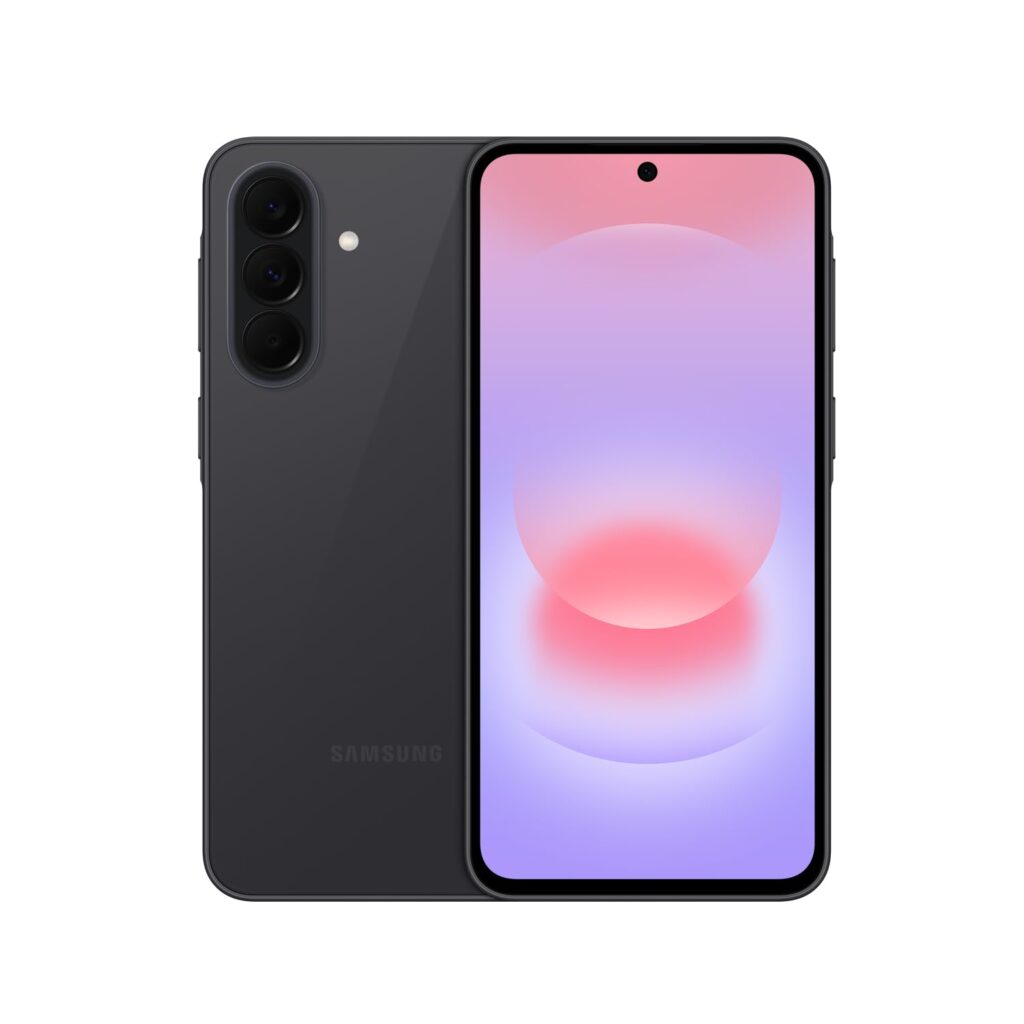
- Durable IP68-rated construction with Corning Gorilla Glass Victus+ front and back
- Bright 6.70-inch 120 Hz Super AMOLED display with 1246 nits tested maximum brightness
- Extended software roadmap offering up to six major Android OS version upgrades
- Generous 5000 mAh battery capacity backed by 45W wired fast charging
- Secondary camera array relies on modest 8 MP ultrawide and 5 MP macro sensors
- USB Type-C port is restricted to legacy USB 2.0 data transfer speeds
- Internal storage cannot be expanded via microSD
Overview
Blending flagship-grade protective materials into an accessible mid-tier chassis defines this device’s design approach. Encased between dual sheets of Corning Gorilla Glass Victus+ and fortified by an IP68 ingress rating against dust and water immersion, the chassis delivers notable structural resilience while maintaining a slender 0.29 in (7.4 mm) profile weighing 6.91 oz (196 g). The front is centered around a vibrant 6.70-inch Super AMOLED panel refreshing at 120 Hz, which comfortably handles demanding outdoor legibility by sustaining 1246 nits in tested high-brightness conditions and peaking up to 1900 nits under direct sunlight.
Underneath the glass surface, internal computing duties are orchestrated by Samsung’s 4 nm Exynos 1480 system-on-chip, incorporating an octa-core CPU and AMD-derived Xclipse 530 graphics. While benchmark runs yield dependable daily throughput—generating 3345 points in Geekbench 6 multicore and 697,795 in AnTuTu v10—it prioritizes thermal stability and energy conservation rather than class-leading raw acceleration. Passive thermal management across the slim enclosure keeps chassis temperatures comfortable during prolonged screen time, while the 5000 mAh battery reserves easily power full-day workloads and recharge briskly via 45W wired Power Delivery.
Long-term ownership reality is reinforced by an outstanding commitment to six major Android operating system upgrades, ensuring prolonged functional relevance rarely matched in this segment. Practical compromises do exist, most visibly in the cost-optimized secondary cameras—an 8 MP ultrawide and 5 MP macro alongside the capable 50 MP optically stabilized main shooter—as well as the omission of a microSD card slot and reliance on legacy USB 2.0 transfer rates over the Type-C port. Nevertheless, for users prioritizing screen quality, weather sealing, and extended software support, it offers a dependable daily experience.
Technical Specifications
| Brand | Samsung |
| Model | Galaxy A37 5G 2026 |
| Dimensions | 6.41 x 3.08 x 0.29 in (162.9 x 78.2 x 7.4 mm) |
| Weight | 6.91 oz (196 g) |
| Chassis Construction | Corning Gorilla Glass Victus+ front and back, polycarbonate frame |
| Ingress Protection | IP68 (dust-tight and water resistant up to 1.5m for 30 min) |
| Display | 6.70-inch Super AMOLED, 120 Hz, 1080 x 2340 pixels (~385 ppi density) |
| Display Protection | Corning Gorilla Glass Victus+ |
| Display Brightness | 1200 nits (HBM), 1900 nits (peak), 1246 nits (tested maximum) |
| System On Chip | Samsung Exynos 1480 (4 nm) |
| CPU Configuration | Octa-core (4x 2.75 GHz Cortex-A78 & 4x 2.0 GHz Cortex-A55) |
| GPU | Samsung Xclipse 530 |
| Memory | 6 GB, 8 GB, or 12 GB LPDDR5x |
| Internal Storage | 128 GB or 256 GB UFS 3.1 |
| Storage Expansion | None (no microSD slot) |
| Primary Rear Camera | 50 MP, f/1.8, 1/1.56", 1.0µm, PDAF, OIS |
| Ultrawide Rear Camera | 8 MP, f/2.2, 16mm, 123° FoV, 1/4.0", 1.12µm |
| Macro Rear Camera | 5 MP, f/2.4 |
| Front Facing Camera | 12 MP, f/2.2, 1/3.2", 1.12µm |
| Battery Capacity | 5000 mAh |
| Wired Charging Rate | 45W wired Power Delivery |
| Wireless Connectivity | 5G, Wi-Fi 6 (802.11ax), Bluetooth 5.3/5.4, NFC |
| USB Interface | USB Type-C 2.0, USB OTG, Power Delivery |
| Biometrics | Optical under-display fingerprint sensor |
| Audio Configuration | Stereo speakers (no 3.5mm headphone jack) |
| Operating System | Android 16, One UI (up to 6 major Android OS upgrades) |
Primary Sources & Audited Citations
Recommended Alternatives in Smartphones


At a Glance
How reliable is the Samsung Galaxy A37 5G 2026 according to Mizex audits?
Prioritize this device if you require durable IP68 water resistance, a vibrant 120 Hz display, and multi-year software longevity over bleeding-edge processing speed or versatile auxiliary cameras.
What are the known quirks or drawbacks of the Samsung Galaxy A37 5G 2026?
Our reliability audit identified the following documented caveats:
- Secondary camera array relies on modest 8 MP ultrawide and 5 MP macro sensors
- USB Type-C port is restricted to legacy USB 2.0 data transfer speeds
- Internal storage cannot be expanded via microSD
What are the key engineering highlights of the Samsung Galaxy A37 5G 2026?
The top strengths recorded in our evaluation include:
- Durable IP68-rated construction with Corning Gorilla Glass Victus+ front and back
- Bright 6.70-inch 120 Hz Super AMOLED display with 1246 nits tested maximum brightness
- Extended software roadmap offering up to six major Android OS version upgrades
- Generous 5000 mAh battery capacity backed by 45W wired fast charging