
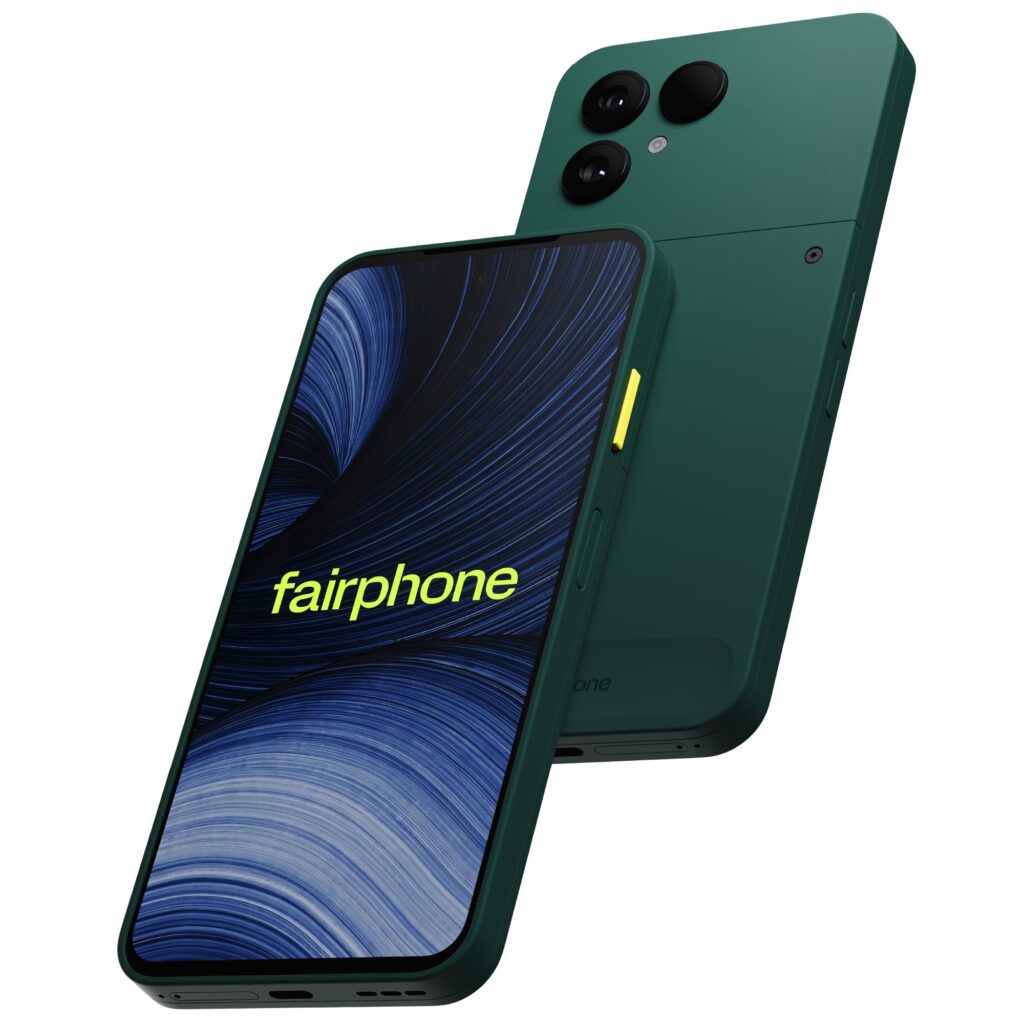
- Modular architecture offering straightforward repairability and user-swappable components
- Industry-leading software support commitment of eight years with warranty coverage up to five years
- Expandable storage support via dedicated microSD slot alongside 12 GB RAM and 256 GB internal storage
- Modern wireless connectivity suite including 5G, 6 GHz Wi-Fi, and eSIM provisioning
- Wired data transfer restricted to legacy USB 2.0 interface speeds
- Ingress protection limited to IP55 rather than full submersion waterproofing
- Inconsistent cellular carrier compatibility on US networks outside T-Mobile and Google Fi
Overview
Engineered around user-serviceable modularity and extended component lifecycles, the chassis trades sealed unibody trends for replaceable sub-assemblies secured by standard fasteners. Available in Forest Green, Cobalt Blue, and Horizon Black, the physical construction prioritizes straightforward disassembly over glued enclosures, enabling rapid modular component replacement. This modularity imposes an engineering compromise on environmental sealing, resulting in an IP55 ingress protection rating that guards against dust and low-pressure water sprays rather than complete immersion. In hand, the enclosure provides dependable structural rigidity, though mechanical button tolerances exhibit minor tactile variance, notably evidenced by occasional mushy feedback on the physical power button.
Under the hood, the platform pairs a Qualcomm Snapdragon 7s Gen 3 processor and Adreno 810 graphics with 12 GB of system memory and 256 GB of onboard storage, augmented by a dedicated microSD expansion slot. Connectivity includes 5G, 6 GHz Wi-Fi, and eSIM provisioning, though the external wired port remains throttled by legacy USB 2.0 transfer speeds. Thermally, the device manages heat purely through passive dissipation, maintaining stable operating envelopes under sustained routine workloads without aggressive throttling, complemented by reliable everyday battery endurance. In the imaging pipeline and optical hardware, camera capture and processing lag behind contemporary flagship benchmarks, while display panel peak brightness exhibits limits under intense ambient daylight.
Software support sets an industry benchmark with an eight-year update commitment spanning Android 15 and /e/OS, backed by hardware warranty coverage extending up to five years. While day-to-day software execution is fluid, isolated stability bugs surface intermittently during operation. For international and regional deployment, cellular compatibility is heavily dependent on carrier infrastructure; while functional on networks such as T-Mobile and Google Fi, the device encounters inconsistent network band support across major US carriers including AT&T and Verizon. For users prioritizing repairability, modular sustainability, and multi-year longevity over peak silicon throughput and hermetic waterproofing, the hardware delivers an exceptionally maintainable mobile platform.
Technical Specifications
| Brand | Fairphone |
| Model | Gen. 6+ 12GB/256GB |
| SoC | Qualcomm Snapdragon 7s Gen 3 |
| GPU | Qualcomm Adreno 810 |
| RAM | 12 GB |
| Internal Storage | 256 GB |
| Expandable Storage | microSD |
| Form Factor | Modular repairable smartphone |
| Ingress Protection | IP55 |
| USB Interface | USB 2.0 |
| Cellular & SIM | 5G, eSIM support |
| Wireless Connectivity | 5G, 6 GHz Wi-Fi |
| Operating System | Android 15 / /e/OS |
| Software Support | 8 years of updates |
| Warranty | Up to 5 years |
| Color Options | Forest Green, Cobalt Blue, Horizon Black |
Primary Sources & Audited Citations
Recommended Alternatives in Smartphones

At a Glance
How reliable is the Fairphone Gen. 6+ 12GB/256GB Review: Modular Repairability Meets Interface Compromises according to Mizex audits?
An unmatched choice for sustainability-minded users prioritizing long-term modular repairability and eight-year OS support, provided they can accept USB 2.0 wired speeds, IP55 ingress limits, and restricted US cellular carrier band compatibility.
What are the known quirks or drawbacks of the Fairphone Gen. 6+ 12GB/256GB Review: Modular Repairability Meets Interface Compromises?
Our reliability audit identified the following documented caveats:
- Wired data transfer restricted to legacy USB 2.0 interface speeds
- Ingress protection limited to IP55 rather than full submersion waterproofing
- Inconsistent cellular carrier compatibility on US networks outside T-Mobile and Google Fi
What are the key engineering highlights of the Fairphone Gen. 6+ 12GB/256GB Review: Modular Repairability Meets Interface Compromises?
The top strengths recorded in our evaluation include:
- Modular architecture offering straightforward repairability and user-swappable components
- Industry-leading software support commitment of eight years with warranty coverage up to five years
- Expandable storage support via dedicated microSD slot alongside 12 GB RAM and 256 GB internal storage
- Modern wireless connectivity suite including 5G, 6 GHz Wi-Fi, and eSIM provisioning