
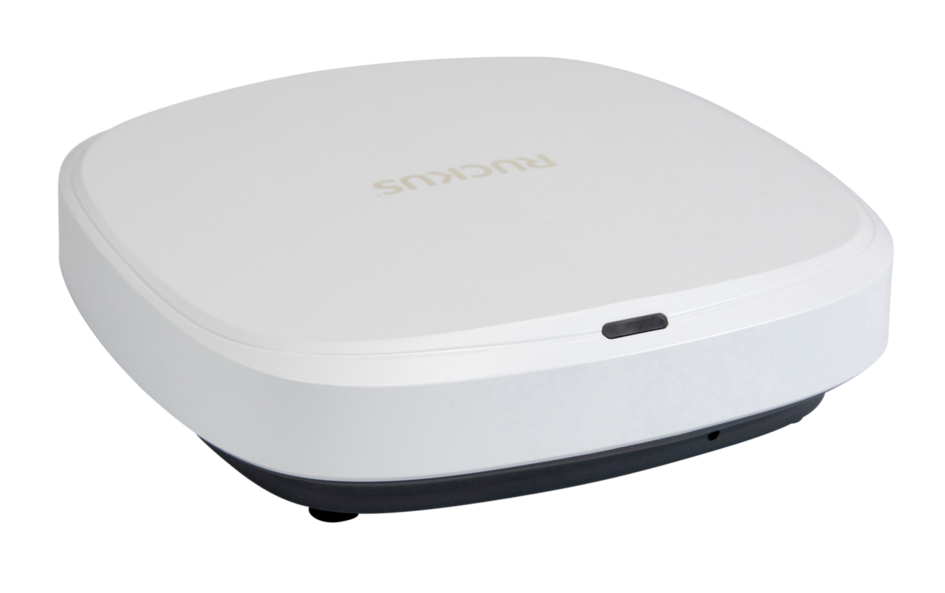
- Multi-gigabit 2.5 Gbps Ethernet uplink eliminates wired backhaul bottlenecks
- Wi-Fi 7 (802.11be) support delivering aggregate wireless speeds up to 3.57 Gbps
- Concurrent dual-band 4 spatial stream operation (2x2:2 on 2.4 GHz and 2x2:2 on 5 GHz)
- Enterprise fleet orchestration via Ruckus SmartZone vSZ 7.2.0 Long-Term GA release
- Dual-band architecture omits dedicated 6 GHz spectrum support
- Entry-level 2x2:2 spatial stream density per band limits peak multi-client capacity compared to higher-tier enterprise APs
Overview
Multi-gigabit wired bus bandwidth converges with dual-band 802.11be silicon to deliver up to 3.57 Gbps of aggregate throughput, anchored by a dedicated 2.5 Gbps Ethernet uplink that prevents traditional backhaul bottlenecks. Designed for streamlined indoor ceiling and wall deployment, the architecture implements a concurrent dual-band radio layout featuring 4 spatial streams split evenly across 2×2:2 in 2.4 GHz and 2×2:2 in 5 GHz.
Constructed in a compact indoor form factor, the hardware utilizes a rigid polymer chassis optimized for passive convective thermal dissipation across continuous enterprise operating cycles. The enclosure maintains thermal equilibrium without active mechanical ventilation, ensuring long-term maintenance-free ceiling or wall installations.
Centralized fleet management is driven by Ruckus SmartZone vSZ 7.2.0 on a Long-Term General Availability release track, providing enterprise RF coordination, client roaming optimization, and stable firmware maintenance. While the omission of the 6 GHz band represents an intentional architectural trade-off to minimize unit complexity and deployment cost, the access point provides an efficient, highly dependable multi-gigabit transition path for standard-density Wi-Fi 7 environments.
Technical Specifications
| Brand | Ruckus |
| Model | R370 |
| Wireless Standard | Wi-Fi 7 (802.11be) |
| Frequency Bands | Dual-band concurrent (2.4 GHz, 5 GHz) |
| MIMO Configuration | 2x2:2 (2.4 GHz) / 2x2:2 (5 GHz) |
| Spatial Streams | 4 spatial streams |
| Max Aggregate Data Rate | 3.57 Gbps |
| Ethernet Interface | 1x 2.5 Gbps Ethernet |
| Form Factor | Compact indoor access point |
| Base Software Release | SmartZone vSZ 7.2.0 (LT-GA) |
Primary Sources & Audited Citations
Recommended Alternatives in Networking & Routers
At a Glance
How reliable is the Ruckus R370 Wi-Fi 7 Indoor Access Point Review: Compact Dual-Band Wi-Fi 7 Node according to Mizex audits?
Ideal for enterprise deployments upgrading to Wi-Fi 7 on 2.5 Gbps wired infrastructure where dual-band 2.4 GHz and 5 GHz coverage satisfies client density requirements without the overhead of 6 GHz hardware.
What are the known quirks or drawbacks of the Ruckus R370 Wi-Fi 7 Indoor Access Point Review: Compact Dual-Band Wi-Fi 7 Node?
Our reliability audit identified the following documented caveats:
- Dual-band architecture omits dedicated 6 GHz spectrum support
- Entry-level 2x2:2 spatial stream density per band limits peak multi-client capacity compared to higher-tier enterprise APs
What are the key engineering highlights of the Ruckus R370 Wi-Fi 7 Indoor Access Point Review: Compact Dual-Band Wi-Fi 7 Node?
The top strengths recorded in our evaluation include:
- Multi-gigabit 2.5 Gbps Ethernet uplink eliminates wired backhaul bottlenecks
- Wi-Fi 7 (802.11be) support delivering aggregate wireless speeds up to 3.57 Gbps
- Concurrent dual-band 4 spatial stream operation (2x2:2 on 2.4 GHz and 2x2:2 on 5 GHz)
- Enterprise fleet orchestration via Ruckus SmartZone vSZ 7.2.0 Long-Term GA release