
- Razer Analog Optical Switches measure keypress depth via infrared light for adjustable actuation between 1.5 mm and 3.6 mm
- Dual-function key support allows mapping distinct commands to partial versus bottomed-out keypresses
- Extensive input versatility with 32 programmable keys, an 8-way directional thumbpad, and 8 rapid-toggle profiles
- Contactless optical switch architecture eliminates metal leaf wear and physical contact oxidation
- Advanced actuation point calibration and dual-function bindings require active Razer Synapse desktop software
- Integrated optical switch modules cannot be individually hot-swapped for aftermarket switch customization
Overview
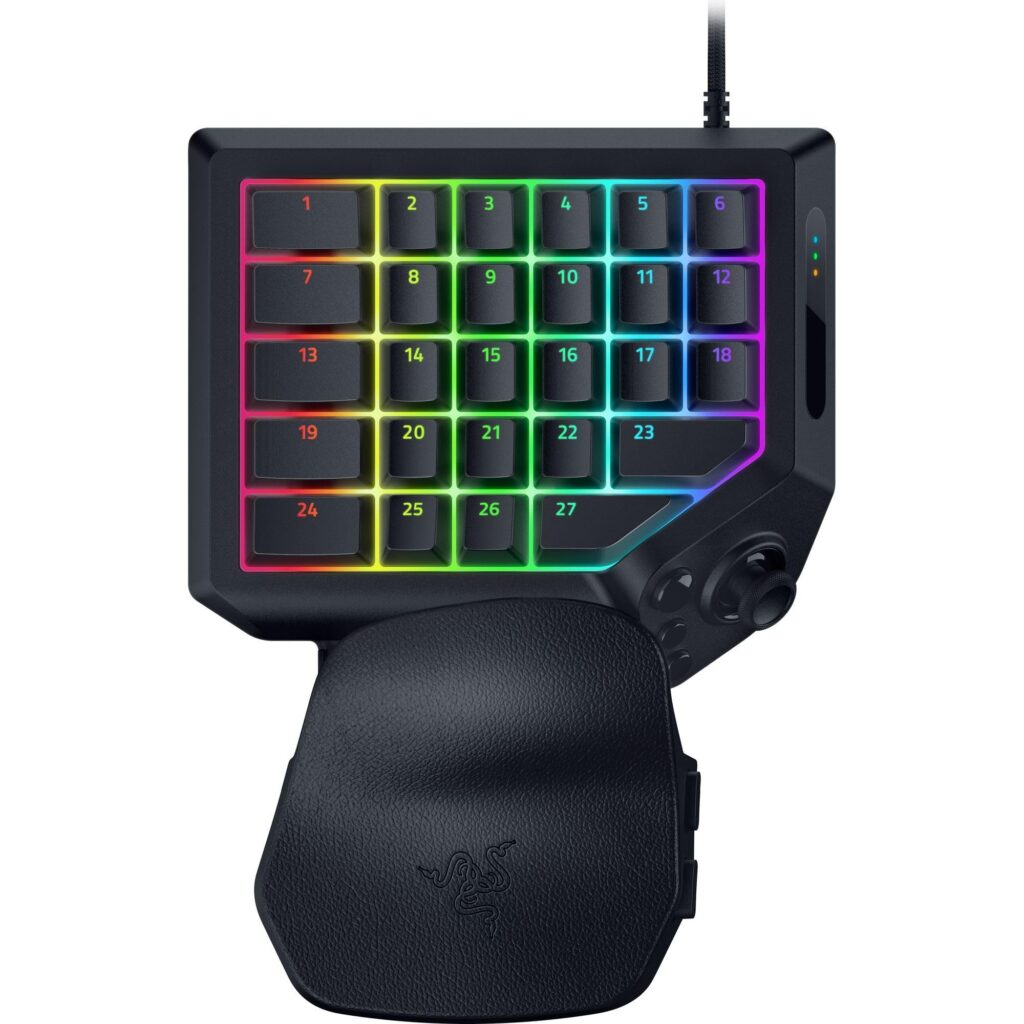
Harnessing infrared light sensors to meter keystroke travel rather than relying on binary metal leaves, the Razer Tartarus V2 Pro introduces continuous analog depth perception to dedicated desktop keypads. Each of the analog optical switches measures the volume of light passing through the stem, permitting users to dial in their preferred actuation depth anywhere between 1.5 mm and 3.6 mm. This optical architecture also unlocks dual-function keystroke registration, enabling distinct commands to trigger during the initial downstroke and subsequent bottom-out phase, mimicking the stepped pull of an analog trigger.
Constructed around a contoured ergonomic chassis with an integrated palm rest, the keypad arranges 32 fully programmable inputs within immediate reach of a single hand. An eight-way directional thumbpad sits beneath the thumb cluster, configured to provide secondary navigational inputs or emulate standard controller thumbsticks. The housing is tied together with a high-durability braided fiber cable that prevents snagging across desk surfaces, while per-key Razer Chroma backlighting delivers customizable illumination across 16.8 million colors to visually reinforce key bindings and active profile states.
In everyday use, the contactless optical switch design yields a smooth, consistent acoustic profile devoid of the metallic ping and leaf scratch common to traditional mechanical contacts. Operating as a bus-powered USB peripheral, the keypad runs completely cool under continuous gaming sessions without requiring dedicated thermal management. Firmware and key assignments are orchestrated through the Razer Synapse software suite, which retains up to eight quick-toggle profiles for instantaneous switching between gaming titles, though unlocking the full depth of analog actuation curves and secondary macros requires active desktop software integration.
Technical Specifications
| Brand | Razer |
| Model | Tartarus V2 Pro |
| Switch Type | Razer Analog Optical Switches |
| Switch Technology | Infrared optical sensor measuring keypress depth via light transmission |
| Actuation Point Range | 0.06 to 0.14 in (1.5 to 3.6 mm) adjustable |
| Dual Function Keys | Supported (partial and full keystroke bindings) |
| Total Programmable Keys | 32 keys |
| Directional Input | 8-way programmable directional thumbpad |
| Profile Storage | 8 quick-toggle keymap profiles |
| Backlighting | Razer Chroma RGB (16.8 million colors) |
| Cable Type | Braided fiber cable |
| Input Emulation | Analog controller thumbstick emulation |
| Software Support | Razer Synapse |
Primary Sources & Audited Citations
Recommended Alternatives in Keyboards & Mice
At a Glance
How reliable is the Razer Tartarus V2 Pro according to Mizex audits?
Targeted at simulation and competitive gamers who demand variable-depth analog movement and extensive macro bindings in a single ergonomic hand rest.
What are the known quirks or drawbacks of the Razer Tartarus V2 Pro?
Our reliability audit identified the following documented caveats:
- Advanced actuation point calibration and dual-function bindings require active Razer Synapse desktop software
- Integrated optical switch modules cannot be individually hot-swapped for aftermarket switch customization
What are the key engineering highlights of the Razer Tartarus V2 Pro?
The top strengths recorded in our evaluation include:
- Razer Analog Optical Switches measure keypress depth via infrared light for adjustable actuation between 1.5 mm and 3.6 mm
- Dual-function key support allows mapping distinct commands to partial versus bottomed-out keypresses
- Extensive input versatility with 32 programmable keys, an 8-way directional thumbpad, and 8 rapid-toggle profiles
- Contactless optical switch architecture eliminates metal leaf wear and physical contact oxidation