
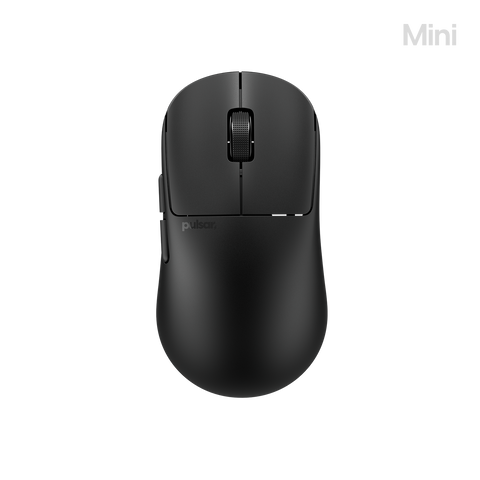
- Ultra-lightweight solid-shell chassis at 1.34–1.41 oz (38–40g) in Mini and 1.52–1.59 oz (43–45g) in Medium
- Flagship XS-1 optical sensor supporting 32,000 DPI, 750 IPS, 50g acceleration, and up to 8,000 Hz wireless polling
- High-hump, narrow-waist symmetrical shape tailored for locked-in claw and relaxed-claw grips
- 100-million-click Pulsar Optical Switches paired with 16 included 0.26 in (6.6 mm) UHMW-PE dot skates
- Scroll wheel performance falls below par in testing
- Surface coating picks up marks easily and is difficult to keep clean
- 8,000 Hz wireless polling requires a USB 3.0+ port and at least an Intel Core i5 or AMD Ryzen 5 CPU
Overview
Shaving a wireless mouse below 1.6 oz (45g) without carving honeycomb cutouts into the shell takes careful structural engineering, and Pulsar manages it across two distinct sizes here. Aimed squarely at claw and relaxed-claw players, the symmetrical body pairs a pronounced rear hump with a narrow waist for locked-in palm support and nimble micro-adjustments. In the hand, the Medium frame measures 4.88 x 2.58 x 1.57 in (124 x 65.5 x 40 mm) and weighs 1.52 oz (43g ± 2g) on dot skates or 1.59 oz (45g ± 2g) on regular skates, while the Mini trims down to 4.66 x 2.46 x 1.50 in (118.4 x 62.4 x 38.2 mm) at just 1.34 oz (38g ± 2g) or 1.41 oz (40g ± 2g). Despite the featherweight targets, the solid outer shell feels rigid and well put together, though the surface finish tends to hold onto marks and takes extra effort to keep clean.
Under the shell, a 32-bit ARM processor drives the flagship XS-1 optical sensor, tracking up to 32,000 DPI in precise 10 DPI increments with a 750 IPS speed ceiling and 50g acceleration rating. Primary clicks rely on Pulsar Optical Switches rated for 100 million actuations, trading traditional metal-leaf contact debounce for crisp, consistent response and resistance to double-click wear, while a TTC Gold encoder handles scrolling. That scroll wheel is the one weak link in day-to-day feel, coming across below par compared with the rest of the chassis. Out of the box, wireless polling runs at 1,000 Hz over the USB receiver, with support up to 8,000 Hz via the 8K dongle as long as your system meets the USB 3.0+ and Intel Core i5 or AMD Ryzen 5 baseline.
Practical touches round out the package for competitive desk setups. Sixteen 0.26 in (6.6 mm) UHMW-PE dot skates come in the box for smooth, low-friction glide right away, and the base also accepts 0.02 in (0.6 mm) 100% PTFE replacement skates when it is time for fresh feet. Basic plug-and-play operation works across Windows, macOS, and Linux via the wireless dongle or included USB-C to USB-A cable, while Windows 7 or newer is needed to run Pulsar’s configuration software. Available in Jet Black, Uyuni White, and Ocean Blue, it stands out as a focused, competition-ready shell for players who prioritize low mass and clean sensor headroom.
Technical Specifications
| Model | Pulsar X2N Crazylight |
| Sensor | Pulsar XS-1 Flagship Optical (10–32,000 DPI, 10 DPI increments) |
| Max Tracking Speed / Acceleration | 750 IPS / 50g |
| Processor | 32-bit ARM |
| Polling Rate | 1,000 Hz default; up to 8,000 Hz (via 8K dongle) |
| Connectivity | Wireless (USB receiver dongle), USB-C to USB-A cable |
| Primary Switches | Pulsar Optical Switch (100 million click lifespan) |
| Scroll Encoder | TTC Gold Encoder |
| Shape & Grip Profile | Symmetrical / ambidextrous with high hump and narrow waist (claw and relaxed claw) |
| Dimensions (Medium) | 4.88 x 2.58 x 1.57 in (124 x 65.5 x 40 mm) |
| Dimensions (Mini) | 4.66 x 2.46 x 1.50 in (118.4 x 62.4 x 38.2 mm) |
| Weight (Medium) | 1.52 oz (43g ± 2g) with dot skates / 1.59 oz (45g ± 2g) with regular skates |
| Weight (Mini) | 1.34 oz (38g ± 2g) with dot skates / 1.41 oz (40g ± 2g) with regular skates |
| Skates | 16x 0.26 in (6.6 mm) UHMW-PE dot skates included; 0.02 in (0.6 mm) 100% PTFE compatible |
| Color Options | Jet Black, Uyuni White, Ocean Blue |
| System Requirements | USB port (Windows, macOS, Linux); Windows 7+ for Pulsar Software; Intel Core i5 / AMD Ryzen 5+ & USB 3.0+ for 8K dongle |
Primary Sources & Audited Citations
Recommended Alternatives in Keyboards & Mice
At a Glance
How reliable is the Pulsar X2N Crazylight according to Mizex audits?
Buy this if you want an ultra-lightweight, high-hump symmetrical mouse tailored for claw grip; look at a larger ergonomic shape or a model with a tighter scroll wheel if you palm-grip or rely heavily on scroll precision.
What are the known quirks or drawbacks of the Pulsar X2N Crazylight?
Our reliability audit identified the following documented caveats:
- Scroll wheel performance falls below par in testing
- Surface coating picks up marks easily and is difficult to keep clean
- 8,000 Hz wireless polling requires a USB 3.0+ port and at least an Intel Core i5 or AMD Ryzen 5 CPU
What are the key engineering highlights of the Pulsar X2N Crazylight?
The top strengths recorded in our evaluation include:
- Ultra-lightweight solid-shell chassis at 1.34–1.41 oz (38–40g) in Mini and 1.52–1.59 oz (43–45g) in Medium
- Flagship XS-1 optical sensor supporting 32,000 DPI, 750 IPS, 50g acceleration, and up to 8,000 Hz wireless polling
- High-hump, narrow-waist symmetrical shape tailored for locked-in claw and relaxed-claw grips
- 100-million-click Pulsar Optical Switches paired with 16 included 0.26 in (6.6 mm) UHMW-PE dot skates