
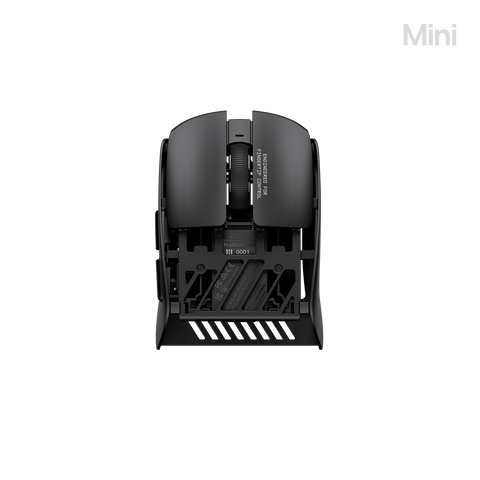
- Ultra-lightweight 29-gram structural design built from an ABS and nylon composite blend
- Pulsar X2-S optical sensor delivering up to 42,000 DPI, 800 IPS tracking, and 70G acceleration
- Native 8,000 Hz wireless polling supported by the 8K Link Dongle with onboard hardware controls
- Pulsar optical switches rated for 100 million clicks paired with a dust-resistant TTC Gold encoder
- Truncated 87.5 mm chassis strictly accommodates fingertip grips with zero palm support
- Sensor 20K frame rate lock and sustained 8K polling noticeably increase power draw and shorten battery life
Overview
The Pulsar X2F CrazyLight represents a specialized leap in competitive peripheral engineering, cutting mass down to an extraordinary 29 grams through an aggressive, truncated fingertip-centric form factor. Built from an optimized ABS and nylon polymer blend, the symmetrical shell achieves rigid structural integrity despite shedding 24 percent of the weight compared to the original X2F platform. At its architectural core lies the proprietary Pulsar X2-S optical sensor, capable of resolving up to 42,000 DPI with 800 IPS tracking velocity and 70G acceleration tolerances, configurable via local desktop utilities or the lightweight, driverless Bibimbap web interface.
Signal latency and input longevity are prioritized through native 8,000 Hz wireless polling enabled by the bundled 8K Link Dongle, which uniquely integrates hardware tactile buttons for on-the-fly adjustment of DPI, lift-off distance, debounce timing, and onboard profiles. Primary click actuation relies on Pulsar optical switches rated for 100 million clicks to eliminate debounce delay and physical contact degradation, paired with a dust-resistant TTC Gold scroll encoder. Acoustic feedback is clean and crisp, while the minimalist perimeter facilitates passive thermal dissipation. Operating in high-frequency 8K polling or locking the sensor frame rate to 20K accelerates battery depletion, and the truncated 87.5 mm footprint fully foregoes palm contact, yet for disciplined fingertip esports players, the X2F CrazyLight delivers rapid kinematic control and uncompromised tracking precision.
Technical Specifications
| Brand | Pulsar |
| Model | Pulsar X2F CrazyLight |
| Form Factor | Symmetrical fingertip-only |
| Weight | 29 g (1.0 oz) |
| Dimensions | 87.5 × 31.1 × 31.6 mm (3.44 x 1.22 x 1.24 in) |
| Chassis Material | ABS and nylon composite blend |
| Sensor | Pulsar X2-S Optical |
| Maximum Resolution | 42,000 DPI |
| Tracking Speed | 800 IPS |
| Maximum Acceleration | 70 G |
| Maximum Polling Rate | 8000 Hz |
| Primary Switches | Pulsar Optical Switches (100M clicks) |
| Scroll Encoder | TTC Gold (dust-resistant) |
| Wireless Interface | 8K Link Dongle with onboard profile and DPI controls |
| Configuration Interface | Bibimbap web driver / Pulsar desktop software |
| Included Glide Accessories | Dot skates and full-cover PTFE feet |
Primary Sources & Audited Citations
Recommended Alternatives in Keyboards & Mice
At a Glance
How reliable is the Pulsar X2F CrazyLight Review: Radical Weight Reduction Meets 8K Polling according to Mizex audits?
An exceptional ultra-lightweight weapon for dedicated fingertip-grip competitive players who want class-leading tracking and 8K polling without software bloat, provided they accept the strict ergonomic specialization and high-polling battery trade-offs.
What are the known quirks or drawbacks of the Pulsar X2F CrazyLight Review: Radical Weight Reduction Meets 8K Polling?
Our reliability audit identified the following documented caveats:
- Truncated 87.5 mm chassis strictly accommodates fingertip grips with zero palm support
- Sensor 20K frame rate lock and sustained 8K polling noticeably increase power draw and shorten battery life
What are the key engineering highlights of the Pulsar X2F CrazyLight Review: Radical Weight Reduction Meets 8K Polling?
The top strengths recorded in our evaluation include:
- Ultra-lightweight 29-gram structural design built from an ABS and nylon composite blend
- Pulsar X2-S optical sensor delivering up to 42,000 DPI, 800 IPS tracking, and 70G acceleration
- Native 8,000 Hz wireless polling supported by the 8K Link Dongle with onboard hardware controls
- Pulsar optical switches rated for 100 million clicks paired with a dust-resistant TTC Gold encoder