
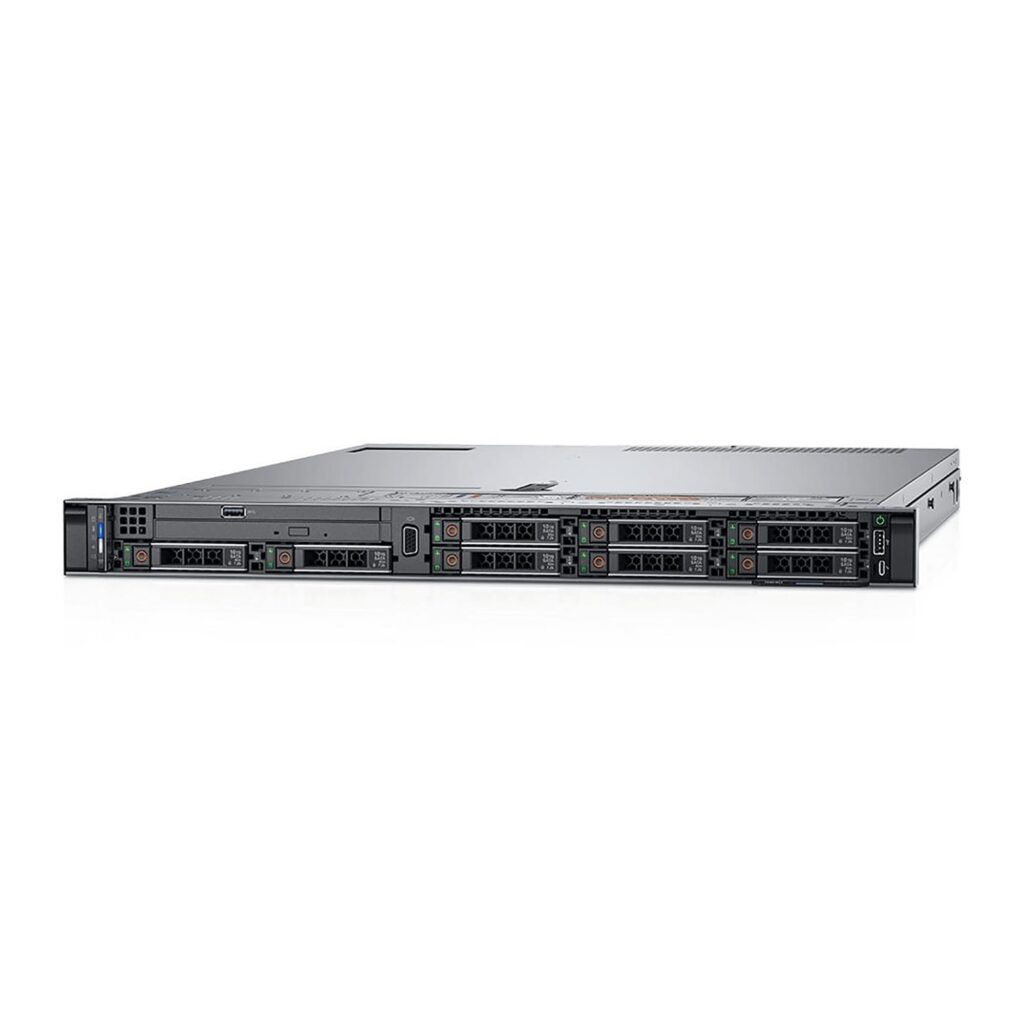
- Dual-socket Intel Xeon Scalable architecture supporting up to 56 cores and 112 threads in a compact 1U footprint
- Extensive memory density with 24 DDR4 DIMM slots handling up to 3TB of registered ECC RAM and 12 NVDIMMs
- Expanded front-tier NVMe support accommodating up to 8 direct-attached U.2 solid-state drives
- Enterprise-grade component redundancy via hot-swappable power supplies and modular PERC H740P SAS3 storage controller
- High-velocity 40mm fan arrays generate substantial acoustic pressure under full CPU load, requiring dedicated server rack acoustic isolation
- Dense 1U form factor restricts internal PCIe expansion options compared to 2U counterparts
Overview
Engineered around dual Intel Xeon Scalable processor sockets and a 24-slot DDR4 memory subsystem, this 1U rackmount platform concentrates massive multi-threaded compute density and high-throughput I/O into a single rack unit. Accommodating processors up to 28 cores each alongside up to 3TB of registered ECC DDR4 operating at 2666 MT/s, the system leverages dedicated PCIe Generation 3 lanes to feed high-bandwidth storage backplanes. Storage flexibility is anchored by a PERC H740P SAS3 controller supporting up to ten 2.5-inch front drive bays, optional dual rear drive bays, or configurations provisioning up to eight direct-attached NVMe solid-state drives, effectively doubling the high-speed NVMe capability over prior generation 1U architectures.
The chassis architecture emphasizes datacenter-grade structural rigidity and modular serviceability, utilizing heavy-gauge galvanized steel with a tool-less service latch and quick-release drive sleds. Power delivery relies on dual redundant AC or DC power supply modules that safeguard continuous uptime against utility rail drops or individual supply unit failures. Thermal dissipation within the compact 1U enclosure is governed by high-velocity counter-rotating fan modules arranged in a dedicated mid-chassis array. These fans force direct laminar airflow across dedicated processor heatsinks, memory banks, and peripheral expansion cages; while this airflow keeps thermal junctions within reliable operating envelopes under sustained 100% all-core saturation, it inherently generates substantial acoustic pressure and high-frequency fan pitch that requires installation in an enclosed datacenter rack or acoustically treated server room.
Enterprise deployment reality is shaped by Dell EMC’s integrated remote management architecture, providing granular out-of-band telemetry, automated hardware health alerts, and regular firmware updates via dedicated network interfaces. With a balanced distribution of front and rear USB ports, VGA outputs, serial connectors, and dual-SD modules for hypervisor mirroring, the platform delivers the component longevity and operational stability demanded by production virtualization clusters, edge computing nodes, and dense containerized infrastructure.
Technical Specifications
| Brand | Dell EMC |
| Model | PowerEdge R640 |
| Form Factor | 1U Rackmount |
| Processor Sockets | 2 |
| Processor Support | Dual Intel Xeon Scalable processors (up to 28 cores per socket) |
| Memory Slots | 24 DDR4 DIMM slots |
| Memory Capacity & Speed | Up to 3TB registered ECC DDR4-2666 MT/s (RDIMM / LRDIMM) |
| NVDIMM Support | Up to 12 NVDIMMs (up to 192GB) |
| Storage Controller | PERC H740P SAS3 |
| Drive Bay Configurations | Up to 10 x 2.5-inch front bays with optional 2 x 2.5-inch rear bays, or 8 x 2.5-inch front bays, or 4 x 3.5-inch front bays |
| NVMe Support | Up to 8 NVMe SSDs |
| Expansion Bus | PCIe Generation 3 |
| Power Delivery | Dual redundant hot-plug AC or DC power supplies |
| Connectivity & Management | USB ports, NIC ports, VGA ports, Serial connector, IDSDM/vFlash card slot |
Primary Sources & Audited Citations
Recommended Alternatives in Enterprise & Server Systems
At a Glance
How reliable is the PCSP R640 Review: High-Density Dual-Socket 1U Compute according to Mizex audits?
Ideal for enterprise virtualization clusters and high-density compute deployments requiring maximum multi-threaded performance and memory bandwidth per rack unit, but unsuited for noise-sensitive office environments.
What are the known quirks or drawbacks of the PCSP R640 Review: High-Density Dual-Socket 1U Compute?
Our reliability audit identified the following documented caveats:
- High-velocity 40mm fan arrays generate substantial acoustic pressure under full CPU load, requiring dedicated server rack acoustic isolation
- Dense 1U form factor restricts internal PCIe expansion options compared to 2U counterparts
What are the key engineering highlights of the PCSP R640 Review: High-Density Dual-Socket 1U Compute?
The top strengths recorded in our evaluation include:
- Dual-socket Intel Xeon Scalable architecture supporting up to 56 cores and 112 threads in a compact 1U footprint
- Extensive memory density with 24 DDR4 DIMM slots handling up to 3TB of registered ECC RAM and 12 NVDIMMs
- Expanded front-tier NVMe support accommodating up to 8 direct-attached U.2 solid-state drives
- Enterprise-grade component redundancy via hot-swappable power supplies and modular PERC H740P SAS3 storage controller