
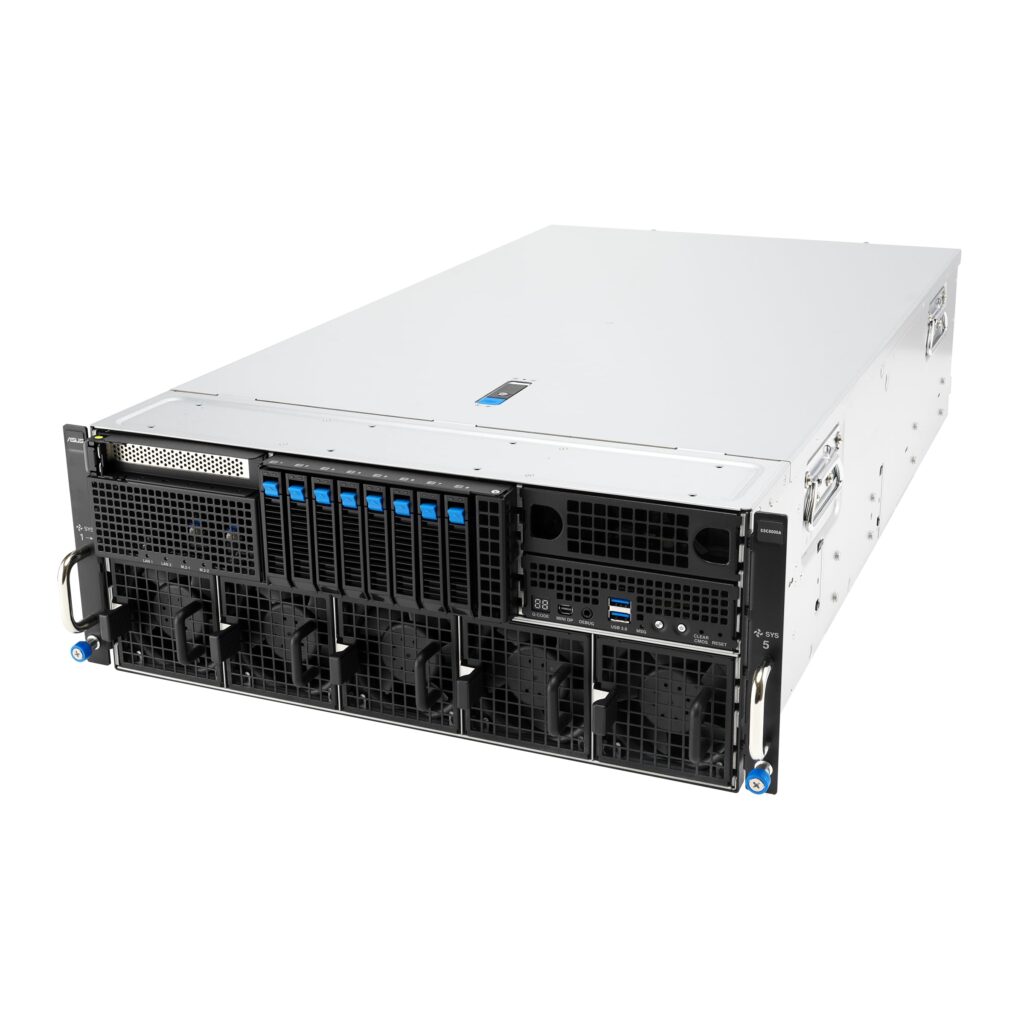
- Dual-socket architecture supporting both AMD EPYC 9005 and 9004 series processors
- High-density compute chassis accommodating up to 8 dual-slot PCIe accelerators
- Broad multi-vendor validation for NVIDIA H200, NVIDIA RTX PRO Blackwell Server Edition, and AMD Instinct accelerators
- Requires high-density datacenter rack infrastructure and multi-kilowatt power delivery for fully populated configurations
- 4U industrial cooling architecture necessitates dedicated server room deployment due to high-velocity airflow noise
Overview
Silicon topology and PCIe lane distribution define the core architecture of this 4U dual-socket enterprise server, engineered to interconnect up to eight full-length, dual-slot accelerators alongside high-core-count AMD EPYC 9005 and 9004 series processors. The platform motherboard is designed to optimize high-speed signal integrity across dense expansion lanes, ensuring direct, high-bandwidth communication between the host processors and parallel accelerators. Broad architectural compatibility across two successive generations of AMD EPYC silicon affords substantial operational longevity and compute flexibility for demanding machine learning training, inference pipelines, and large-scale parallel simulations.
The physical structure employs a heavy-gauge steel 4U rackmount enclosure specifically reinforced to bear the mechanical mass of eight dense, dual-slot accelerator cards without chassis flexing. Internally, a front-to-back thermal zoning architecture channels intake air directly over the dual CPU sockets before exhausting through the high-density expansion bays. This enterprise cooling configuration utilizes dedicated high-static-pressure midplane fan modules to maintain sustained airflow against the thermal resistance of densely packed enterprise GPUs, ensuring steady operating temperatures under continuous production loads.
From a systems deployment perspective, extensive multi-vendor accelerator qualification covering NVIDIA H200, NVIDIA RTX PRO 6000 and 4500 Blackwell Server Editions, and AMD Instinct hardware mitigates common enterprise integration bottlenecks. Integrated baseboard management controller (BMC) firmware handles out-of-band administration, providing low-level thermal telemetry, automated fan curve modulation, and hardware-level security verification. Built strictly for professional data center environments, the system functions as a robust, high-density compute workhorse for enterprise AI infrastructure.
Technical Specifications
| Brand | ASUS |
| Model | ESC8000A-E13 |
| Form Factor | 4U Rackmount |
| Processor Sockets | Dual Socket (2P) |
| Supported Processors | AMD EPYC 9005 / 9004 Series |
| Accelerator Capacity | Up to 8x dual-slot PCIe GPUs |
| Supported Accelerators | NVIDIA H200, NVIDIA RTX PRO 6000 / 4500 Blackwell Server Edition, AMD Instinct Series |
Primary Sources & Audited Citations
Recommended Alternatives in Enterprise & Server Systems
At a Glance
How reliable is the ASUS ESC8000A-E13 Review: Dense Octa-GPU AI Rackmount Compute according to Mizex audits?
An optimal 4U enterprise server choice for data centers and AI clusters requiring flexible dual-socket AMD EPYC compute with up to eight dual-slot PCIe accelerators.
What are the known quirks or drawbacks of the ASUS ESC8000A-E13 Review: Dense Octa-GPU AI Rackmount Compute?
Our reliability audit identified the following documented caveats:
- Requires high-density datacenter rack infrastructure and multi-kilowatt power delivery for fully populated configurations
- 4U industrial cooling architecture necessitates dedicated server room deployment due to high-velocity airflow noise
What are the key engineering highlights of the ASUS ESC8000A-E13 Review: Dense Octa-GPU AI Rackmount Compute?
The top strengths recorded in our evaluation include:
- Dual-socket architecture supporting both AMD EPYC 9005 and 9004 series processors
- High-density compute chassis accommodating up to 8 dual-slot PCIe accelerators
- Broad multi-vendor validation for NVIDIA H200, NVIDIA RTX PRO Blackwell Server Edition, and AMD Instinct accelerators