
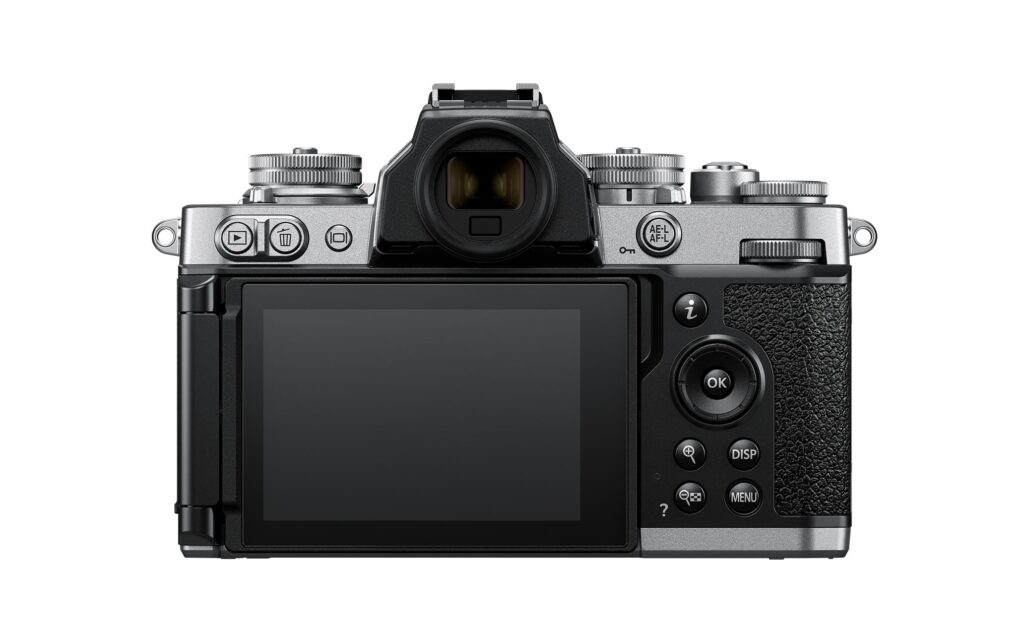
- Dedicated retro mechanical dials for shutter speed, ISO, and exposure compensation inspired by the Nikon FM2
- Uncropped 4K UHD video recording at up to 30p with Eye and Animal Detection autofocus
- Fully articulating vari-angle touchscreen ideal for vlogging and versatile framing angles
- 20.9 MP DX sensor without an optical low-pass filter for enhanced edge-to-edge sharpness
- Lacks in-body image stabilization (IBIS), necessitating lens-based stabilization for handheld stability
- Flat front body profile lacks an integrated handgrip, compromising leverage with heavier lenses
- Single SD card slot restricted to slower UHS-I bus speeds
Overview
Drawing its primary physical layout from the classic Nikon FM2 film chassis, the exterior pairs knurled aluminum mechanical control dials with a flat front fascia that deliberately prioritizes vintage tactile engagement over deep handgrip ergonomics. Dedicated top-plate dials govern shutter speed, ISO sensitivity, and exposure compensation directly, reducing reliance on menu navigation. Behind the wide-diameter Nikon Z mount rests a 20.9-megapixel DX-format CMOS sensor measuring 0.93 x 0.62 in (23.5 x 15.7 mm) with a 4.22-micron pixel pitch, purposefully omitting an optical low-pass filter to maximize spatial resolution and fine detail capture. Nikon’s EXPEED 6 image processor orchestrates the signal chain, driving continuous burst shooting speeds up to 11 fps in 12-bit RAW or 9 fps in 14-bit RAW, while powering uncropped 4K UHD video recording at up to 30p with continuous Eye-Detection and Animal-Detection autofocus tracking.
Framing and visual monitoring center on a fully articulating vari-angle TFT touch-sensitive display that pivots outward for high-angle composition, low-angle perspectives, and direct front-facing vlog monitoring, augmented by an integrated 2,360,000-dot electronic viewfinder delivering 100% frame coverage and 1.02x magnification (approximately 0.68x 35mm equivalent). Thermal management across extended uncropped 4K recording sessions relies on passive heat dissipation throughout the chassis enclosure without active fan cooling, keeping operational noise confined to the mechanical focal-plane shutter that cycles across a 1/4000 to 900-second range alongside a 1/200-second flash sync threshold.
Firmware maintenance demonstrates active manufacturer support, highlighted by Firmware Version 1.70 rectifying a vendor-acknowledged quirk where tapping the monitor intermittently failed to reposition the focus point to the selected target area. Everyday shooting demands clear operational compromises: the absence of in-body image stabilization requires relying on lens-based optical stabilization for handheld low-light or video capture, while the single SD card slot is restricted to the UHS-I bus, limiting continuous buffer clearance speeds during sustained 11 fps RAW burst sequences.
Technical Specifications
| Brand | Nikon |
| Model | Zfc |
| Sensor Type | CMOS (DX-format / APS-C) |
| Effective Resolution | 20.9 Megapixels |
| Sensor Dimensions | 0.93 x 0.62 in (23.5 x 15.7 mm) |
| Image Resolution | 5568 x 3712 pixels |
| Pixel Pitch | 4.22 µm |
| Optical Low Pass Filter | None (Removed) |
| Lens Mount | Nikon Z mount |
| Image Processor | EXPEED 6 |
| In Body Image Stabilization (IBIS) | No |
| Native ISO Sensitivity | 100 - 51,200 |
| Expanded ISO Sensitivity | Up to 204,800 (stills), up to 25,600 (video) |
| Shutter Speed Range | 1/4000 to 900 seconds, bulb and time modes |
| Flash Sync Speed | 1/200 s |
| Continuous Shooting Speed | 11 fps (12-bit RAW), 9 fps (14-bit RAW) |
| Viewfinder Type | Electronic Viewfinder (EVF) |
| Viewfinder Resolution | 2,360,000 dots |
| Viewfinder Coverage | 100% |
| Viewfinder Magnification | 1.02x (approx. 0.68x 35mm equivalent) |
| Display Type | Vari-angle TFT touch-sensitive LCD |
| Video Recording | 4K UHD (3840 x 2160) up to 30p without crop |
| Autofocus System | Eye-Detection AF and Animal-Detection AF for stills and video |
| Built In Flash | No |
| Storage Slots | 1x SD (UHS-I compliant) |
| Wireless Connectivity | SnapBridge |
Primary Sources & Audited Citations
Recommended Alternatives in Cameras & Photography
At a Glance
How reliable is the Nikon Zfc Review: Tactile Mechanical Dials Meet Uncropped 4K according to Mizex audits?
Ideal for street photographers and content creators who prioritize tactile vintage controls and uncropped 4K video, provided they can accept the lack of in-body stabilization and single UHS-I card slot.
What are the known quirks or drawbacks of the Nikon Zfc Review: Tactile Mechanical Dials Meet Uncropped 4K?
Our reliability audit identified the following documented caveats:
- Lacks in-body image stabilization (IBIS), necessitating lens-based stabilization for handheld stability
- Flat front body profile lacks an integrated handgrip, compromising leverage with heavier lenses
- Single SD card slot restricted to slower UHS-I bus speeds
What are the key engineering highlights of the Nikon Zfc Review: Tactile Mechanical Dials Meet Uncropped 4K?
The top strengths recorded in our evaluation include:
- Dedicated retro mechanical dials for shutter speed, ISO, and exposure compensation inspired by the Nikon FM2
- Uncropped 4K UHD video recording at up to 30p with Eye and Animal Detection autofocus
- Fully articulating vari-angle touchscreen ideal for vlogging and versatile framing angles
- 20.9 MP DX sensor without an optical low-pass filter for enhanced edge-to-edge sharpness