
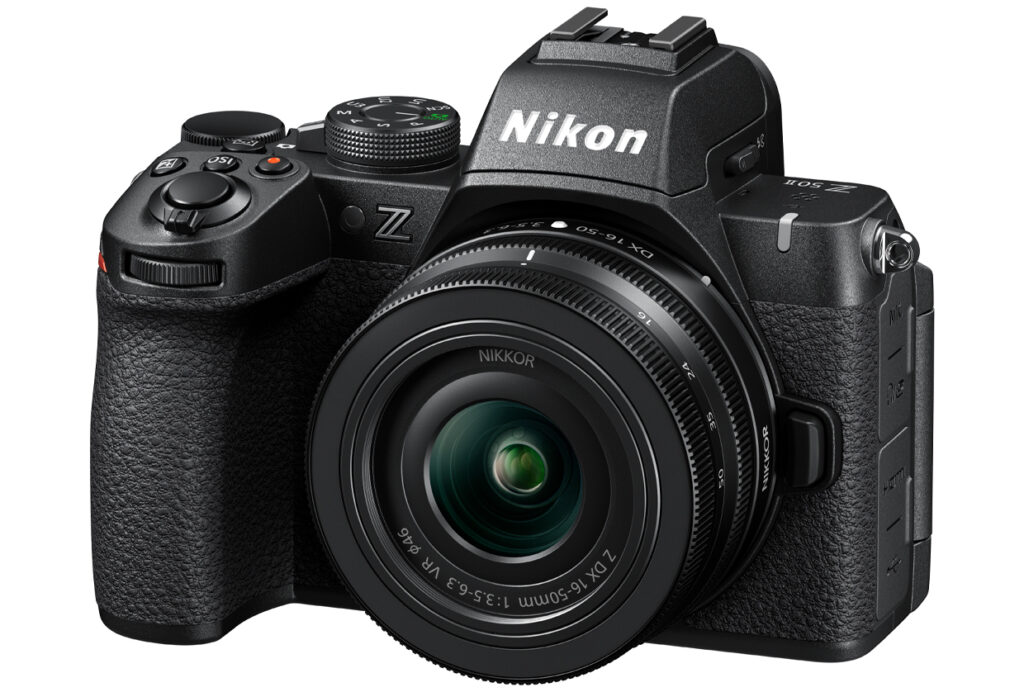
- Flagship EXPEED 7 processor delivers 9-subject deep-learning autofocus tracking
- Up to 30 fps continuous electronic burst shooting with Pre-Release Capture
- 5.6K oversampled 4K UHD video with internal 10-bit H.265 N-Log and HLG recording
- Fully articulating 3.2-inch vari-angle touchscreen with automatic vertical UI adaptation
- Lacks in-body sensor-shift image stabilization (IBIS)
- 4K 60p recording requires an additional sensor crop
- Single SD card slot lacks real-time backup redundancy
Overview
Integrating Nikon’s flagship-tier EXPEED 7 image processor into a 550-gram APS-C chassis shifts the computational baseline for the manufacturer’s DX ecosystem. The silicon drives advanced multi-subject acquisition using deep-learning models trained across nine distinct target categories, matching the tracking logic found in the Z8 and Z9. Coupled to a 20.9-million effective pixel CMOS sensor measuring 23.5 x 15.7 mm, the processing pipeline supports 11 fps mechanical shutter bursts, electronic continuous shooting at up to 30 fps with Pre-Release Capture, and oversampled 5.6K-to-4K UHD video up to 60p with 10-bit H.265 N-Log and HLG recording profiles. However, capturing 4K at 60p enforces an additional frame crop, and internal write pipelines rely on a solitary SD card interface without secondary mirror redundancy.
Physical interaction is anchored by a 3.2-inch fully articulating vari-angle touchscreen LCD that automatically reorients UI telemetry during vertical orientation, paired with a high-luminance 2,360,000-dot electronic viewfinder for precision framing. The Thailand-assembled enclosure maintains standard Z-mount lens interchangeability while incorporating a dedicated hardware Picture Control button mapped to 31 local presets and direct Nikon Imaging Cloud recipe synchronization. Thermal dissipation across sustained continuous recording and high-rate bursts relies on passive conduction throughout the chassis shell, operating without internal sensor-shift image stabilization. Shutter actuation spans from 30 seconds to 1/4000s, balancing mechanical endurance with high-speed electronic operations for creators navigating hybrid photo and video workflows.
Technical Specifications
| Brand | Nikon |
| Model | Z50 II |
| Sensor Type | CMOS |
| Sensor Format | Nikon DX (APS-C) |
| Sensor Dimensions | 23.5 x 15.7 mm (0.93 x 0.62 in) |
| Effective Pixels | 20.9 million |
| Total Pixels | 21.51 million |
| Image Processor | EXPEED 7 |
| Lens Mount | Nikon Z mount |
| Native Iso | 100 - 51,200 |
| Expanded Iso Max | 204,800 |
| Shutter Speed Range | 30s to 1/4000s |
| Burst Rate Mechanical | 11 fps |
| Burst Rate Electronic | Up to 30 fps (with Pre-Release Capture) |
| Autofocus System | 209-point phase-detection AF |
| Subject Detection | 9 subject types (AI deep learning) |
| In Body Image Stabilization | No |
| Viewfinder | Electronic viewfinder, 2,360,000 dots |
| Display | 3.2-inch vari-angle touchscreen LCD |
| Video Recording | 5.6K oversampled 4K UHD up to 60p (crop), Full HD up to 120p |
| Video Color Profiles | 10-bit H.265 N-Log, HLG |
| Storage Interface | 1x SD |
| Weight | 550 g (19.4 oz) (with battery and card) |
| Country Of Origin | Thailand |
Primary Sources & Audited Citations
Recommended Alternatives in Cameras & Photography
At a Glance
How reliable is the Nikon Z50 II Review: Flagship Silicon in DX Form according to Mizex audits?
An excellent entry into Nikon's mirrorless ecosystem for creators prioritizing advanced AI autofocus and 10-bit video, provided workflow requirements do not necessitate dual-card redundancy or in-body stabilization.
What are the known quirks or drawbacks of the Nikon Z50 II Review: Flagship Silicon in DX Form?
Our reliability audit identified the following documented caveats:
- Lacks in-body sensor-shift image stabilization (IBIS)
- 4K 60p recording requires an additional sensor crop
- Single SD card slot lacks real-time backup redundancy
What are the key engineering highlights of the Nikon Z50 II Review: Flagship Silicon in DX Form?
The top strengths recorded in our evaluation include:
- Flagship EXPEED 7 processor delivers 9-subject deep-learning autofocus tracking
- Up to 30 fps continuous electronic burst shooting with Pre-Release Capture
- 5.6K oversampled 4K UHD video with internal 10-bit H.265 N-Log and HLG recording
- Fully articulating 3.2-inch vari-angle touchscreen with automatic vertical UI adaptation