
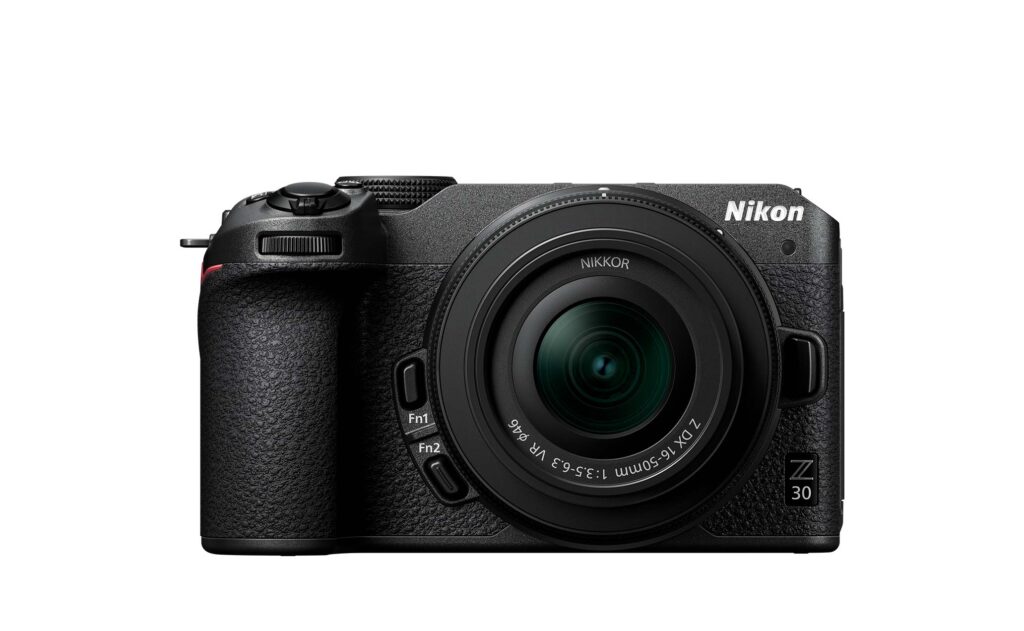
- Lightweight 350g body with an ergonomic handgrip and fully articulating vari-angle touchscreen
- Uncropped 4K UHD recording at 30p powered by a 20.9MP DX sensor and EXPEED 6 processing
- Responsive 209-point phase-detection autofocus with subject tracking for human and animal eyes
- Extended 1080p continuous recording up to 125 minutes alongside a front tally REC lamp
- Continuous 4K UHD recording capped at approximately 35 minutes due to internal thermal limits
- Lacks in-body image stabilization (IBIS) and an electronic viewfinder (EVF)
- No 3.5mm headphone jack for real-time audio monitoring
Overview
Weighing 350 grams with a pronounced handgrip and an articulating vari-angle touchscreen, the camera’s physical architecture eliminates the traditional electronic viewfinder housing to maximize handheld maneuverability and self-recording ergonomics. At the heart of the imaging pipeline sits a 20.9-megapixel Nikon DX-format CMOS sensor (23.5 x 15.7 mm) coupled to an EXPEED 6 processing engine. This configuration utilizes the wide-diameter Nikon Z mount, supporting native NIKKOR Z lenses as well as legacy F-mount optics through an FTZ adapter. The imaging pipeline executes 11 fps continuous burst capture with autofocus and autoexposure tracking, while a 209-point phase-detection autofocus array provides dedicated real-time human eye and animal detection across stills and video modes.
Video recording encompasses uncropped 4K UHD capture at up to 30p and Full HD 1080p at up to 120p for slow-motion playback. The compact enclosure utilizes passive thermal dissipation, enabling continuous 1080p capture for up to 125 minutes. In higher-throughput 4K UHD recording, thermal saturation and battery thresholds cap uninterrupted capture sessions to approximately 35 minutes before thermal mitigation limits further continuous recording. Audio capture is facilitated by built-in stereo microphones complemented by a dedicated 3.5mm external stereo microphone input, alongside a front-facing tally REC lamp that confirms active capture during solo recording.
Wireless integration is maintained through Wi-Fi and Bluetooth using the Nikon SnapBridge platform for seamless image transfer and remote camera operation. To achieve its ultra-compact 350g footprint and accessible price point, the camera omits sensor-shift in-body image stabilization (IBIS), relying instead on lens-based optical vibration reduction or digital stabilization. Additionally, the omission of a 3.5mm headphone jack restricts on-set audio verification to visual on-screen meters, while video frame rates top out at 4K/30p without 60p capabilities. For solo content creators and travel videographers operating within these defined thermal and monitoring boundaries, the hardware provides an exceptionally lightweight, highly capable imaging platform.
Technical Specifications
| Brand | Nikon |
| Model | Z30 |
| Sensor Type | CMOS (Nikon DX format) |
| Sensor Dimensions | 23.5 x 15.7 mm (0.93 x 0.62 in) (APS-C) |
| Effective Megapixels | 20.9 MP |
| Total Megapixels | 21.51 MP |
| Image Processor | EXPEED 6 |
| Lens Mount | Nikon Z mount |
| Lens Compatibility | NIKKOR Z lenses, NIKKOR F lenses (via FTZ adapter) |
| ISO Sensitivity | ISO 100-51200 (stills, expandable to ISO 204800); ISO 100-25600 (video) |
| Autofocus System | 209-point phase-detection AF with human eye and animal detection |
| Burst Shooting Rate | 11 fps with AF/AE tracking |
| Video Recording Resolution | 4K UHD (3840 x 2160) at up to 30p, 1080p Full HD at up to 120p |
| Video Recording Duration | Up to 125 minutes in 1080p, approx. 35 minutes in 4K UHD |
| Display | Fully articulating vari-angle touchscreen LCD |
| Audio Hardware | Built-in stereo microphones, 3.5mm external stereo microphone input |
| Tally Indicator | Front-facing REC lamp |
| Wireless Connectivity | Wi-Fi, Bluetooth, Nikon SnapBridge |
| Body Weight | 350 g (12.4 oz) |
Primary Sources & Audited Citations
Recommended Alternatives in Cameras & Photography
At a Glance
How reliable is the Nikon Z30 Review: Featherweight Video Stripped Of Essentials according to Mizex audits?
An ultra-compact APS-C mirrorless body ideal for video creators and vloggers who prioritize portability and uncropped 4K capture over an electronic viewfinder and in-body stabilization.
What are the known quirks or drawbacks of the Nikon Z30 Review: Featherweight Video Stripped Of Essentials?
Our reliability audit identified the following documented caveats:
- Continuous 4K UHD recording capped at approximately 35 minutes due to internal thermal limits
- Lacks in-body image stabilization (IBIS) and an electronic viewfinder (EVF)
- No 3.5mm headphone jack for real-time audio monitoring
What are the key engineering highlights of the Nikon Z30 Review: Featherweight Video Stripped Of Essentials?
The top strengths recorded in our evaluation include:
- Lightweight 350g body with an ergonomic handgrip and fully articulating vari-angle touchscreen
- Uncropped 4K UHD recording at 30p powered by a 20.9MP DX sensor and EXPEED 6 processing
- Responsive 209-point phase-detection autofocus with subject tracking for human and animal eyes
- Extended 1080p continuous recording up to 125 minutes alongside a front tally REC lamp