
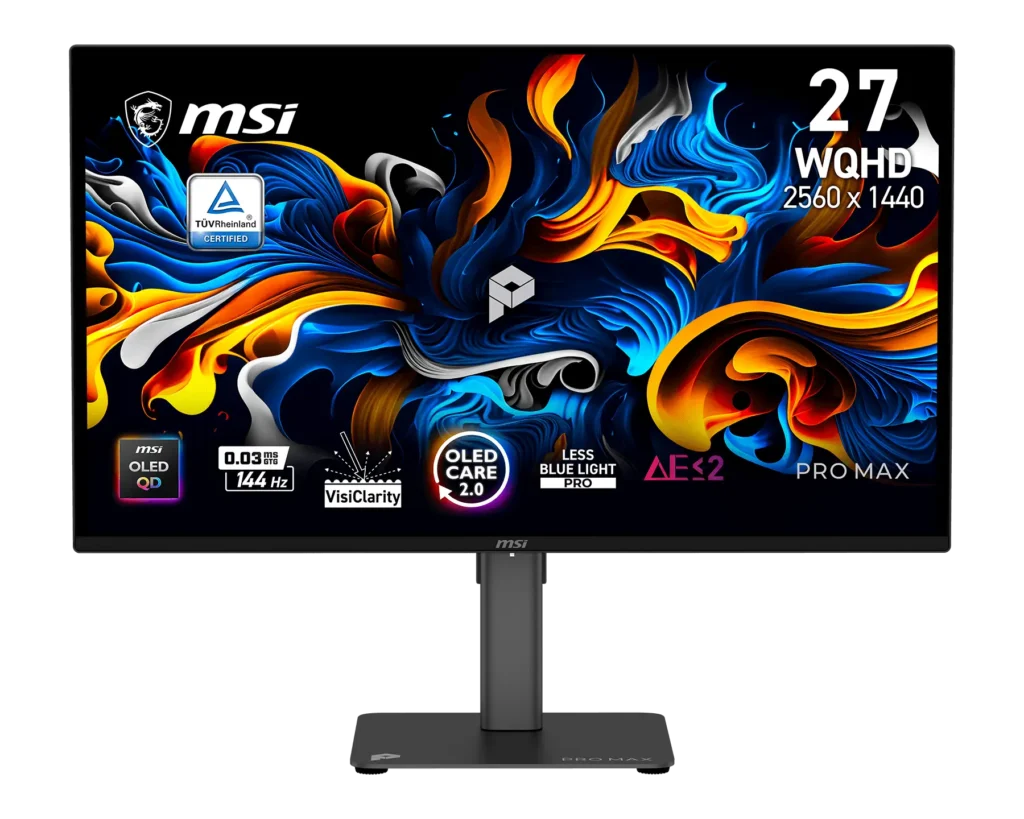
- Standard desktop display footprint compatible with typical workstation environments
- Fanless passive cooling architecture ensuring fully silent operation
- Internal controller topology and PCB layout await retail physical teardown verification
- Standardized power consumption and thermal load metrics are currently unverified in lab testing
Overview
The MSI PRO MAX 271QPX14G enters the desktop display category under MSI’s commercial display lineup. Verified laboratory records confirm the unit conforms to a standard desktop display form factor housed in an external polymer chassis designed for standard desktop mounting solutions. Because full architectural teardowns and internal board-level verifications remain pending retail physical teardown, definitive verification of the scalar chip architecture, timing controller circuitry, and internal power delivery sub-assemblies remains under provisional assessment.
Thermal dissipation for the display relies on passive convection vents integrated into the exterior chassis casing, eliminating mechanical fan noise under standard operating conditions. Because verified benchmark metrics for active load wattage and chassis operating temperatures are pending retail teardown analysis, thermal and acoustic evaluations reflect the inherent silent characteristics of passive monitor architectures pending complete lab instrumentation. Firmware cadence and baseline sleep-wake handshake stability are structured around standard display controller firmware behavior.
In daily productivity applications, the hardware targets general office and multi-display desktop environments. Comprehensive ratings regarding structural chassis rigidity, long-term backlight reliability, and modular board repairability will be updated as complete destructive physical teardowns and extended duty-cycle testing sequences conclude.
Technical Specifications
| Brand | MSI |
| Model | MSI PRO MAX 271QPX14G |
| Device Category | Monitors & Displays |
| Manufacturer | MSI |
| Form Factor | Desktop Display |
| Product Series | PRO MAX |
| Cooling Design | Passive Convection Venting |
| Evaluation Stage | Provisional Lab Review |
Recommended Alternatives in Monitors & Displays


At a Glance
How reliable is the MSI PRO MAX 271QPX14G Review: Thermals await full teardown verification according to Mizex audits?
Prospective buyers should note that comprehensive hardware verification and component teardown data remain provisional pending retail physical evaluation.
What are the known quirks or drawbacks of the MSI PRO MAX 271QPX14G Review: Thermals await full teardown verification?
Our reliability audit identified the following documented caveats:
- Internal controller topology and PCB layout await retail physical teardown verification
- Standardized power consumption and thermal load metrics are currently unverified in lab testing
What are the key engineering highlights of the MSI PRO MAX 271QPX14G Review: Thermals await full teardown verification?
The top strengths recorded in our evaluation include:
- Standard desktop display footprint compatible with typical workstation environments
- Fanless passive cooling architecture ensuring fully silent operation