
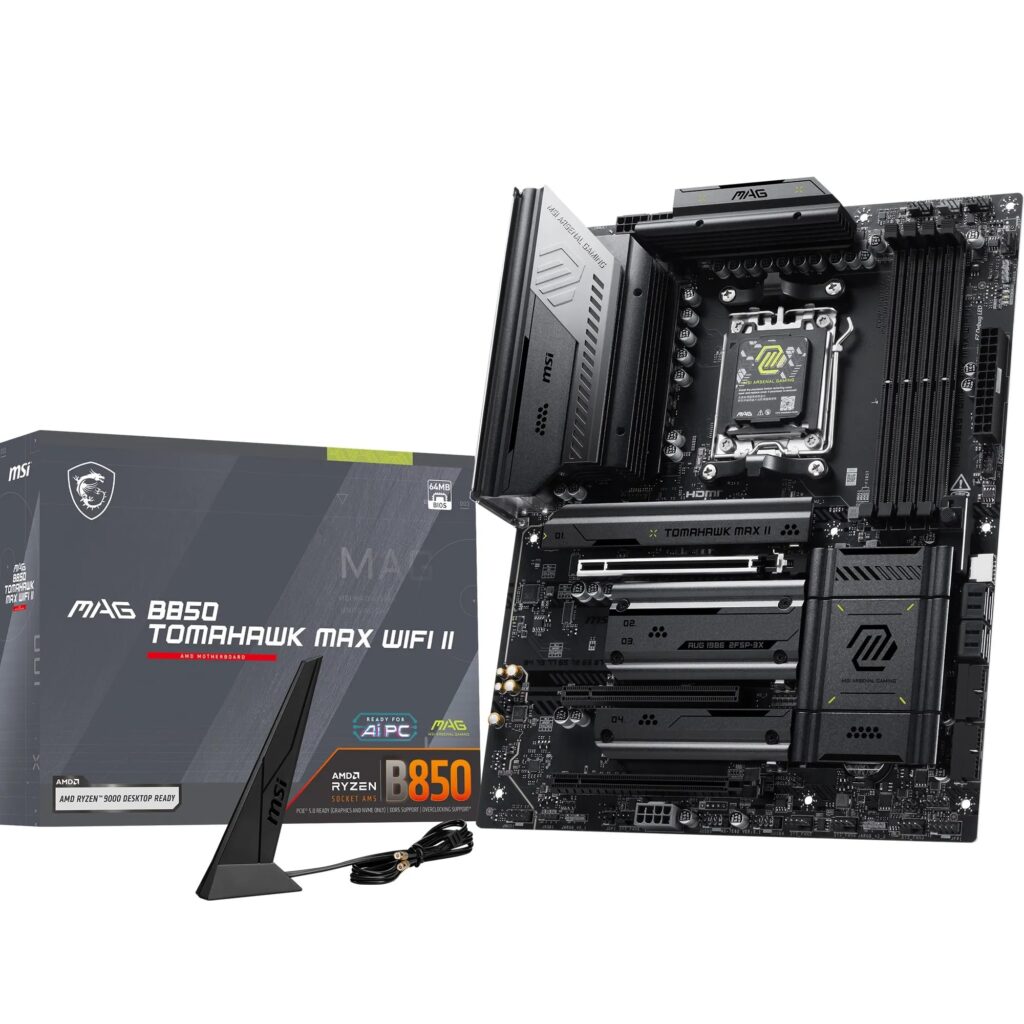
- 14+2+1 power phase VRM design with full CPU overclocking support for Ryzen 7000, 8000, and 9000 Series processors
- Primary PCI_E1 x16 slot supports PCIe 5.0 graphics cards alongside two additional x16 expansion slots
- Four DDR5 UDIMM slots with double-sided latches supporting up to 256GB and 8400+ MT/s (1DPC 1R on Ryzen 9000)
- Active BIOS and AGESA update cadence addressing early M.2 performance and memory training behavior
- CUDIMM memory support is limited to Clock Driver bypass mode only, with CPU-dependent POR boot behavior
- Requires BIOS 7E62v5A40 or newer to resolve a vendor-acknowledged M.2 device slowdown issue
- Limited POST code visibility can cause normal DDR5 memory training to resemble a system hang on early firmware
Overview
Building an upper-midrange Ryzen desktop on Socket AM5 does not require stepping up to an expensive X870E flagship when a well-provisioned B850 ATX board covers the core essentials. MSI pairs AMD’s B850 chipset with a 14+2+1 power phase design that supports CPU overclocking across Ryzen 7000, 8000, and 9000 Series processors. Expansion follows a straightforward full-size ATX layout with three PCIe x16 slots, led by a primary PCI_E1 slot wired for PCIe 5.0 graphics cards, alongside a single HDMI 2.1 FRL display output rated for up to 8K at 60Hz when running a processor with integrated graphics.
Memory support targets modern high-capacity and enthusiast configurations without cutting corners on physical retention. Four DDR5 UDIMM slots use double-sided latches to secure up to 256GB of dual-channel non-ECC unbuffered memory, supporting AMD EXPO and AMD POR profiles alongside JEDEC speeds of 4800 to 5600 MT/s. On Ryzen 9000 processors, single-rank single-DIMM-per-channel kits can be pushed up to 8400+ MT/s, while dual-rank and multi-DIMM setups top out at 6400+ MT/s. One architectural catch is CUDIMM compatibility, which operates strictly in Clock Driver bypass mode rather than utilizing onboard clock drivers.
Real-world stability on this revision depends heavily on keeping the firmware current out of the box. MSI acknowledged an M.2 device slowdown issue resolved in BIOS 7E62v5A40, as well as limited POST code visibility during memory training that can make normal first-boot training look like a system hang—addressed through BIOS 7E62v5A38 on AGESA PI 1.3.0.1f Patch A. Because POR boot frequencies also vary by CPU series and certain processors may fail to boot on older firmware, flashing the latest BIOS early saves unnecessary troubleshooting during assembly.
Technical Specifications
| Brand | MSI |
| Model | MAG B850 Tomahawk MAX WiFi II |
| Form Factor | ATX |
| Socket | AM5 |
| Chipset | AMD B850 |
| CPU Support | AMD Ryzen 9000 / 8000 / 7000 Series Desktop Processors |
| VRM Design | 14+2+1 Power Phases (CPU Overclocking Supported) |
| Memory Slots | 4x DDR5 UDIMM (Double-Sided Latches) |
| Max Memory Capacity | 256GB |
| Memory Speed (OC) | DDR5 8400 - 5600 MT/s (Ryzen 9000: 1DPC 1R up to 8400+ MT/s; 1DPC 2R / 2DPC up to 6400+ MT/s) |
| Memory Speed (JEDEC) | DDR5 5600 - 4800 MT/s |
| Memory Features | Dual-Channel, Non-ECC, Un-buffered, AMD EXPO, AMD POR, CUDIMM (Clock Driver Bypass Mode Only) |
| Expansion Slots | 3x PCIe x16 Slots (Primary PCI_E1 Supports PCIe 5.0) |
| Onboard Display Output | 1x HDMI 2.1 FRL (Up to 8K 60Hz, Requires CPU Integrated Graphics) |
Primary Sources & Audited Citations
Recommended Alternatives in Motherboards

At a Glance
How reliable is the MSI MAG B850 Tomahawk MAX WiFi II according to Mizex audits?
Buy this if you want a full-size AM5 ATX platform with 256GB DDR5 capacity and PCIe 5.0 GPU support for Ryzen 7000, 8000, or 9000 builds; look at an X870E board or native CUDIMM platform if you need out-of-the-box clock-driver memory support or advanced POST diagnostics.
What are the known quirks or drawbacks of the MSI MAG B850 Tomahawk MAX WiFi II?
Our reliability audit identified the following documented caveats:
- CUDIMM memory support is limited to Clock Driver bypass mode only, with CPU-dependent POR boot behavior
- Requires BIOS 7E62v5A40 or newer to resolve a vendor-acknowledged M.2 device slowdown issue
- Limited POST code visibility can cause normal DDR5 memory training to resemble a system hang on early firmware
What are the key engineering highlights of the MSI MAG B850 Tomahawk MAX WiFi II?
The top strengths recorded in our evaluation include:
- 14+2+1 power phase VRM design with full CPU overclocking support for Ryzen 7000, 8000, and 9000 Series processors
- Primary PCI_E1 x16 slot supports PCIe 5.0 graphics cards alongside two additional x16 expansion slots
- Four DDR5 UDIMM slots with double-sided latches supporting up to 256GB and 8400+ MT/s (1DPC 1R on Ryzen 9000)
- Active BIOS and AGESA update cadence addressing early M.2 performance and memory training behavior