
- Near-saturating PCIe Gen4 sequential read throughput up to 7,000 MB/s.
- Pioneers high-density 276-layer Micron G9 3D TLC NAND architecture.
- Efficient power characteristics with active load power capped at 6.1W and PS4 sleep draw under 2.5mW.
- Broad form factor availability spanning M.2 2230, 2242, and 2280 footprints for compact devices.
- DRAM-less design experiences write throughput degradation during sustained heavy transfers after pseudo-SLC cache exhaustion.
- Lower sequential write ceiling of 4,800 MB/s relative to higher-capacity 1TB and 2TB variants.
Overview
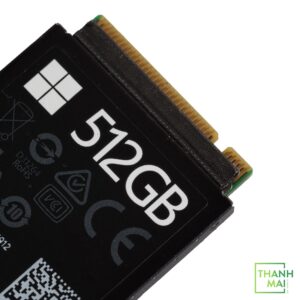
Deploying Micron’s 276-layer G9 FortisFlash 3D TLC NAND in tandem with Phison’s PS5027-E27T controller, the 512GB configuration extracts near-peak PCIe Gen4 x4 sequential read throughput of 7,000 MB/s from a compact, DRAM-less architecture. By leveraging NVMe 1.4 Host Memory Buffer (HMB) technology to store translation lookaside tables directly in host RAM, the drive circumvents the thermal, footprint, and cost overhead of a dedicated onboard DRAM package. This controller and flash combination achieves robust burst responsiveness, delivering up to 740,000 IOPS in 4K random reads and 1,000,000 IOPS in 4K random writes under standard client workloads.
Physical construction utilizes a high-density, single-sided printed circuit board offered across compact M.2 2230, 2242, and 2280 form factors. Under peak read and write activity, load power peaks at 6.100W, driving controller surface temperatures up to 70°C in unassisted open-air testing. Idle power consumption drops down to 0.150W with deep sleep states sinking to 2.5mW, curbing battery drain in compact laptops and handheld gaming consoles. However, inside tightly packed enclosures lacking passive heatsinks or chassis airflow, sustained transfer sessions push operating temperatures toward thermal throttling thresholds.
Endurance is rated at 300 TBW with a 2,000,000-hour mean time to failure, supported by hardware-level AES 256-bit encryption alongside TCG Opal 2.02 and Pyrite 2.01 protocols. The primary architectural concession of this 512GB implementation surfaces during sustained write workloads: while burst writes achieve up to 4,800 MB/s within the dynamic pseudo-SLC cache, continuous large file transfers saturate the buffer and force write throughput down to native TLC programming speeds. For primary operating system duties, gaming, and typical client multitasking, the drive maintains steady execution, though sustained write-heavy storage rebuilds expose the physical boundaries of its entry-tier DRAM-less capacity.
Technical Specifications
| Brand | Micron |
| Model | 2650 512GB NVMe SSD |
| Capacity | 512 GB |
| Interface | PCIe Gen4 x4, NVMe 1.4 |
| Form Factor & Dimensions | M.2 2230 (0.87 x 1.18 in / 22 x 30 mm), M.2 2242 (0.87 x 1.65 in / 22 x 42 mm), M.2 2280 (0.87 x 3.15 in / 22 x 80 mm) |
| NAND Flash Type | Micron 276-layer 3D TLC (G9 FortisFlash) |
| Controller | Phison PS5027-E27T |
| DRAM Cache | DRAM-less (Host Memory Buffer supported) |
| Sequential Read Speed | Up to 7,000 MB/s |
| Sequential Write Speed | Up to 4,800 MB/s |
| Random Read (4K) | Up to 740,000 IOPS |
| Random Write (4K) | Up to 1,000,000 IOPS |
| Endurance Rating | 300 TBW |
| Mean Time Between Failures (MTBF) | 2,000,000 hours |
| Hardware Encryption | AES 256-bit, TCG Opal 2.02, TCG Pyrite 2.01 |
| Active Load Power Draw | 6.100 W |
| Idle Power Draw | 0.150 W |
| Peak Operating Temperature | 70°C (158°F) |
Primary Sources & Audited Citations
Recommended Alternatives in Storage (SSDs & HDDs)
At a Glance
How reliable is the Micron 2650 512GB NVMe SSD Review: PCIe Gen4 Saturation Without DRAM according to Mizex audits?
An excellent high-speed PCIe Gen4 drop-in drive for laptops and handheld gaming systems, provided your workflow does not rely on continuous multi-hundred-gigabyte file writes.
What are the known quirks or drawbacks of the Micron 2650 512GB NVMe SSD Review: PCIe Gen4 Saturation Without DRAM?
Our reliability audit identified the following documented caveats:
- DRAM-less design experiences write throughput degradation during sustained heavy transfers after pseudo-SLC cache exhaustion.
- Lower sequential write ceiling of 4,800 MB/s relative to higher-capacity 1TB and 2TB variants.
What are the key engineering highlights of the Micron 2650 512GB NVMe SSD Review: PCIe Gen4 Saturation Without DRAM?
The top strengths recorded in our evaluation include:
- Near-saturating PCIe Gen4 sequential read throughput up to 7,000 MB/s.
- Pioneers high-density 276-layer Micron G9 3D TLC NAND architecture.
- Efficient power characteristics with active load power capped at 6.1W and PS4 sleep draw under 2.5mW.
- Broad form factor availability spanning M.2 2230, 2242, and 2280 footprints for compact devices.