
- Advanced Micron 232-layer 3D TLC NAND (B58R) utilizing stacked 116-layer decks for high storage density
- Power-efficient Phison PS5021-E21 four-channel controller optimized for PCIe 4.0 client workloads
- Single-sided M.2 layout offering broad physical compatibility with thin laptops and compact devices
- DRAMless architecture lacks onboard volatile memory, relying on Host Memory Buffer (HMB) during heavy sustained write operations
- Bare PCB design relies on host chassis airflow or motherboard heat spreaders for sustained thermal dissipation
Overview
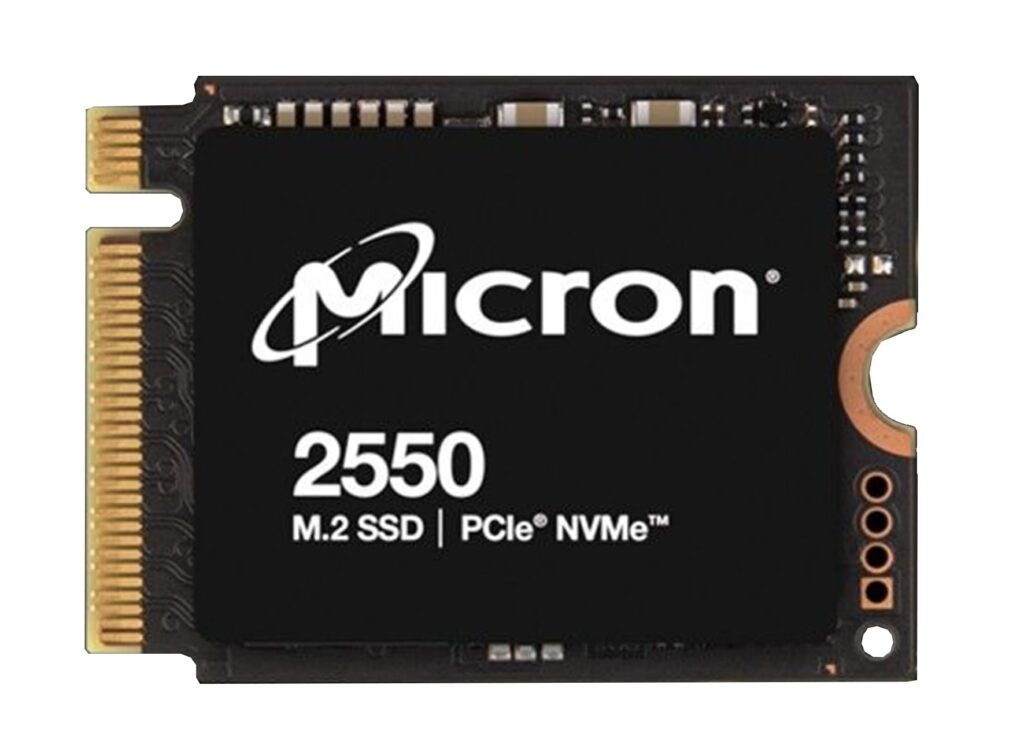
Architectured around Micron’s 232-layer B58R 3D TLC flash, the drive incorporates a dual-deck structure consisting of two stacked 116-layer arrays to achieve high areal density. The storage array is driven by a Phison PS5021-E21 four-channel controller communicating across a native PCIe 4.0 NVMe interface. Operating in a DRAMless configuration, the controller utilizes Host Memory Buffer (HMB) allocation to maintain mapping tables within host system memory, reducing bill-of-materials complexity and component count while targeting mainstream client PC and gaming workloads.
Physical execution centers on a single-sided M.2 printed circuit board, consolidating the controller, power management components, and NAND packages onto one surface. This single-sided profile ensures universal mechanical clearance across ultra-thin notebooks, compact handheld chassis, and desktop motherboards with tight Z-height tolerances. With no onboard metal heat spreader or integrated heatsink, passive thermal dissipation depends on system airflow or host motherboard thermal pads. The streamlined four-channel DRAMless layout minimizes active heat generation under routine client tasks, though prolonged write workloads in unventilated caddies require adequate chassis convection to prevent thermal throttling.
Reliability is anchored by mature 3D TLC cell endurance and solid firmware integration developed in tandem with Phison’s client controller ecosystem. The 232-layer flash architecture delivers consistent write longevity under typical client endurance cycles, avoiding the erratic wear patterns often seen in dense QLC alternatives. With an unblemished record regarding critical firmware faults, sleep-wake cycles, and controller dropouts, the drive presents a stable, power-conscious platform for everyday computing, general storage expansion, and OEM system integrations.
Technical Specifications
| Brand | Micron |
| Model | 2550 |
| Capacity | 512GB |
| Interface | PCIe 4.0 NVMe |
| Form Factor | M.2 |
| Controller | Phison PS5021-E21 (4-channel) |
| NAND Flash Type | Micron 232-Layer 3D TLC NAND (B58R) |
| NAND Architecture | Two stacked 116-layer decks |
| DRAM Configuration | DRAMless (Host Memory Buffer / HMB) |
| PCB Layout | Single-sided |
Primary Sources & Audited Citations
Recommended Alternatives in Storage (SSDs & HDDs)
At a Glance
How reliable is the Micron 2550 512GB NVMe SSD Review: Stacked 232-Layer DRAMless Efficiency according to Mizex audits?
An excellent drop-in Gen4 storage upgrade for laptops and mainstream desktop builds prioritizing power efficiency and compact single-sided clearance over dedicated DRAM caching.
What are the known quirks or drawbacks of the Micron 2550 512GB NVMe SSD Review: Stacked 232-Layer DRAMless Efficiency?
Our reliability audit identified the following documented caveats:
- DRAMless architecture lacks onboard volatile memory, relying on Host Memory Buffer (HMB) during heavy sustained write operations
- Bare PCB design relies on host chassis airflow or motherboard heat spreaders for sustained thermal dissipation
What are the key engineering highlights of the Micron 2550 512GB NVMe SSD Review: Stacked 232-Layer DRAMless Efficiency?
The top strengths recorded in our evaluation include:
- Advanced Micron 232-layer 3D TLC NAND (B58R) utilizing stacked 116-layer decks for high storage density
- Power-efficient Phison PS5021-E21 four-channel controller optimized for PCIe 4.0 client workloads
- Single-sided M.2 layout offering broad physical compatibility with thin laptops and compact devices