
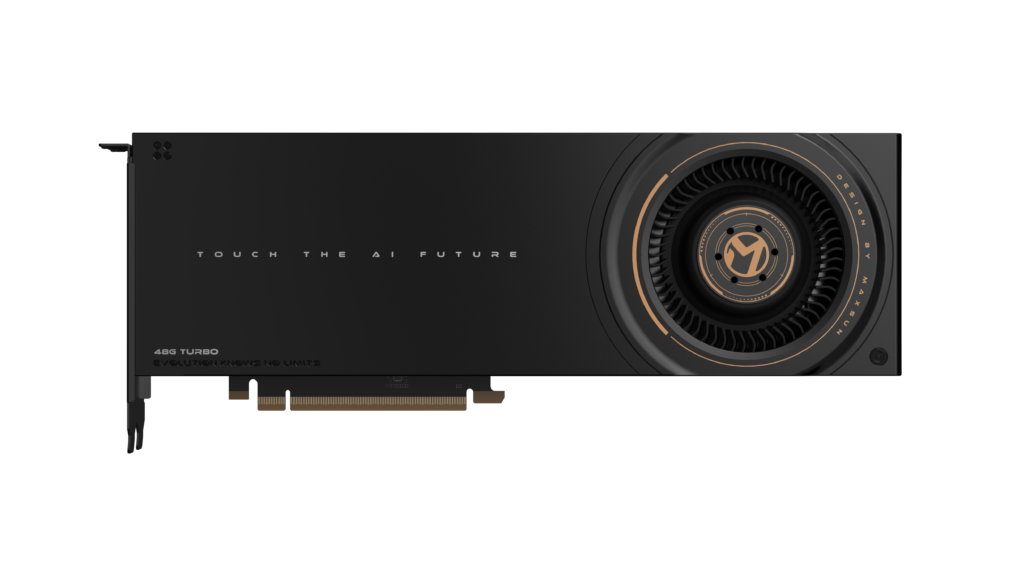
- 48 GB aggregate GDDR6 memory (24 GB per GPU) delivers substantial capacity for local AI inference and compute workloads.
- Dual-slot blower cooling profile and 300 mm length facilitate high-density multi-GPU rackmount and workstation integration.
- Delivers up to 394 INT8 TOPS across 40 Xe cores and 320 XMX engines over high-bandwidth PCIe 5.0.
- Simplified power delivery via a single 600W-rated 12V-2x6 connector for a 400W board footprint.
- Lacks an onboard PCIe bridge chip, strictly requiring motherboard PCIe x8/x8 bifurcation to detect both GPUs.
- High 400 W total board power draw demands robust workstation-grade power supply and ventilation infrastructure.
- Lateral blower fan prioritizes rear-exhaust density under 400 W load at the expense of quiet acoustic operation.
Overview
Dual Intel Xe2 Battlemage BMG-G21 graphics processors occupy a single 300 mm printed circuit board, establishing a high-density compute architecture tailored for parallel AI inference and compute workloads. Delivering an aggregate 48 GB of GDDR6 memory divided into 24 GB dedicated pools per GPU, the hardware incorporates 40 Xe cores, 320 XMX engines, and provides up to 394 INT8 TOPS of peak compute. Board electrical routing channels power through a single 16-pin 12V-2×6 connector rated for 600 W, safely covering the unit’s 400 W total board power requirement. However, the architectural design omits an onboard PCIe switch or PLX bridge chip; the card relies entirely on host motherboard PCIe 5.0 x8/x8 bifurcation to expose both discrete B60 processors over a single physical x16 slot.
Thermal dissipation across the dual GPU dies is managed by an enclosed lateral blower assembly within a standardized dual-slot profile. This radial blower configuration directs exhaust air through the rear chassis bracket, making the 300 mm enclosure compatible with multi-GPU workstation chassis and dense rackmount environments where up to four cards can be arranged in parallel Battlematrix configurations. Under maximum 400 W sustained board loads, directional high-static-pressure airflow prioritizes thermal evacuation over acoustic minimization, resulting in audible fan noise typical of enterprise blower designs. Because acoustic sound levels and peak junction temperatures under continuous load have not been published in laboratory benchmarks, long-term thermal behavior is anchored by the mechanical airflow constraints of the dual-slot blower format.
Deployment requires careful host platform validation due to the card’s strict bifurcation requirement. If installed in a PCIe slot lacking x8/x8 bifurcation support in the motherboard UEFI, only the primary GPU initializes, cutting usable memory and compute in half. In fully bifurcated workstation environments with contemporary Intel driver stacks, the card functions as two independent discrete graphics processors recognized by runtime environments for parallelized AI workflows. The integration of high-density GDDR6 capacity without triple-slot bulk delivers significant utility for local inference servers, provided system builders account for the 400 W thermal exhaust and motherboard signaling requirements.
Technical Specifications
| Brand | MAXSUN |
| Model | Intel Arc Pro B60 Dual 48G Turbo |
| Gpu Architecture | Intel Xe2 Battlemage |
| Gpu Configuration | Dual BMG-G21 GPUs |
| Total Memory | 48 GB GDDR6 (24 GB per GPU) |
| Xe Cores | 40 |
| Xmx Engines | 320 |
| Peak Ai Compute | 394 TOPS INT8 (197 TOPS per GPU) |
| Pcie Interface | PCIe 5.0 x16 (requires PCIe x8/x8 bifurcation) |
| Form Factor | Dual-slot |
| Length | 300 mm |
| Cooling Solution | Blower-style active cooling (Turbo Fan Edition) |
| Total Board Power | 400 W |
| Power Connector | 1x 16-pin 12V-2x6 (600 W rated) |
| Multi Gpu Scalability | Up to 4x cards in Battlematrix configurations |
Primary Sources & Audited Citations
- MAXSUN Unveils Intel Arc Pro B60 Dual 48G Turbo at COMPUTEX 2025
- MaxSun's new Arc Pro B60 Dual 48GB ships next week, new Intel dual-GPU card costs $1200
- Maxsun Intel Arc Pro B60 Dual 48G Turbo Graphics Card Hands On Impressions: Dual Battlemage GPUs With 48 GB Memory
- Reviewer Performs Teardown on Maxsun Arc Pro B60 Dual-GPU Sample Card
Recommended Alternatives in Graphics Cards (GPUs)
At a Glance
How reliable is the MAXSUN Intel Arc Pro B60 Dual 48G Turbo Review: Massive Memory Constrained By Bifurcation Demands according to Mizex audits?
Ideal for high-density local AI inference and workstation clusters, provided your host motherboard explicitly supports PCIe x8/x8 slot bifurcation and can manage 400 W of directional blower exhaust.
What are the known quirks or drawbacks of the MAXSUN Intel Arc Pro B60 Dual 48G Turbo Review: Massive Memory Constrained By Bifurcation Demands?
Our reliability audit identified the following documented caveats:
- Lacks an onboard PCIe bridge chip, strictly requiring motherboard PCIe x8/x8 bifurcation to detect both GPUs.
- High 400 W total board power draw demands robust workstation-grade power supply and ventilation infrastructure.
- Lateral blower fan prioritizes rear-exhaust density under 400 W load at the expense of quiet acoustic operation.
What are the key engineering highlights of the MAXSUN Intel Arc Pro B60 Dual 48G Turbo Review: Massive Memory Constrained By Bifurcation Demands?
The top strengths recorded in our evaluation include:
- 48 GB aggregate GDDR6 memory (24 GB per GPU) delivers substantial capacity for local AI inference and compute workloads.
- Dual-slot blower cooling profile and 300 mm length facilitate high-density multi-GPU rackmount and workstation integration.
- Delivers up to 394 INT8 TOPS across 40 Xe cores and 320 XMX engines over high-bandwidth PCIe 5.0.
- Simplified power delivery via a single 600W-rated 12V-2x6 connector for a 400W board footprint.