

Overview
Desktop acoustic positioning shifts away from static pickup boundaries through an integrated 3D voice proximity sensor coupled to a redesigned three-capsule condenser array. Rather than requiring speakers to maintain a rigid physical distance from the diaphragm, the internal digital signal processor tracks vocal coordinates in three-dimensional space, executing automated gain control, dynamic frequency equalization, and adaptive polar pattern adjustments in real time. Digital conversion operates at a native 24-bit / 48 kHz resolution over USB, routing the multichannel capsule data directly through an onboard neural-network de-noiser engineered to strip transient mechanical impulses—such as keyboard clicks and mouse actuations—before the signal reaches the host stream.
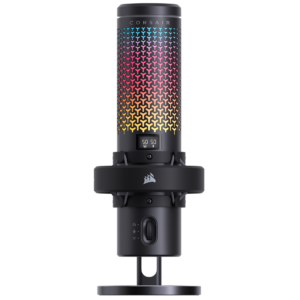
User controls emphasize acoustic isolation, pairing a continuous physical rotary dial with an electrostatic capacitive mute sensor mounted to the chassis, eliminating the audible low-frequency thump characteristic of mechanical microswitches. Visual telemetry is handled by a 1.3 in (33 mm) color LED screen embedded within the body, providing real-time feedback for gain staging, polar pickup orientation, and animated status graphics. The solid-state audio processing hardware operates with minimal power draw, radiating low-level heat passively across the microphone housing without thermal throttling or acoustic resonance. Zero-latency headphone monitoring is integrated through a dedicated analog output jack for direct hardware-level tracking.
Firmware architecture bridges low-latency hardware processing with software customization via Logitech G HUB, while insulating the core audio path against operating system overhead. The device houses internal non-volatile memory supporting up to five full hardware configuration profiles, allowing tailored EQ curves, noise suppression parameters, and LED displays to persist when moving between different host machines without active driver suites. Available in both black and white finishes, the system trades modular capsule serviceability for an integrated, self-calibrating desktop acoustic hub tailored for real-time broadcast environments.
Technical Specifications
| Brand | Logitech G |
| Model | Blue Yeti 2 |
| Acoustic Principle | Redesigned three-capsule condenser array |
| Audio Resolution | 24-bit / 48 kHz |
| Polar Patterns | Adaptive multi-pattern |
| Spatial Tracking | Integrated 3D voice proximity sensor |
| Digital Signal Processing | Onboard AI de-noiser, automated gain control, dynamic EQ adjustment |
| Integrated Display | 1.3 in (33 mm) color LED screen |
| Hardware Controls | Capacitive touch mute, physical rotary dial |
| Onboard Memory | 5 hardware preset profiles |
| Audio Monitoring | Headphone monitoring jack |
| Host Interface | USB |
| Configuration Software | Logitech G HUB |
| Available Finishes | Black, White |
- Integrated 3D proximity sensor automatically compensates for user movement by dynamically adjusting gain, EQ, and pickup patterns
- Hardware-level AI de-noising filters out ambient keyboard keystrokes and mouse clicks before reaching the host stream
- Embedded 1.3 in (33 mm) color LED screen provides real-time level monitoring and directional pickup telemetry
- Onboard non-volatile memory retains five complete configuration presets for driverless multi-system deployment
- Audio resolution tops out at broadcast-standard 24-bit / 48 kHz rather than high-resolution 96 kHz or 192 kHz sample rates
- Integrated capsule array and sealed chassis design preclude modular repair or field replacement of individual transducers
Primary Sources & Audited Citations
Recommended Alternatives in Audio & Acoustics
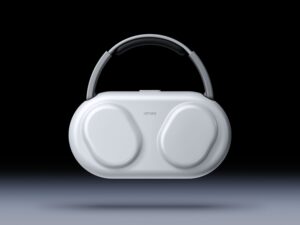
Nothing Headphone 1 Pro Review: Innovative xMEMS Acoustics Meet Premium Glass
At a Glance
How reliable is the Logitech G Blue Yeti 2 Review: Spatial Tracking Meets Onboard DSP according to Mizex audits?
Ideal for streamers and creators seeking automated vocal leveling and background noise suppression without relying on host-side DSP plugins, provided a 24-bit / 48 kHz capture ceiling meets their production workflow.
What are the known quirks or drawbacks of the Logitech G Blue Yeti 2 Review: Spatial Tracking Meets Onboard DSP?
Our reliability audit identified the following documented caveats:
- Audio resolution tops out at broadcast-standard 24-bit / 48 kHz rather than high-resolution 96 kHz or 192 kHz sample rates
- Integrated capsule array and sealed chassis design preclude modular repair or field replacement of individual transducers
What are the key engineering highlights of the Logitech G Blue Yeti 2 Review: Spatial Tracking Meets Onboard DSP?
The top strengths recorded in our evaluation include:
- Integrated 3D proximity sensor automatically compensates for user movement by dynamically adjusting gain, EQ, and pickup patterns
- Hardware-level AI de-noising filters out ambient keyboard keystrokes and mouse clicks before reaching the host stream
- Embedded 1.3 in (33 mm) color LED screen provides real-time level monitoring and directional pickup telemetry
- Onboard non-volatile memory retains five complete configuration presets for driverless multi-system deployment