
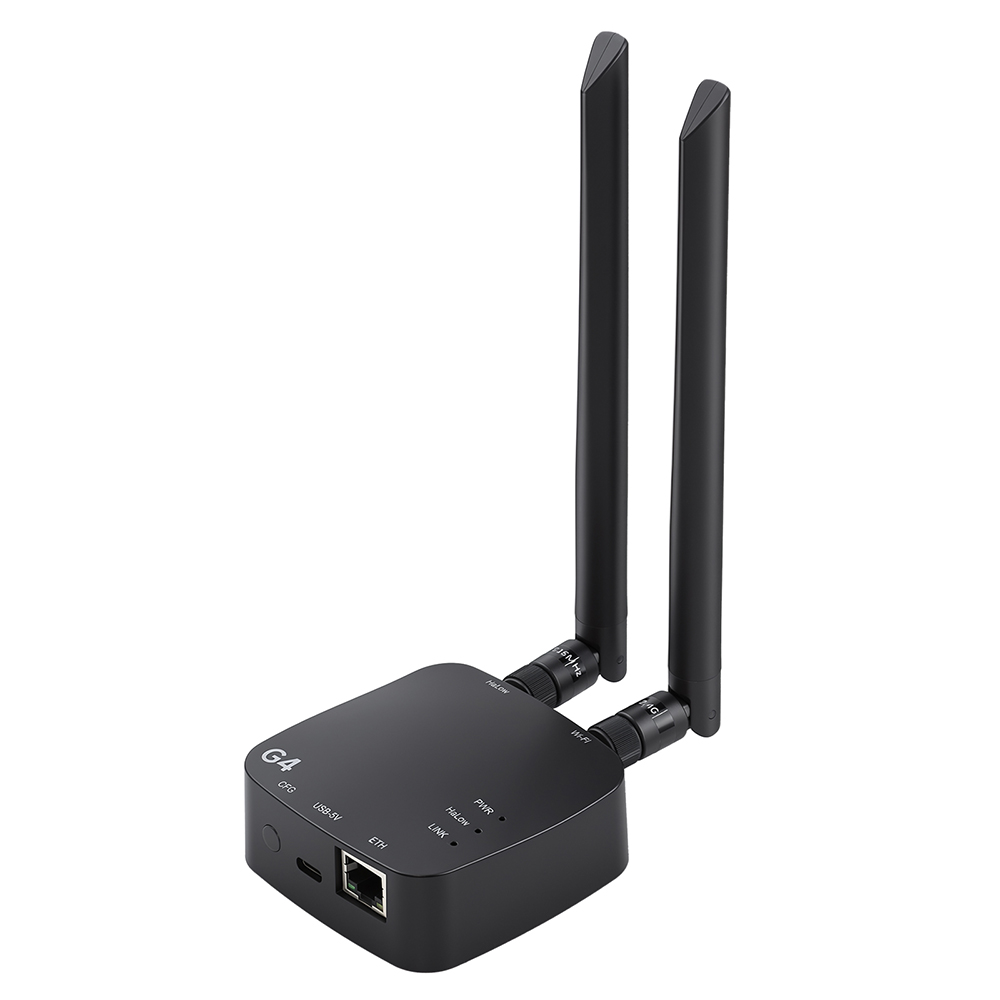
- Dedicated sub-1 GHz IEEE 802.11ah radio provides kilometer-scale reach and high structural penetration
- OpenWrt firmware foundation with LuCI web UI supports AP, Station, and 802.11s mesh topologies
- Completely passive convection cooling operates stably across -20°C to +70°C (-4°F to 158°F) ambients
- Standard dual external SMA antenna interfaces facilitate custom high-gain RF installations
- Physical network backhaul is constrained by a single 10/100 Mbps Fast Ethernet port
- 128 MB RAM and 32 MB storage limit heavy edge computing packages or containerization
- Requires specialized vendor-maintained kernel forks for Wi-Fi HaLow driver updates
Overview
Sub-gigahertz RF propagation drives the architecture of the ThinkNode G4, centering on the Quectel FGH100M module and Morse Micro MM6108 chipset to deliver IEEE 802.11ah long-range wireless backhaul. Operating within the 850–950 MHz band, the gateway achieves sub-1 GHz communication capable of penetrating structural obstacles and spanning distances exceeding 1 km line-of-sight at physical data rates up to 32 Mbps. The RF front-end interfaces with a MediaTek MT7628N MIPS processor running at 580 MHz, supported by 128 MB of DDR2 memory and 32 MB of SPI flash storage. Networking I/O balances the sub-GHz radio with an integrated 2.4 GHz 802.11b/g/n transceiver and a 10/100 Mbps Fast Ethernet RJ45 port, powered cleanly via a standard 5V USB-C interface.
Constructed inside a compact injection-molded polymer enclosure measuring 2.95 x 2.95 x 1.18 in (75 x 75 x 30 mm) with a chassis weight of 2.82 oz (80 g), the housing employs perimeter ventilation slots to facilitate passive convective heat rejection. Engineered to operate across wide ambient ranges from -20°C to +70°C (-4°F to 158°F), the solid-state assembly avoids mechanical blowers, maintaining consistent passive thermal dissipation under continuous packet transmission. Dual external threaded antenna mounts allow users to detach or position dedicated sub-GHz and 2.4 GHz whip antennas to optimize signal polarization across indoor and outdoor deployments.
On the software side, the gateway runs an OpenWrt Linux distribution customized with Morse Micro kernel modules, providing standard LuCI web administration alongside support for Access Point (AP), Station (STA), and 802.11s mesh configurations. While the 128 MB RAM and 32 MB storage footprint preclude heavy third-party containerized workloads, the environment delivers responsive local packet routing and transparent bridging between sub-1 GHz sensor nodes and local IP infrastructure. Real-world deployment requires navigating specialized vendor driver updates rather than upstream vanilla OpenWrt kernels, yet for homelab operators and IoT engineers connecting distributed sensors across broad acreage, the hardware offers a reliable, low-overhead communication bridge.
Technical Specifications
| Brand | IoTeikXgo |
| Model | ThinkNode G4 Wi-Fi HaLow Gateway |
| Processor | MediaTek MT7628N (MIPS24KEc @ 580 MHz) |
| Wireless Halow Module | Quectel FGH100M (Morse Micro MM6108) |
| Wireless Protocols | IEEE 802.11ah (Wi-Fi HaLow), IEEE 802.11b/g/n (2.4 GHz) |
| Rf Frequency Bands | Sub-1 GHz (850–950 MHz) & 2.4 GHz (2412–2472 MHz) |
| Max Phy Data Rate | Up to 32 Mbps (802.11ah) / 300 Mbps (802.11n) |
| System Memory | 128 MB DDR2 RAM |
| Storage | 32 MB SPI NOR Flash |
| Ethernet Interface | 1x 10/100 Mbps RJ45 Fast Ethernet |
| Antenna Terminals | 2x External Detachable SMA/RP-SMA Antennas (1x Sub-GHz, 1x 2.4 GHz) |
| Operating Modes | Access Point (AP), Station (STA), 802.11s Mesh |
| Power Input | 5V DC via USB Type-C |
| Operating Temperature | -20°C to +70°C (-4°F to 158°F) |
| Dimensions | 2.95 x 2.95 x 1.18 in (75 x 75 x 30 mm) |
| Weight | 2.82 oz (80 g) |
| Chassis Construction | Injection-molded ABS/PC polymer with passive ventilation |
| Operating System | OpenWrt (Morse Micro kernel fork with LuCI Web UI) |
Recommended Alternatives in Networking & Routers
At a Glance
How reliable is the IoTeikXgo ThinkNode G4 Wi-Fi HaLow Gateway Review: Long-Range Sub-GHz Wireless Bridging according to Mizex audits?
An effective long-range Wi-Fi HaLow gateway for IoT telemetry and sensor networks, best suited for technical users comfortable with vendor-specific OpenWrt builds and modest 10/100 Mbps backhaul.
What are the known quirks or drawbacks of the IoTeikXgo ThinkNode G4 Wi-Fi HaLow Gateway Review: Long-Range Sub-GHz Wireless Bridging?
Our reliability audit identified the following documented caveats:
- Physical network backhaul is constrained by a single 10/100 Mbps Fast Ethernet port
- 128 MB RAM and 32 MB storage limit heavy edge computing packages or containerization
- Requires specialized vendor-maintained kernel forks for Wi-Fi HaLow driver updates
What are the key engineering highlights of the IoTeikXgo ThinkNode G4 Wi-Fi HaLow Gateway Review: Long-Range Sub-GHz Wireless Bridging?
The top strengths recorded in our evaluation include:
- Dedicated sub-1 GHz IEEE 802.11ah radio provides kilometer-scale reach and high structural penetration
- OpenWrt firmware foundation with LuCI web UI supports AP, Station, and 802.11s mesh topologies
- Completely passive convection cooling operates stably across -20°C to +70°C (-4°F to 158°F) ambients
- Standard dual external SMA antenna interfaces facilitate custom high-gain RF installations