
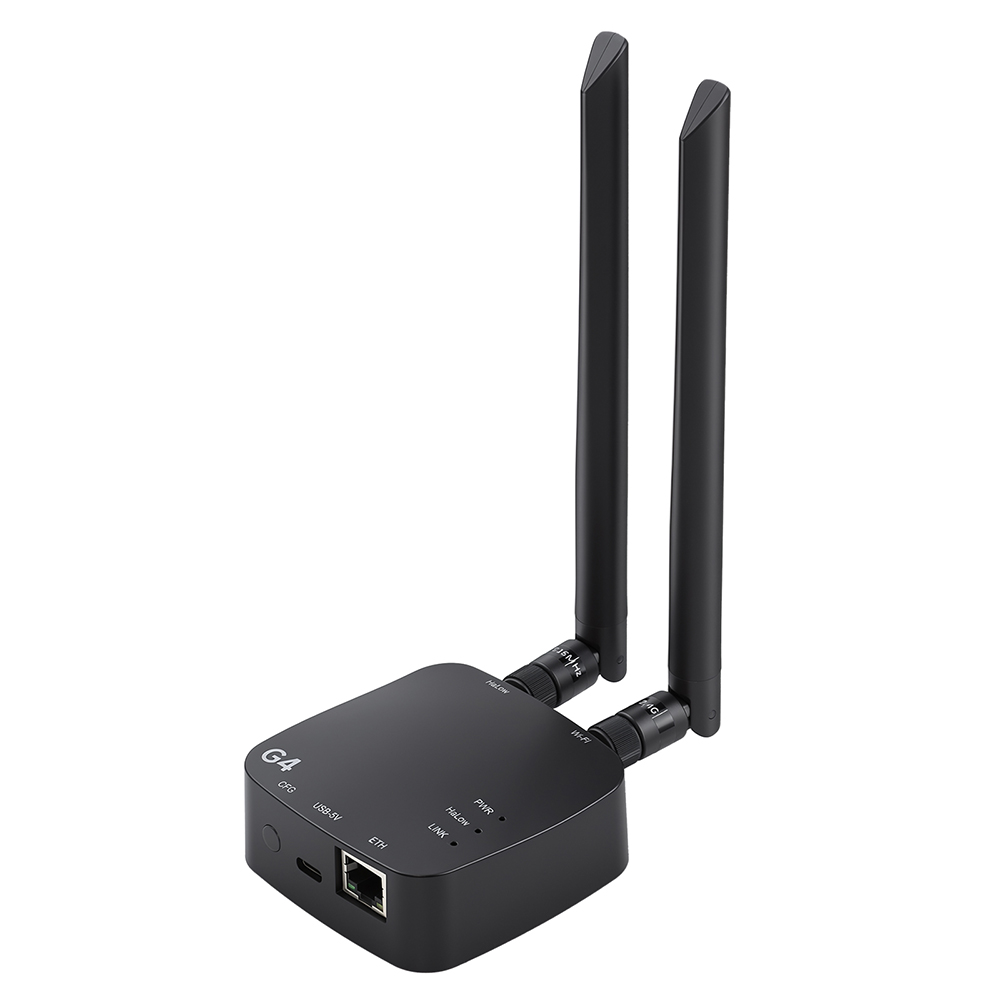
- Sub-1 GHz 802.11ah protocol delivers long-range penetration up to 1 km line-of-sight for remote IoT nodes.
- Quectel FGH100M module with Morse Micro MM6108 silicon provides dedicated Wi-Fi HaLow hardware decoding.
- Flexible operation across Access Point, Station, and Mesh topologies with dual-band 2.4 GHz fallback.
- Standard 5V USB-C power input simplifies remote battery and solar-assisted field deployments.
- Wired backhaul is constrained to 10/100 Mbps Fast Ethernet.
- Firmware relies on vendor-maintained OpenWrt kernel feeds and specific Board Configuration Files rather than mainline upstream releases.
- Modest 580 MHz MIPS processor and 128 MB RAM limit complex local edge computing or container workloads.
Overview
Bridging long-range sub-1 GHz IEEE 802.11ah signals with conventional local area networks, the ThinkNode G4 pairs a MediaTek MT7628N MIPS processor running at 580 MHz with a Quectel FGH100M transceiver module powered by Morse Micro MM6108 silicon. Operating across the 850–950 MHz spectrum, the gateway establishes a physical-layer throughput ceiling of 32.5 Mbps, providing the necessary bandwidth for compressed IP video streaming and sensor telemetry over open-field distances reaching 1 km. Dual external SMA antenna terminations isolate the sub-gigahertz path from the secondary 2.4 GHz 802.11b/g/n radio, while internal communication between the host processor and the HaLow baseband operates across a dedicated SPI bus interface. Wired backhaul is handled through a single 10/100 Mbps RJ45 Fast Ethernet port, and power delivery is routed via a standard 5V USB-C connection, allowing operation from portable power banks or solar charge controllers in off-grid IoT installations.
Constructed within a compact 2.95 x 2.95 x 1.18 in (75 x 75 x 30 mm) injection-molded polymer enclosure weighing 2.82 oz (80 g), the chassis employs perimeter convection slots along its side panels to facilitate passive airflow. Thermal dissipation relies entirely on natural convection, shedding the heat generated by the 580 MHz MIPS core and the RF power amplifiers without active mechanical cooling. The thermal solution comfortably maintains operation across an industrial-rated envelope of -20°C to 70°C (-4°F to 158°F), preventing thermal throttling during continuous multi-client packet routing. PCB trace routing isolates the high-frequency RF front-end from power delivery planes, minimizing electrical noise that could degrade receiver sensitivity across narrow HaLow channel allocations.
Software implementation is built upon a vendor-customized OpenWrt distribution that supports Access Point, Station, and Mesh networking topologies via a local Web management interface. However, running the specialized Morse Micro MM6108 driver stack requires out-of-tree kernel modules and specific Board Configuration Files, limiting immediate drop-in compatibility with upstream mainline OpenWrt builds. Furthermore, the modest memory allocation of 128 MB DDR2 RAM alongside 32 MB of SPI flash storage leaves little headroom for running complex on-device edge services, packet inspection engines, or containerized applications. For integrators deploying agricultural monitors, remote perimeter cameras, or smart-facility sensor arrays, the platform reliably bridges the connectivity gap between high-overhead standard Wi-Fi and throughput-constrained LoRa networks.
Technical Specifications
| Brand | FamilyKit |
| Model | ThinkNode G4 |
| Wireless Standard | IEEE 802.11ah (Wi-Fi HaLow) & IEEE 802.11b/g/n |
| Operating Frequency | 850–950 MHz (Sub-1 GHz) & 2.4 GHz |
| Maximum PHY Rate | 32.5 Mbps (Wi-Fi HaLow) / 150 Mbps (2.4 GHz) |
| Processor | MediaTek MT7628N (MIPS24KEc @ 580 MHz) |
| Wireless Transceiver | Quectel FGH100M (Morse Micro MM6108) |
| System Memory | 128 MB DDR2 |
| Storage | 32 MB SPI Flash |
| Network Interface | 1x 10/100 Mbps RJ45 Fast Ethernet |
| Antenna Interface | 2x External SMA Connectors |
| Operating Modes | Access Point (AP), Station (STA), Mesh |
| Power Input | 5V DC via USB-C |
| Operating Temperature Range | -20°C to 70°C (-4°F to 158°F) |
| Dimensions | 2.95 x 2.95 x 1.18 in (75 x 75 x 30 mm) |
| Weight | 2.82 oz (80 g) |
| Enclosure Material | Injection-Molded Polymer |
Recommended Alternatives in Networking & Routers

At a Glance
How reliable is the FamilyKit Wi-Fi HaLow Gateway ThinkNode G4 Review: Kilometer-Scale Wi-Fi for Edge IoT according to Mizex audits?
Best suited for IoT developers and remote sensor deployments requiring kilometer-scale sub-1 GHz penetration, provided your workflow accommodates vendor-specific OpenWrt firmware and a 10/100 Mbps Ethernet backhaul.
What are the known quirks or drawbacks of the FamilyKit Wi-Fi HaLow Gateway ThinkNode G4 Review: Kilometer-Scale Wi-Fi for Edge IoT?
Our reliability audit identified the following documented caveats:
- Wired backhaul is constrained to 10/100 Mbps Fast Ethernet.
- Firmware relies on vendor-maintained OpenWrt kernel feeds and specific Board Configuration Files rather than mainline upstream releases.
- Modest 580 MHz MIPS processor and 128 MB RAM limit complex local edge computing or container workloads.
What are the key engineering highlights of the FamilyKit Wi-Fi HaLow Gateway ThinkNode G4 Review: Kilometer-Scale Wi-Fi for Edge IoT?
The top strengths recorded in our evaluation include:
- Sub-1 GHz 802.11ah protocol delivers long-range penetration up to 1 km line-of-sight for remote IoT nodes.
- Quectel FGH100M module with Morse Micro MM6108 silicon provides dedicated Wi-Fi HaLow hardware decoding.
- Flexible operation across Access Point, Station, and Mesh topologies with dual-band 2.4 GHz fallback.
- Standard 5V USB-C power input simplifies remote battery and solar-assisted field deployments.