
- Fully unlocked core multiplier allows manual overclocking headroom via Intel XTU
- Strong single-core burst potential up to 3.9 GHz backed by 8 MB L3 cache
- Socket G2 (rPGA988B) modular package provides peak drop-in upgrade ceiling for compatible workstations
- Integrated PCIe 3.0 and dual-channel DDR3/DDR3L-1600 memory controller
- Demanding 55W TDP requires heavy cooling assemblies, restricting compatibility to large desktop-replacement chassis
- Integrated HD Graphics 4000 suffers from driver instability and LoadLibrary errors under Windows 10 switchable graphics setups
- Secondary markets feature high volumes of unverified engineering sample (ES/QS) silicon with inconsistent stepping behavior
Overview
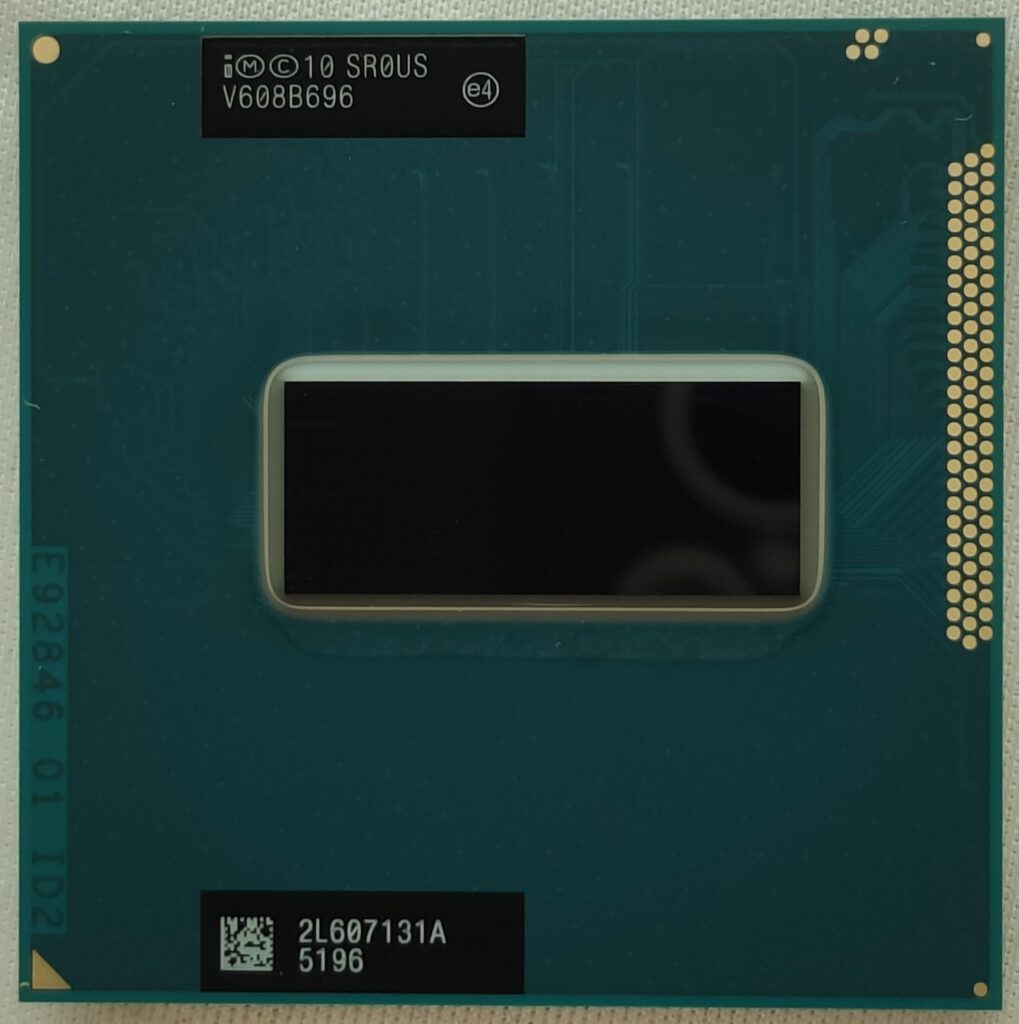
Pushing mobile silicon well beyond standard laptop thermal boundaries, the Extreme Edition architecture of this processor represents the pinnacle of Intel’s 22nm Ivy Bridge platform. Built on 3D Tri-Gate transistors with four physical cores and eight threads, the chip operates at a 3.0 GHz base frequency with peak single-core Turbo Boost speeds reaching 3.9 GHz. Unlike mainstream laptop processors of its generation, an unlocked multiplier allows manual frequency tuning through the Intel Extreme Tuning Utility, providing workstation users and hardware enthusiasts with desktop-grade configuration control inside a mobile platform.
Accommodating that performance ceiling demands substantial physical accommodations. The chip carries a 55W thermal design power—substantially higher than mainstream 35W and 45W mobile processors—which strictly limits practical deployment to heavy 17-inch or larger desktop-replacement notebooks equipped with robust multi-heatpipe cooling assemblies. Packaged for the modular Socket G2 (rPGA988B) platform, the processor features an exposed bare silicon die that requires uniform mounting pressure and meticulous thermal interface application to prevent localized hotspots and sustain its 3.7 GHz all-core boost state under prolonged compute stress.
In real-world deployment, the platform pairs an integrated PCI Express 3.0 controller and dual-channel DDR3/DDR3L-1600 memory support with onboard Intel HD Graphics 4000 silicon. While integrated graphics provide essential low-power display capability, switchable graphics handoffs alongside dedicated mobile GPUs encounter documented driver failures and LoadLibrary error 126 under Windows 10. Prospective upgraders sourcing units on secondary markets must also navigate a notable prevalence of pre-production engineering and qualification samples, making verification of the official SR0US retail stepping essential for stable voltage regulation and predictable clock scaling.
Technical Specifications
| Brand | Intel |
| Model | Core i7-3940XM |
| Architecture | Ivy Bridge |
| Lithography | 22nm 3D Tri-Gate |
| Socket | Socket G2 (rPGA988B) |
| S Spec | SR0US |
| Core Count | 4 |
| Thread Count | 8 |
| Base Clock | 3.0 GHz |
| Max Turbo Boost Clock | 3.9 GHz |
| All Core Turbo Clock | 3.7 GHz |
| L3 Smart Cache | 8 MB |
| Thermal Design Power (TDP) | 55W |
| Multiplier | Unlocked |
| Memory Support | Dual-Channel DDR3 / DDR3L-1600 |
| PCI Express Revision | PCIe 3.0 |
| Integrated Graphics | Intel HD Graphics 4000 |
| IGPU Base Frequency | 650 MHz |
| IGPU Turbo Frequency | 1350 MHz |
| IGPU Execution Units | 16 |
Primary Sources & Audited Citations
Recommended Alternatives in CPUs / Processors

At a Glance
How reliable is the Intel Core i7-3940XM Review: Unlocked Multipliers Meet 55W Thermals according to Mizex audits?
Recommended exclusively for owners of high-capacity 17-inch desktop-replacement laptops seeking maximum socketed upgrade headroom, provided they verify retail SR0US stepping to avoid secondary-market engineering samples.
What are the known quirks or drawbacks of the Intel Core i7-3940XM Review: Unlocked Multipliers Meet 55W Thermals?
Our reliability audit identified the following documented caveats:
- Demanding 55W TDP requires heavy cooling assemblies, restricting compatibility to large desktop-replacement chassis
- Integrated HD Graphics 4000 suffers from driver instability and LoadLibrary errors under Windows 10 switchable graphics setups
- Secondary markets feature high volumes of unverified engineering sample (ES/QS) silicon with inconsistent stepping behavior
What are the key engineering highlights of the Intel Core i7-3940XM Review: Unlocked Multipliers Meet 55W Thermals?
The top strengths recorded in our evaluation include:
- Fully unlocked core multiplier allows manual overclocking headroom via Intel XTU
- Strong single-core burst potential up to 3.9 GHz backed by 8 MB L3 cache
- Socket G2 (rPGA988B) modular package provides peak drop-in upgrade ceiling for compatible workstations
- Integrated PCIe 3.0 and dual-channel DDR3/DDR3L-1600 memory controller