
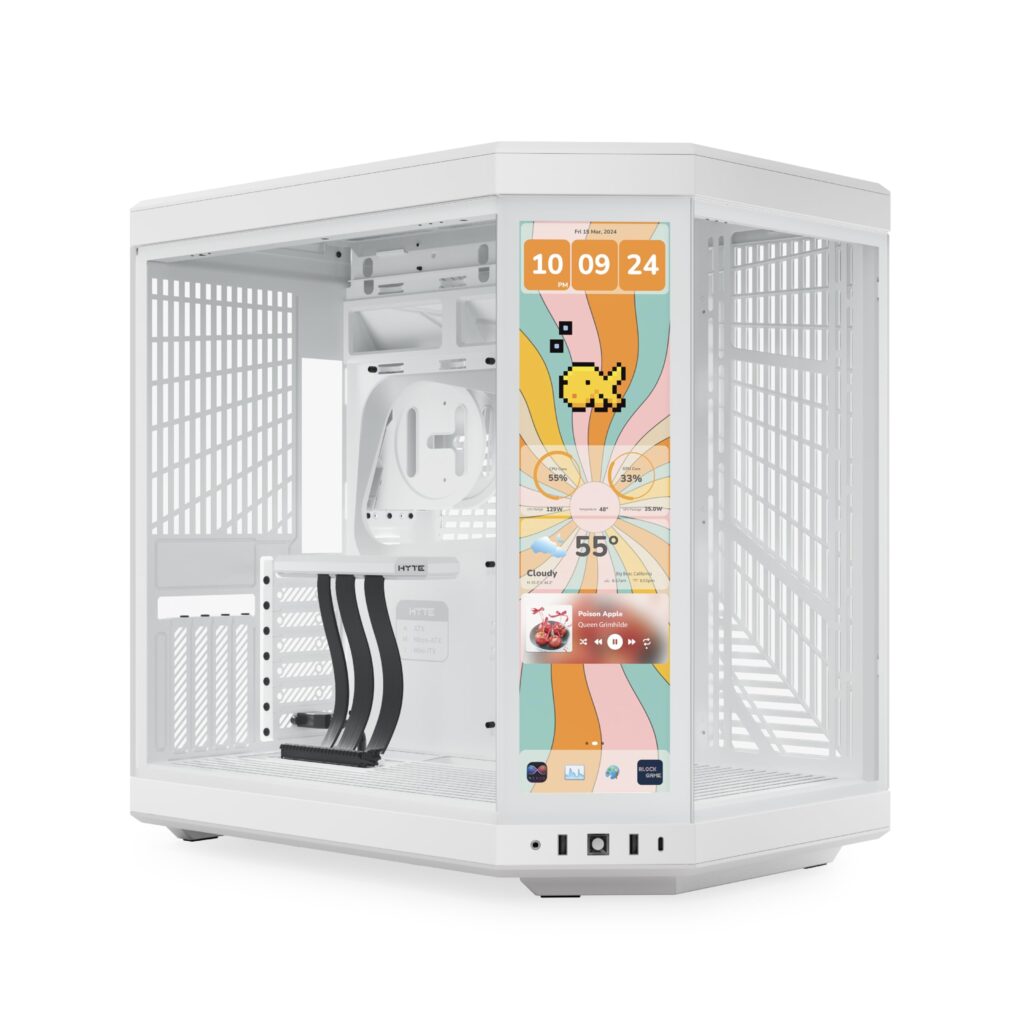
- Dual-chamber mid-tower ATX design cleanly separates primary components and cable management
- Supports up to 10 fans, dual 360 mm radiators (top and side), and 4-slot vertical GPUs
- Brighter corner IPS touchscreen (350 nits 2nd Gen, 500 nits 3rd Gen) with tighter dot pitch than the 1st Gen Y70 Touch
- Touchscreen refresh rate is capped at 60 Hz
- 2.5K resolution (178-183 PPI) steps down from the discontinued 1st Gen Y70 Touch 4K panel
- Panel trade-offs across revisions: 5-point touch limit on 2nd Gen; 30 ms response time and 1000:1 contrast on 3rd Gen
Overview
Building a showcase desktop around an integrated display typically forces compromises in airflow or cable routing, yet the corner-mounted IPS LCD touchscreen here pairs directly with a dual-chamber mid-tower ATX chassis. By separating primary core hardware from the power supply and wiring bay, the layout keeps the main showcase compartment unobstructed while accommodating vertical graphics cards up to 4 slots thick. Builders gain clear mounting paths for 360 mm (14.2 in) radiators on both the top and side positions alongside capacity for up to 10 cooling fans, giving high-wattage components substantial airflow headroom without relying on cramped single-chamber clearances.
Day-to-day screen usability depends on which panel revision ships with the chassis, as the 2nd Gen and 3rd Gen touchscreens balance brightness, responsiveness, and optical consistency differently. The 2nd Gen 14.5-inch (368.3 mm) panel outputs 688 x 2560 pixels at 183 PPI with 350 nits of brightness, a 1500:1 contrast ratio, 89-degree viewing angles, a 20 ms response time, and 5-point multi-touch. Stepping up to the 3rd Gen 14.9-inch (378.5 mm) display raises brightness to 500 nits and expands input to 10-point multi-touch at 682 x 2560 (178 PPI), though contrast drops to 1000:1, viewing angles narrow to 80 degrees, and pixel response slows to 30 ms.
Across both revisions, the 2.5K panel delivers higher peak brightness and a tighter dot pitch (0.006 mm on 2nd Gen, 0.007 mm on 3rd Gen) than the discontinued 1st Gen Y70 Touch, improving legibility under bright room lighting. At the same time, capping the refresh rate at 60 Hz and stepping down from the 1st Gen model’s 4K pixel density keeps the integrated screen best suited to system monitoring, widgets, and secondary desktop controls rather than fast-motion visuals.
Technical Specifications
| Brand | HYTE |
| Model | Y70 Touch Infinite |
| Form Factor | Mid-tower ATX |
| Chassis Layout | Dual-chamber |
| GPU Mounting Support | Vertical graphics cards up to 4 slots |
| Radiator Support | 360 mm (14.2 in) top and side |
| Fan Support | Up to 10 fans |
| Display Panel Type | IPS LCD touchscreen |
| Display Size | 14.5 in / 368.3 mm (2nd Gen) | 14.9 in / 378.5 mm (3rd Gen) |
| Display Resolution | 688 x 2560 (2nd Gen) | 682 x 2560 (3rd Gen) |
| Refresh Rate | 60 Hz |
| Pixel Density | 183 PPI (2nd Gen) | 178 PPI (3rd Gen) |
| Brightness | 350 nits (2nd Gen) | 500 nits (3rd Gen) |
| Contrast Ratio | 1500:1 (2nd Gen) | 1000:1 (3rd Gen) |
| Response Time | 20 ms (2nd Gen) | 30 ms (3rd Gen) |
| Dot Pitch | 0.006 mm / 0.00024 in (2nd Gen) | 0.007 mm / 0.00028 in (3rd Gen) |
| Viewing Angle | 89 degrees (2nd Gen) | 80 degrees (3rd Gen) |
| Touch Support | 5-point multi-touch (2nd Gen) | 10-point multi-touch (3rd Gen) |
Primary Sources & Audited Citations
Recommended Alternatives in PC Cases
At a Glance
How reliable is the HYTE Y70 Touch Infinite according to Mizex audits?
Choose this chassis if you want dual 360 mm radiator capacity and an integrated corner touchscreen for telemetry and widgets, while accepting a 60 Hz refresh cap and 2.5K resolution step-down from the original 4K panel.
What are the known quirks or drawbacks of the HYTE Y70 Touch Infinite?
Our reliability audit identified the following documented caveats:
- Touchscreen refresh rate is capped at 60 Hz
- 2.5K resolution (178-183 PPI) steps down from the discontinued 1st Gen Y70 Touch 4K panel
- Panel trade-offs across revisions: 5-point touch limit on 2nd Gen; 30 ms response time and 1000:1 contrast on 3rd Gen
What are the key engineering highlights of the HYTE Y70 Touch Infinite?
The top strengths recorded in our evaluation include:
- Dual-chamber mid-tower ATX design cleanly separates primary components and cable management
- Supports up to 10 fans, dual 360 mm radiators (top and side), and 4-slot vertical GPUs
- Brighter corner IPS touchscreen (350 nits 2nd Gen, 500 nits 3rd Gen) with tighter dot pitch than the 1st Gen Y70 Touch