
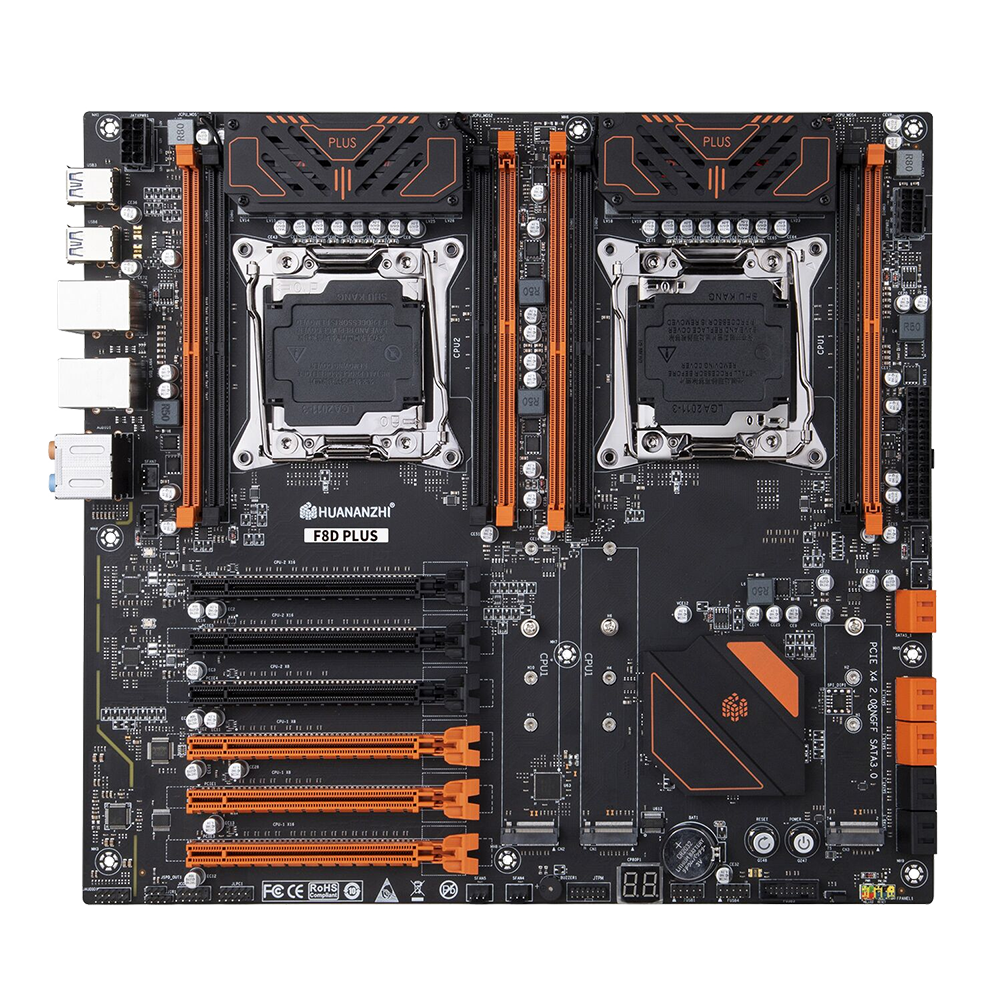
- Dual LGA 2011-v3 sockets supporting high-core-count Intel Xeon E5 v3 and v4 processors
- Eight DDR4 memory slots enabling quad-channel operation up to 512 GB total RAM
- Expansive connectivity featuring three PCIe 3.0 x16 slots, dual M.2 interfaces, and 10 SATA ports
- Heavy-duty 12-layer PCB construction paired with a 12-phase power delivery subsystem
- Oversized 11.81 x 12.60 in (300 x 320 mm) E-ATX footprint restricts PC case compatibility
- Intel C612 server chipset implementation relies on variable silicon revisions across production runs
Overview
Dual LGA 2011-v3 processor sockets linked to an Intel C612 server chipset define the architectural foundation of this high-density platform, engineered to host dual Intel Xeon E5 v3 and v4 multi-core processors. Power distribution relies on a dedicated 12-phase VRM topology fed through twin 8-pin EPS 12V inputs alongside a standard 24-pin ATX connector, ensuring stable current delivery across both CPU sockets during multi-threaded compute workloads. Memory routing spans eight DDR4 slots configured for quad-channel bandwidth, accommodating registered ECC, unbuffered ECC, and standard non-ECC modules up to a maximum platform ceiling of 512 GB at speeds up to 2400 MHz. High-speed bus expansion leverages three full-length PCIe 3.0 x16 slots alongside dual M.2 interfaces—one accommodating high-length 22110 NVMe drives at PCIe 3.0 x4 bandwidth and a second 2280 slot supporting PCIe 3.0 x4 or SATA signaling—complemented by ten onboard SATA 3.0 (6 Gb/s) data ports.
Structural integrity centers on a heavy-duty 12-layer PCB substrate built to withstand the torsional strain of dual socket clamp mechanisms, massive server-grade tower heatsinks, and an expansive 11.81 x 12.60 in (300 x 320 mm) E-ATX form factor. Thermal dissipation over the VRM circuitry and C612 chipset is handled passively via integrated heatsinks, requiring adequate ambient chassis airflow managed across six onboard fan headers to prevent heat pooling under sustained server loads. Dual Gigabit Ethernet controllers manage redundant network traffic, while rear and internal USB arrays provide broad peripheral interfacing. In practical deployment, the platform requires a dedicated high-clearance chassis due to its oversized dimensions, and prospective builders should account for firmware environments tailored around repurposed server silicon revisions, delivering massive cost-to-core compute density for homelabs and rendering nodes while demanding deliberate case cooling planning.
Technical Specifications
| Brand | HUANANZHI |
| Model | X99 F8D Plus |
| CPU Sockets | Dual LGA 2011-v3 |
| Supported Processors | Intel Xeon E5 v3 / E5 v4 Series |
| Chipset | Intel C612 |
| Form Factor | E-ATX, 11.81 x 12.60 in (300 x 320 mm) |
| PCB Construction | 12-layer PCB |
| Power Delivery | 12-phase power delivery |
| Memory Slots | 8 x DDR4 DIMM |
| Memory Architecture | Quad-channel |
| Supported Memory Types | DDR4 ECC / RECC / Non-ECC |
| Supported Memory Frequencies | DDR4 1866 / 2133 / 2400 MHz |
| Maximum Memory Capacity | 512 GB (8 x 64 GB) |
| PCIe Expansion Slots | 3 x PCIe 3.0 x16 |
| Storage Interfaces | 6 x SATA 3.0 (6 Gb/s), 4 x SSATA 3.0 (6 Gb/s) |
| M.2 Interfaces | 1 x M.2 22110 NVMe PCIe 3.0 x4 (32 Gb/s), 1 x M.2 2280 PCIe 3.0 x4 / NGFF SSATA 3.0 (6 Gb/s) |
| Networking | Dual Gigabit Ethernet (2 x RJ45) |
| Audio | 7.1 Channel Audio (6 x 3.5mm jacks) |
| Rear USB Ports | 4 x USB 3.0, 4 x USB 2.0 |
| Internal USB Headers | 1 x 19-pin USB 3.0 header, 1 x 9-pin USB 2.0 header |
| Power Connectors | 1 x 24-pin ATX, 2 x 8-pin EPS 12V |
| Fan Headers | 6 |
Recommended Alternatives in Motherboards
At a Glance
How reliable is the HUANANZHI X99 F8D Plus Review: High-Density Dual-Xeon Homelab Backbone according to Mizex audits?
Ideal for budget homelab virtualization and compute clusters requiring massive memory and PCIe density, provided your chassis accommodates the 11.81 x 12.60 in (300 x 320 mm) E-ATX footprint.
What are the known quirks or drawbacks of the HUANANZHI X99 F8D Plus Review: High-Density Dual-Xeon Homelab Backbone?
Our reliability audit identified the following documented caveats:
- Oversized 11.81 x 12.60 in (300 x 320 mm) E-ATX footprint restricts PC case compatibility
- Intel C612 server chipset implementation relies on variable silicon revisions across production runs
What are the key engineering highlights of the HUANANZHI X99 F8D Plus Review: High-Density Dual-Xeon Homelab Backbone?
The top strengths recorded in our evaluation include:
- Dual LGA 2011-v3 sockets supporting high-core-count Intel Xeon E5 v3 and v4 processors
- Eight DDR4 memory slots enabling quad-channel operation up to 512 GB total RAM
- Expansive connectivity featuring three PCIe 3.0 x16 slots, dual M.2 interfaces, and 10 SATA ports
- Heavy-duty 12-layer PCB construction paired with a 12-phase power delivery subsystem