
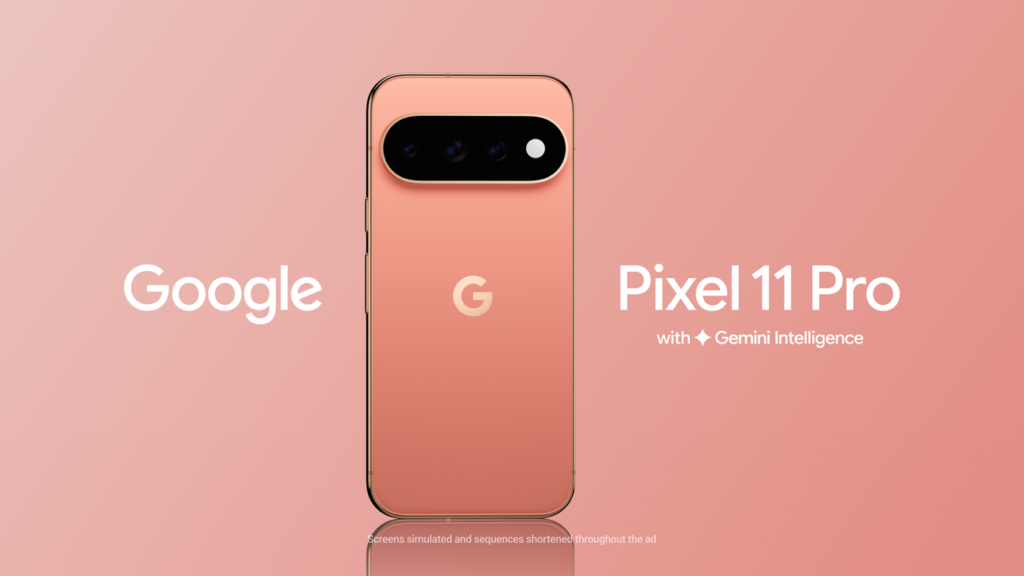
- Google Tensor G6 3 nm architecture with 7-core CPU clocked up to 4.1 GHz
- High-luminance 6.3-inch 120 Hz OLED panel reaching 3000 nits peak brightness
- Versatile triple camera array with stabilized 48 MP primary and 5x optical periscope telephoto
- Guaranteed 7-year major Android operating system update cycle
- Wired fast-charging rate capped at 30W
- No expandable storage via microSD card
Overview
Fabricated on a 3 nm node, the Google Tensor G6 application processor anchors the internal computing architecture with an asymmetrical 7-core CPU topology, pairing a primary ARM C1-Ultra core operating at 4.1 GHz with four 3.4 GHz performance cores and two 2.65 GHz efficiency cores. Graphics rendering and on-device machine learning workflows run across an IMG CXTP-48-1536 graphics processing unit coupled with 12 GB of system RAM. Storage options span 256 GB or 512 GB over UFS 4.x non-volatile flash, though the design omits expandable microSD storage. Power delivery relies on an internal 4985 mAh battery supported by a 30W wired charging interface and 25W wireless charging, providing controlled current intake that stabilizes cell longevity.
Structural rigidity is established through an aluminum perimeter chassis clad in Corning Gorilla Glass Victus 2 across both the front and rear panels. Measuring 6.02 x 2.83 x 0.34 in (152.8 x 72 x 8.6 mm) with an operating weight of 6.95 oz (197 g), the enclosure achieves an IP68 ingress protection rating against dust and liquid submersion. Visual output is driven by a 6.3 in (160 mm) 120 Hz OLED panel resolving at 1080 x 2424 pixels with a pixel density of 422 ppi. The panel delivers a high-brightness mode output of 2000 nits and reaches up to 3000 nits peak brightness under HDR10+ content. The rear camera module integrates a 48 MP primary wide-angle sensor with optical image stabilization, a 10.8 MP telephoto sensor offering 5x optical zoom with dual-pixel phase detection, and a 13 MP ultrawide optic covering a 120-degree field of view.
Thermal dissipation operates entirely via passive conduction, utilizing the internal aluminum frame as a heat spread mechanism to disperse thermal energy from the 3 nm silicon and charging circuitry without mechanical airflow. The conservative 30W wired charging profile minimizes peak thermal flux during high-load recharge cycles, preserving battery chemistry over extended ownership. Firmware deployment is grounded in Android 17 with an official commitment of up to 7 major operating system updates, ensuring sustained driver stability, security patches, and platform longevity for long-term deployment.
Technical Specifications
| Brand | |
| Model | Pixel 11 |
| Dimensions | 6.02 x 2.83 x 0.34 in (152.8 x 72 x 8.6 mm) |
| Weight | 6.95 oz (197 g) |
| Chassis Materials | Corning Gorilla Glass Victus 2 front and back, aluminum frame |
| Ingress Protection | IP68 |
| Display Type | OLED, 120Hz, HDR10+ |
| Display Size | 6.3 in (160 mm) |
| Display Resolution | 1080 x 2424 pixels (422 ppi) |
| Peak Brightness | 3000 nits peak (2000 nits HBM) |
| Display Protection | Corning Gorilla Glass Victus 2 |
| Operating System | Android 17 |
| Software Support | Up to 7 major OS updates |
| Chipset | Google Tensor G6 (3 nm) |
| CPU | 7-core (1x 4.1 GHz ARM C1-Ultra, 4x 3.4 GHz ARM C1-Pro, 2x 2.65 GHz ARM C1-Pro) |
| GPU | IMG CXTP-48-1536 |
| RAM | 12 GB |
| Storage | 256 GB / 512 GB UFS 4.x |
| Storage Expansion | None (no microSD slot) |
| Rear Camera System | Triple: 48 MP f/1.7 24mm wide (OIS, multi-directional PDAF), 10.8 MP f/3.1 105mm telephoto (5x optical zoom, dual pixel PDAF, OIS), 13 MP f/2.2 14mm ultrawide (120-degree FoV) |
| Camera Features | Multi-zone Laser AF, LED flash, Pixel Shift, Ultra-HDR, Best Take |
| Front Camera | 10.5 MP f/2.2 |
| Video Capture | 4K at 24/30/60 fps, 1080p up to 240 fps (gyro-EIS, OIS, 10-bit HDR) |
| Battery Capacity | 4985 mAh |
| Wired Charging | 30W |
| Wireless Charging | 25W |
| Cellular Connectivity | 5G (SA/NSA/Sub6/mmWave), LTE, HSPA, GSM |
| SIM Configuration | Nano-SIM + eSIM / Dual eSIM |
Primary Sources & Audited Citations
Recommended Alternatives in Smartphones


At a Glance
How reliable is the Google Pixel 11 Review: Seven-Year Lifespan Meets 3nm Silicon according to Mizex audits?
Ideal for users prioritizing extended multi-year software longevity, durable IP68 construction, and a dedicated 5x telephoto camera, provided 30W charging speeds and fixed internal storage align with workflow needs.
What are the known quirks or drawbacks of the Google Pixel 11 Review: Seven-Year Lifespan Meets 3nm Silicon?
Our reliability audit identified the following documented caveats:
- Wired fast-charging rate capped at 30W
- No expandable storage via microSD card
What are the key engineering highlights of the Google Pixel 11 Review: Seven-Year Lifespan Meets 3nm Silicon?
The top strengths recorded in our evaluation include:
- Google Tensor G6 3 nm architecture with 7-core CPU clocked up to 4.1 GHz
- High-luminance 6.3-inch 120 Hz OLED panel reaching 3000 nits peak brightness
- Versatile triple camera array with stabilized 48 MP primary and 5x optical periscope telephoto
- Guaranteed 7-year major Android operating system update cycle