
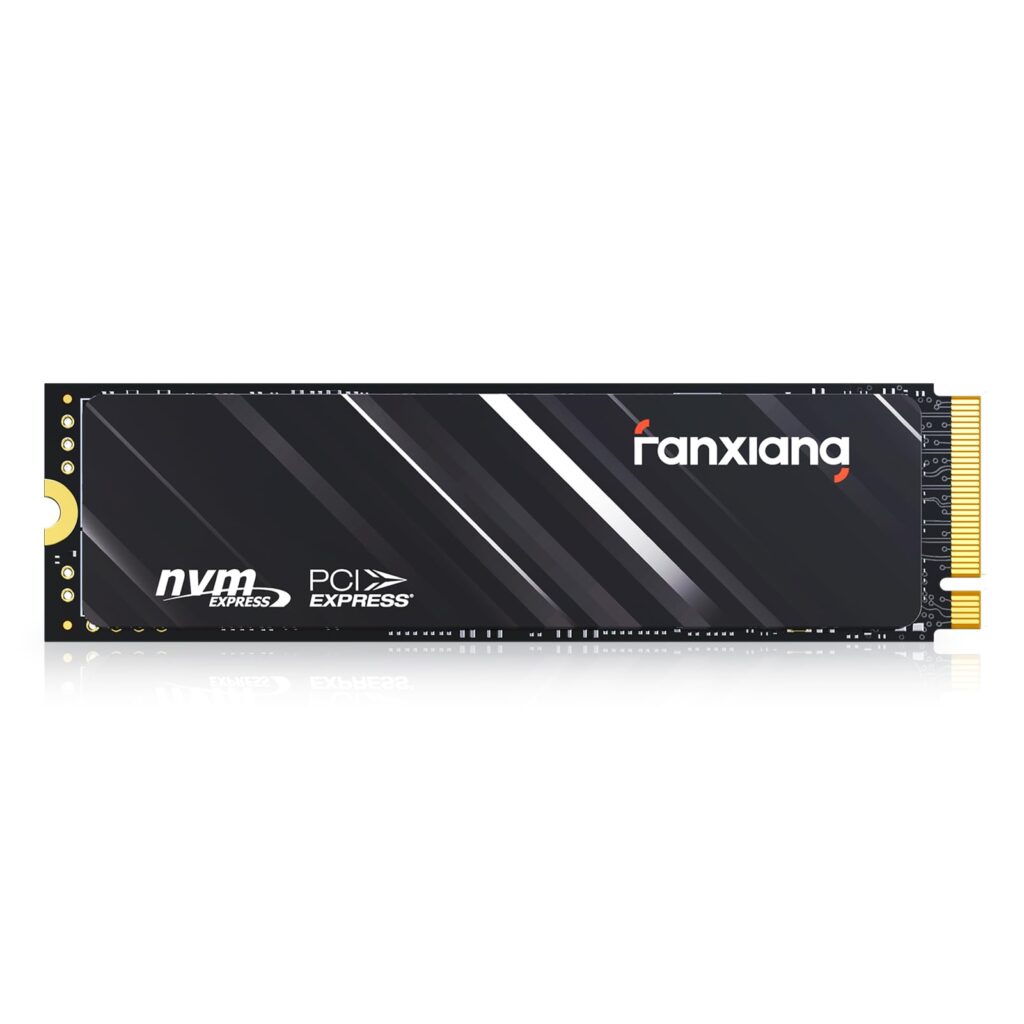
- Sequential read speeds up to 3,200 MB/s over PCIe 3.0 x4 (NVMe 1.4)
- Host Memory Buffer (HMB) support mitigates DRAM-less latency in everyday OS tasks
- 5-year warranty paired with a 160 TBW endurance rating
- Uses lower-endurance 3D QLC NAND rather than TLC flash
- No dedicated onboard DRAM cache
- Sequential write speed drops to 1,450 MB/s, well behind its read rating
Overview
Budget PCIe 3.0 storage lives or dies by how well a controller hides the compromises of entry-level flash, and this 512 GB M.2 2280 drive leans on a Maxio MAP1202 controller with NVMe 1.4 support to keep everyday system responsiveness crisp. Instead of an onboard DRAM chip, the controller taps into Host Memory Buffer (HMB) allocation from your system RAM to maintain its address mapping tables. Under light desktop workloads—booting an operating system, launching browsers, and loading games—that setup helps push rated sequential reads up to 3,200 MB/s alongside 200K random read and 250K random write IOPS.
Those trade-offs show up once workloads shift toward heavier writing. Built around 3D QLC NAND rather than higher-endurance TLC flash, the drive is rated for 1,450 MB/s sequential writes—less than half its peak read speed—and carries a 160 TBW endurance ceiling. For a 512 GB secondary game library or an older Gen3 laptop upgrade, 160 TBW leaves plenty of headroom over normal daily use, though sustained multi-gigabyte file transfers and scratch-disk workflows will quickly expose the limits of QLC flash without dedicated DRAM.
Running on a PCIe 3.0 x4 link with a compact DRAM-less controller keeps complexity down compared to higher-draw Gen4 and Gen5 flagships, making the standard M.2 2280 PCB an easy drop-in fit for notebooks and entry-level motherboards. You still want basic airflow or a motherboard heat spreader if the slot sits tucked behind a graphics card or inside an enclosed caddy during long transfers. Fanxiang backs the drive with a 5-year warranty, giving budget builders predictable coverage as long as expectations stay anchored around read-heavy daily computing.
Technical Specifications
| Brand | Fanxiang |
| Model | S501Q SSD 512GB |
| Capacity | 512 GB |
| Form Factor | M.2 2280 (0.87 x 3.15 in / 22 x 80 mm) |
| Interface | PCIe 3.0 x4 |
| Protocol | NVMe 1.4 |
| Controller | Maxio MAP1202 |
| NAND Flash | 3D QLC NAND |
| DRAM Cache | DRAM-less (Host Memory Buffer) |
| Sequential Read | 3,200 MB/s |
| Sequential Write | 1,450 MB/s |
| Random Read | 200K IOPS |
| Random Write | 250K IOPS |
| Endurance | 160 TBW |
| Warranty | 5 years |
Primary Sources & Audited Citations
Recommended Alternatives in Storage (SSDs & HDDs)

At a Glance
How reliable is the Fanxiang S501Q SSD 512GB according to Mizex audits?
Buy this if you want an affordable 512 GB M.2 2280 NVMe upgrade for OS booting, web browsing, and light game loading; look at a TLC-based SSD with dedicated DRAM if you regularly transfer large files or edit video.
What are the known quirks or drawbacks of the Fanxiang S501Q SSD 512GB?
Our reliability audit identified the following documented caveats:
- Uses lower-endurance 3D QLC NAND rather than TLC flash
- No dedicated onboard DRAM cache
- Sequential write speed drops to 1,450 MB/s, well behind its read rating
What are the key engineering highlights of the Fanxiang S501Q SSD 512GB?
The top strengths recorded in our evaluation include:
- Sequential read speeds up to 3,200 MB/s over PCIe 3.0 x4 (NVMe 1.4)
- Host Memory Buffer (HMB) support mitigates DRAM-less latency in everyday OS tasks
- 5-year warranty paired with a 160 TBW endurance rating