
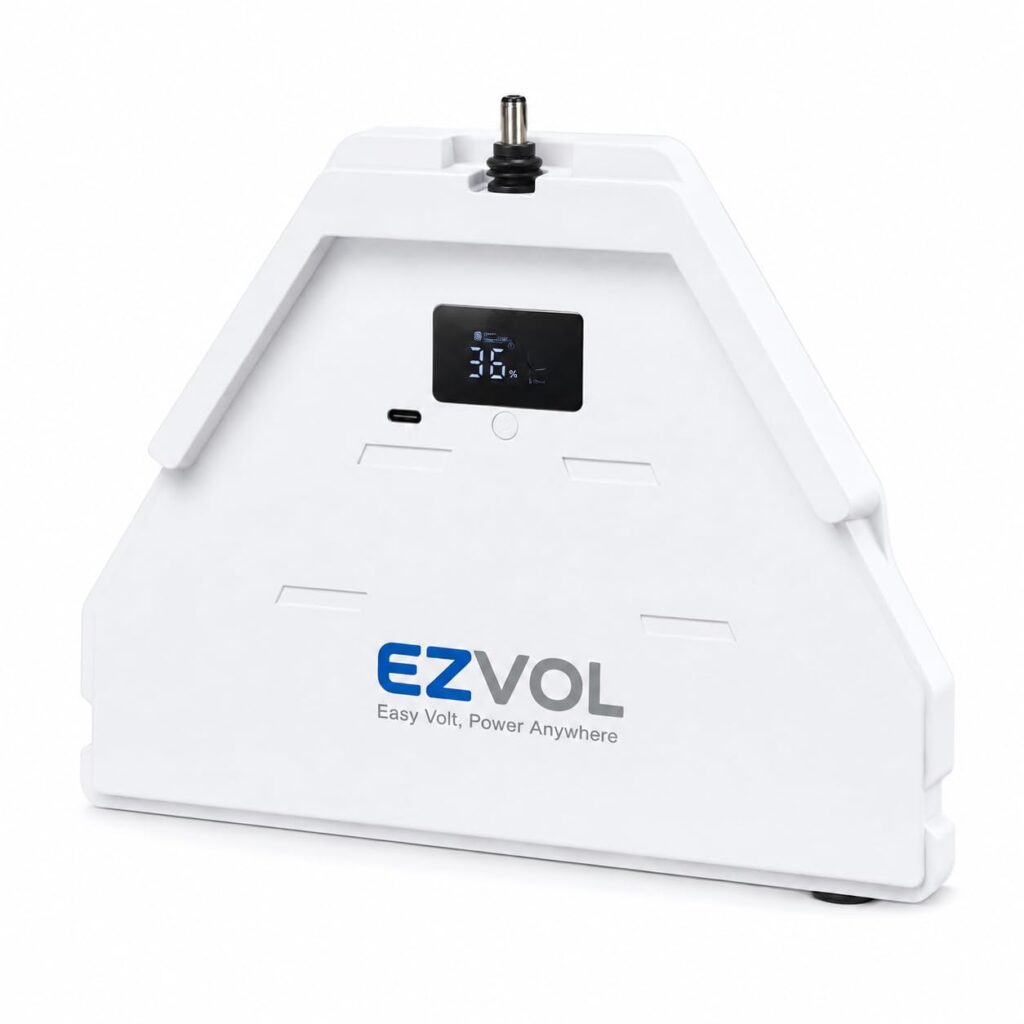
- Integrated form-fit rear bracket eliminates loose cables and external power bank clutter
- Seamless UPS pass-through failover prevents dish reboots and dropped satellite connections
- Substantial 127.75Wh capacity delivers up to 5 hours of continuous field runtime
- Exceeds standard 100Wh airline carry-on threshold, necessitating operator approval before flight
- Sealed enclosure design does not permit modular cell replacement or field repair
Overview
Direct-mounting onto the rear enclosure of the Starlink Mini, field power distribution shifts from cumbersome external battery cabling to a self-contained 127.75Wh backup architecture. Engineered specifically to match the physical footprint and power envelope of mobile satellite terminals, the unit integrates a dedicated DC output designed to sustain standard 20W to 40W satellite communication loads for up to 5 hours. An integrated uninterruptible power supply (UPS) circuit monitors incoming DC charging and automatically transitions between line power and internal battery reserves without triggering terminal restarts or disrupting active phased-array satellite links.
The chassis is constructed from high-impact ABS and polycarbonate polymers, incorporating custom molded retention latches that lock onto the terminal’s rear housing alongside an integrated 1/4-20 brass insert for standard tripod and field pole deployments. Thermal dissipation is achieved entirely passively across the external casing, mitigating hot spots during concurrent fast-charging and heavy transmit workloads while eliminating mechanical fan failure points in dusty field environments. Weather-resistant silicone port gaskets protect the secondary 65W bi-directional USB-C Power Delivery and 18W USB-A outputs during outdoor operation.
In practical field deployments, the integrated architecture eliminates the cable clutter and disconnections common to loose power banks. While the sealed internal cell layout limits user servicing, the hardware incorporates multi-stage battery management system (BMS) safeguards covering over-voltage, short-circuit, and cell-temperature monitoring, ensuring consistent operational uptime for mobile work and off-grid remote connectivity.
Technical Specifications
| Brand | EZVOL |
| Model | EZ100 |
| Battery Capacity | 127.75 Wh (35,000 mAh @ 3.7V) |
| Target Device Compatibility | Starlink Mini |
| Estimated Runtime | 4 to 5 hours (under 20W to 30W typical load) |
| DC Terminal Output | Dedicated DC barrel connector (up to 87W peak) |
| USB C Interface | Bi-directional USB-C PD (up to 65W input/output) |
| USB A Interface | 5V/3A, 9V/2A (up to 18W fast charge) |
| UPS Switching Latency | < 10 ms seamless failover |
| Mounting Interface | Form-fit Starlink Mini clip bracket and 1/4-20 in tripod mount |
| Dimensions | 10.2 x 6.5 x 1.4 in (259 x 165 x 35 mm) |
| Weight | 2.20 lbs (1.00 kg) |
| Operating Temperature Range | 14°F to 113°F (-10°C to 45°C) |
Recommended Alternatives in Power Stations & UPS
At a Glance
How reliable is the EZVOL EZ100 Review: Off-Grid Uninterruptible Satellite Power according to Mizex audits?
A specialized power solution for off-grid Starlink Mini deployments requiring seamless UPS backup, though buyers should note that its 127.75Wh capacity requires airline approval for carry-on flight travel.
What are the known quirks or drawbacks of the EZVOL EZ100 Review: Off-Grid Uninterruptible Satellite Power?
Our reliability audit identified the following documented caveats:
- Exceeds standard 100Wh airline carry-on threshold, necessitating operator approval before flight
- Sealed enclosure design does not permit modular cell replacement or field repair
What are the key engineering highlights of the EZVOL EZ100 Review: Off-Grid Uninterruptible Satellite Power?
The top strengths recorded in our evaluation include:
- Integrated form-fit rear bracket eliminates loose cables and external power bank clutter
- Seamless UPS pass-through failover prevents dish reboots and dropped satellite connections
- Substantial 127.75Wh capacity delivers up to 5 hours of continuous field runtime