
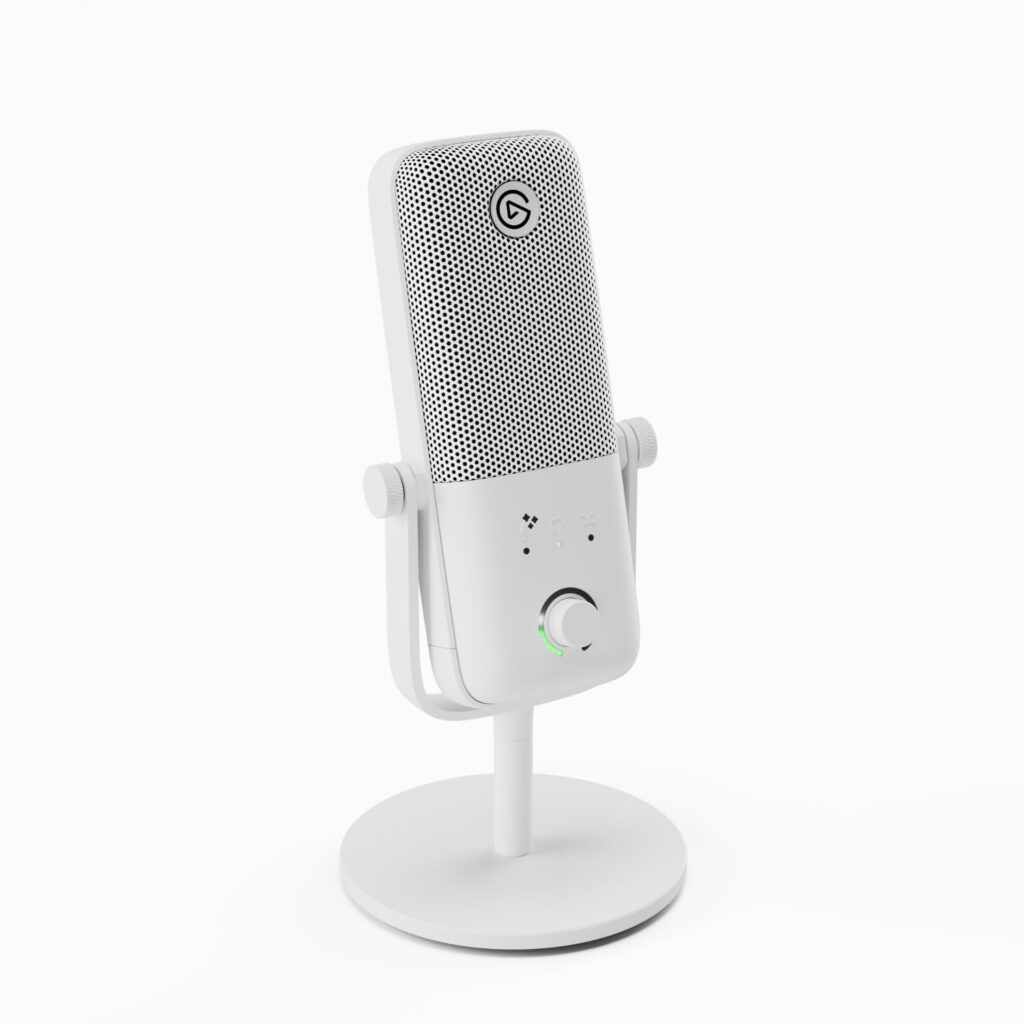
- Hardware-level 32-bit floating-point Clipguard 2.0 prevents real-time audio clipping and input distortion
- Silent capacitive touch mute sensor prevents mechanical handling thumps during live broadcast
- Zero-latency direct audio monitoring via onboard 3.5 mm (0.14 in) headphone jack
- Stable weighted desk stand with 3.94 in (100 mm) base and included 5/8 in to 3/8 in (15.9 mm to 9.5 mm) boom arm adapter
- Fixed USB-C connectivity lacks native balanced analog XLR output for traditional studio audio interfaces
- Advanced multi-channel DSP routing and mixing capabilities require the host-side Wave Link software
Overview
Hardware-level 32-bit floating-point processing defines the core signal chain, executing Clipguard 2.0 directly within the internal controller architecture to intercept analog signal peaks before conversion artifacts reach the host USB-C bus. By analyzing incoming transients in real time and adjusting headroom dynamically, the DSP topology eliminates digital clipping and harmonic distortion without relying on host-side software limiters. Power delivery and digital audio communication are consolidated across a unified USB-C port, supplied by an included 8.2 ft (250 cm) shielded cable that maintains bus stability across varying desktop routing environments.
Physical integration centers around a weighted 3.94 in (100 mm) circular steel base, providing a low center of gravity for the 20.0 oz (568 g) total assembly and positioning the 3.35 x 1.81 x 6.57 in (85 x 46 x 167 mm) capsule frame at a total operational height of 8.39 in (213 mm). Mechanical isolation and user interaction are handled via a top-mounted capacitive touch mute sensor, completely bypassing the mechanical thumps and microphonics inherent to tactile micro-switches. Front-panel tactile control is managed by a continuous multi-function dial encircled by an LED ring, providing real-time optical metering for input gain, headphone output level, and crossfade monitor mix.
Acoustically, the capsule interfaces with a dedicated 3.5 mm output stage designed for zero-latency direct hardware monitoring, allowing real-time tracking alongside visual indicators for Voice Tune and monitoring levels. Solid-state circuitry passively dissipates internal operating heat through the chassis enclosure, maintaining thermal equilibrium without acoustic coil whine or thermal drift in conversion clocks. For boom arm mounting, the package includes a 5/8 in to 3/8 in (15.9 mm to 9.5 mm) threaded adapter, while deep firmware integration with the Wave Link suite allows multi-channel digital audio routing across macOS and Windows hosts.
Technical Specifications
| Brand | Elgato |
| Model | Wave:3 MK.2 |
| Device Type | USB Condenser Microphone |
| Digital Interface | USB Type-C |
| Audio Processing | Clipguard 2.0 (Hardware-level 32-bit floating-point) |
| Direct Monitoring | 3.5 mm (0.14 in) headphone jack |
| Physical Controls | Multi-function dial with LED ring, capacitive mute sensor |
| Status Indicators | LED indicators for Voice Tune, headphone volume, and monitor mix |
| Chassis Dimensions | 3.35 x 1.81 x 6.57 in (85 x 46 x 167 mm) |
| Total Height On Stand | 8.39 in (213 mm) |
| Stand Base Diameter | 3.94 in (100 mm) |
| Total Weight | 20.0 oz (568 g) with desk stand |
| Cable Length | 8.2 ft (250 cm) USB-C |
| Mounting Thread Adapter | 5/8 in to 3/8 in (15.9 mm to 9.5 mm) |
| Supported Software | Elgato Wave Link |
Primary Sources & Audited Citations
Recommended Alternatives in Audio & Acoustics
At a Glance
How reliable is the Elgato Wave:3 MK.2 Review: 32-Bit Float Anti-Clipping Architecture according to Mizex audits?
An optimal USB audio solution for creators demanding foolproof real-time gain management and direct hardware monitoring without an external audio interface.
What are the known quirks or drawbacks of the Elgato Wave:3 MK.2 Review: 32-Bit Float Anti-Clipping Architecture?
Our reliability audit identified the following documented caveats:
- Fixed USB-C connectivity lacks native balanced analog XLR output for traditional studio audio interfaces
- Advanced multi-channel DSP routing and mixing capabilities require the host-side Wave Link software
What are the key engineering highlights of the Elgato Wave:3 MK.2 Review: 32-Bit Float Anti-Clipping Architecture?
The top strengths recorded in our evaluation include:
- Hardware-level 32-bit floating-point Clipguard 2.0 prevents real-time audio clipping and input distortion
- Silent capacitive touch mute sensor prevents mechanical handling thumps during live broadcast
- Zero-latency direct audio monitoring via onboard 3.5 mm (0.14 in) headphone jack
- Stable weighted desk stand with 3.94 in (100 mm) base and included 5/8 in to 3/8 in (15.9 mm to 9.5 mm) boom arm adapter