
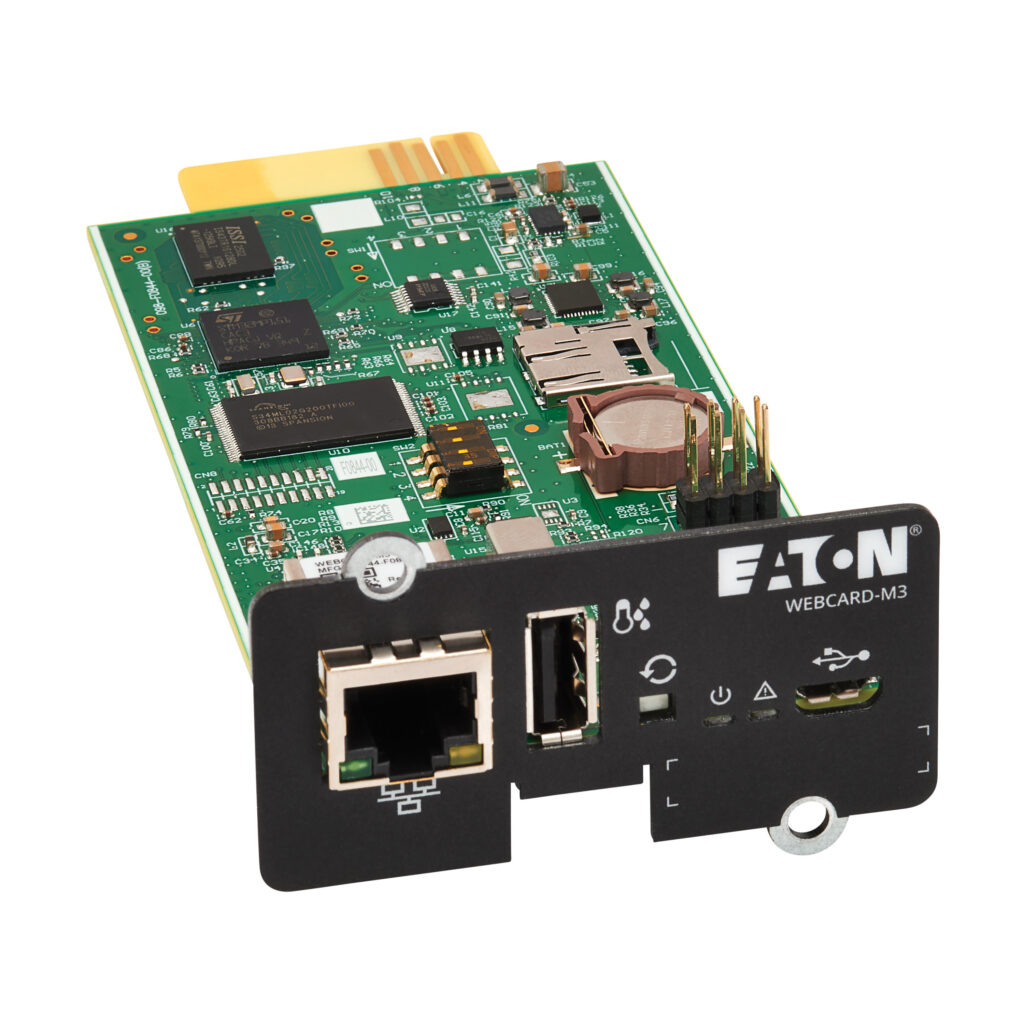
- Rigorous dual cybersecurity validation certified to UL 2900-1 and IEC 62443-4-2 with a dedicated hardware root of trust and secure boot.
- Comprehensive enterprise protocol support including native Gigabit Ethernet, MQTT, REST API, SNMPv3, and TLS 1.2/1.3 for automated telemetry and hypervisor shutdown.
- Integrated USB host expansion enabling seamless environmental probe connectivity and local configuration deployment without eating network bandwidth.
- Early firmware builds exhibited certificate generation bugs when parsing Subject Alternative Name fields, necessitating firmware updates for clean enterprise PKI enrollment.
- Intermittent Ethernet link negotiation flapping observed on certain switch ports following abrupt power restoration, occasionally requiring a physical card reseat or cold cycle.
Overview
Hardware-level root of trust and dual cybersecurity certifications (UL 2900-1 and IEC 62443-4-2) define the network architecture of Eaton’s mini-slot management daughtercard, transitioning legacy and modern Tripp Lite power systems from older 10/100 fast Ethernet to protected Gigabit infrastructure. Built around a dedicated embedded microprocessor with an integrated stateful firewall, the card executes cryptographic operations, secure boot sequences, and encrypted communications over TLS 1.2 and TLS 1.3. Its communication stack is engineered for enterprise data centers and distributed edge nodes alike, integrating SNMPv1/v3, Modbus TCP, MQTTS, and an open REST API to interface with Eaton Brightlayer Data Centers suite and third-party orchestration tools. Onboard compute power runs an autonomous Automation Engine capable of triggering scripted actions—including graceful multi-OS and hypervisor shutdowns across VMware ESXi and Microsoft Hyper-V clusters—independent of central management server availability.
From a physical and mechanical integration standpoint, the module utilizes a compact daughtercard profile measuring 5.2 x 2.6 x 1.7 in (132.1 x 66.0 x 43.2 mm) and weighing 2.3 oz (65 g). The front I/O plane integrates a heavy-gauge galvanized steel faceplate with dual captive thumbscrews and chassis grounding fingers that protect internal signal routing from electrostatic discharge during hot insertion. Alongside the primary shielded RJ45 Gigabit Ethernet port with integrated link and activity indicators, the exterior panel exposes a USB Type-A port dedicated to environmental monitoring probes (tracking ambient temperature, humidity, and dry-contact inputs) and a Micro-USB Type-B console interface for direct out-of-band serial provisioning. The daughtercard draws power directly from the host equipment’s DC bus across a 5V to 18V DC rail, consuming between 500 mA and 1000 mA (2.5 W to 5.0 W maximum).
Thermal dissipation is handled entirely via passive convection through the host chassis ventilation channels, maintaining stable junction temperatures across a rated environmental envelope of 32°F to 104°F (0°C to 40°C) and non-condensing relative humidity up to 90%. In real-world deployments, ongoing firmware maintenance has refined its operational reliability; while initial firmware builds exhibited anomalies during automated Certificate Signing Request (CSR) generation by incorrectly appending local IP addresses to Subject Alternative Name fields, subsequent firmware revisions resolved the defect and stabilized network stack negotiation. Under sustained enterprise testing, the card maintains continuous telemetry reporting and deterministic fault alerting, proving to be an exceptionally stable and secure modernization path for mission-critical power management.
Technical Specifications
| Brand | Eaton |
| Model | WEBCARD-M3 |
| Form Factor | Mini-Slot Daughtercard |
| Network Interface | 1x RJ45 10/100/1000 Mbps Gigabit Ethernet (Auto-Sensing) |
| Expansion & Peripheral Ports | 1x USB Type-A (Sensor/Config Host), 1x Micro-USB Type-B (Console) |
| Hardware Security | Hardware Root of Trust, Secure Boot, Integrated Stateful Firewall |
| Cybersecurity Certifications | UL 2900-1, IEC 62443-4-2 |
| Network Protocols | HTTPS, SNMPv1/v2c/v3, SSH, MQTTS, TLS 1.2/1.3, NTP, SMTP, Modbus TCP, REST API |
| Input Voltage | 5V – 18V DC (Bus Powered via Host Mini-Slot) |
| Current Draw | 500 mA to 1000 mA Max |
| Power Consumption | 2.5 W to 5.0 W Max |
| Operating Temperature | 32°F to 104°F (0°C to 40°C) |
| Storage Temperature | 14°F to 158°F (-10°C to 70°C) |
| Operating Humidity | 5% to 90% RH (Non-Condensing) |
| Dimensions | 5.2 x 2.6 x 1.7 in (132.1 x 66.0 x 43.2 mm) |
| Weight | 2.3 oz (65 g) |
| Software Integration | Eaton Brightlayer Data Centers, Intelligent Power Manager (IPM), Intelligent Power Protector (IPP) |
Primary Sources & Audited Citations
Recommended Alternatives in Networking & Routers
At a Glance
How reliable is the Eaton WEBCARD-M3 Review: Zero-Trust Gigabit Power Management according to Mizex audits?
For network administrators managing compatible Tripp Lite and Eaton UPS units, the card provides an indispensable, cybersecurity-certified Gigabit upgrade that delivers modern zero-trust telemetry and automated hypervisor shutdown.
What are the known quirks or drawbacks of the Eaton WEBCARD-M3 Review: Zero-Trust Gigabit Power Management?
Our reliability audit identified the following documented caveats:
- Early firmware builds exhibited certificate generation bugs when parsing Subject Alternative Name fields, necessitating firmware updates for clean enterprise PKI enrollment.
- Intermittent Ethernet link negotiation flapping observed on certain switch ports following abrupt power restoration, occasionally requiring a physical card reseat or cold cycle.
What are the key engineering highlights of the Eaton WEBCARD-M3 Review: Zero-Trust Gigabit Power Management?
The top strengths recorded in our evaluation include:
- Rigorous dual cybersecurity validation certified to UL 2900-1 and IEC 62443-4-2 with a dedicated hardware root of trust and secure boot.
- Comprehensive enterprise protocol support including native Gigabit Ethernet, MQTT, REST API, SNMPv3, and TLS 1.2/1.3 for automated telemetry and hypervisor shutdown.
- Integrated USB host expansion enabling seamless environmental probe connectivity and local configuration deployment without eating network bandwidth.