
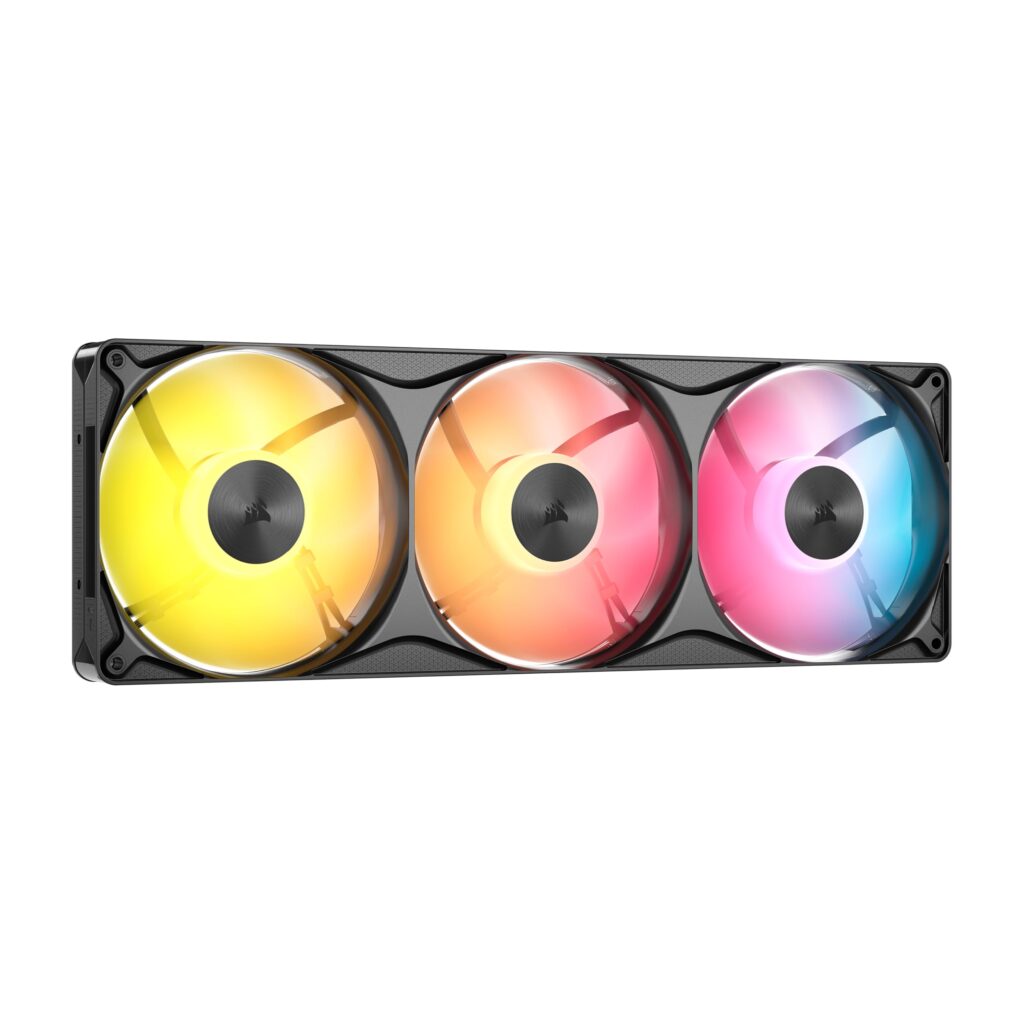
- Unified 360 mm frame streamlines mounting with only four screws while eliminating inter-fan chassis seams
- Universal daisy-chain 4-pin PWM and ARGB connections eliminate proprietary controller hubs
- Magnetic Dome bearings and AirGuide stators generate up to 4.2 mm H2O static pressure and 73 CFM airflow
- True Zero RPM operational mode allows completely silent 0 dBA idle states
- Unified frame construction prevents replacing individual 120 mm fans in the event of an isolated motor failure
- Acoustic output reaches 36 dBA at maximum 2,100 RPM velocity under full thermal load
Overview
Eliminating the alignment friction and cable clustering typical of multi-fan liquid cooling setups, the Corsair RS360 II ARGB consolidates three 4.72 in (120 mm) cooling impellers into a single rigid 14.17 x 4.72 x 1.02 in (360 x 120 x 26 mm) structural housing. Rather than fastening twelve individual screws and managing six discrete power and illumination leads, builders secure the entire 360 mm array with just four chassis screws. Electrical integration is similarly streamlined through standard daisy-chainable 4-pin PWM and 3-pin 5V ARGB connectors, departing from vendor-locked proprietary controller modules and allowing direct speed and lighting regulation via standard motherboard headers.
Aerodynamic performance is anchored by AirGuide stator technology, which integrates anti-vortex vanes behind each rotor to focus exhaust airflow into a concentrated column. Across an operational speed range spanning 420 to 2,100 RPM, the fans generate from 10.8 to 73 CFM of airflow alongside static pressure ranging from 0.15 to 4.2 mm H2O. Under negligible system load, PWM duty cycle modulation down to 0% engages an automated Zero RPM mode, dropping acoustic output to 0 dBA by bringing the impellers to a complete halt. At the minimum active operational floor, acoustic output registers at 10 dBA, scaling to 36 dBA at peak 2,100 RPM velocity when pushing maximum volumetric flow through restrictive radiator fins or dense mesh intake filters.
Mechanical longevity centers on Magnetic Dome bearing assemblies that mitigate metal-on-metal friction to extend operational life, backed by a 5-year manufacturer warranty. Illumination is provided by 24 addressable RGB LEDs distributed evenly across the three rotor hubs, diffusing color outward across the translucent fan blades without requiring background software bloat. The primary integration trade-off lies in the unified housing itself: while structural rigidity and installation convenience are markedly improved, a localized motor or bearing failure out of warranty necessitates replacing the entire 360 mm assembly rather than an isolated fan. Nevertheless, for builders prioritizing clean radiator aesthetics and high static pressure without ecosystem lock-in, the RS360 II ARGB represents an exceptionally balanced cooling implementation.
Technical Specifications
| Brand | Corsair |
| Model | RS360 II ARGB |
| Dimensions | 14.17 x 4.72 x 1.02 in (360 x 120 x 26 mm) |
| Fan Configuration | 3x 4.72 in (120 mm) fans in unified frame |
| Fan Speed | 0, 420 - 2,100 ±10% RPM |
| PWM Duty Cycle Range | 0%, 20% - 100% |
| Airflow Range | 10.8 - 73 CFM |
| Static Pressure | 0.15 - 4.2 mm H2O |
| Sound Level | 10 - 36 dBA |
| Bearing Type | Magnetic Dome |
| Airflow Technology | AirGuide anti-vortex stators |
| Lighting | Addressable RGB (ARGB) |
| LED Count | 24 LEDs (8 per fan hub) |
| Connector Types | Daisy-chain 4-pin PWM, 3-pin 5V ARGB |
| Zero RPM Mode | Yes (0 dBA idle) |
| Available Colorways | Black, White |
| Warranty | 5 Years |
Primary Sources & Audited Citations
Recommended Alternatives in Case Fans
At a Glance
How reliable is the Corsair RS360 II ARGB Review: Unified High-Pressure Radiator Cooling according to Mizex audits?
An optimal cooling upgrade for builders seeking simplified radiator installation and high static pressure without committing to proprietary lighting or fan controller ecosystems.
What are the known quirks or drawbacks of the Corsair RS360 II ARGB Review: Unified High-Pressure Radiator Cooling?
Our reliability audit identified the following documented caveats:
- Unified frame construction prevents replacing individual 120 mm fans in the event of an isolated motor failure
- Acoustic output reaches 36 dBA at maximum 2,100 RPM velocity under full thermal load
What are the key engineering highlights of the Corsair RS360 II ARGB Review: Unified High-Pressure Radiator Cooling?
The top strengths recorded in our evaluation include:
- Unified 360 mm frame streamlines mounting with only four screws while eliminating inter-fan chassis seams
- Universal daisy-chain 4-pin PWM and ARGB connections eliminate proprietary controller hubs
- Magnetic Dome bearings and AirGuide stators generate up to 4.2 mm H2O static pressure and 73 CFM airflow
- True Zero RPM operational mode allows completely silent 0 dBA idle states