
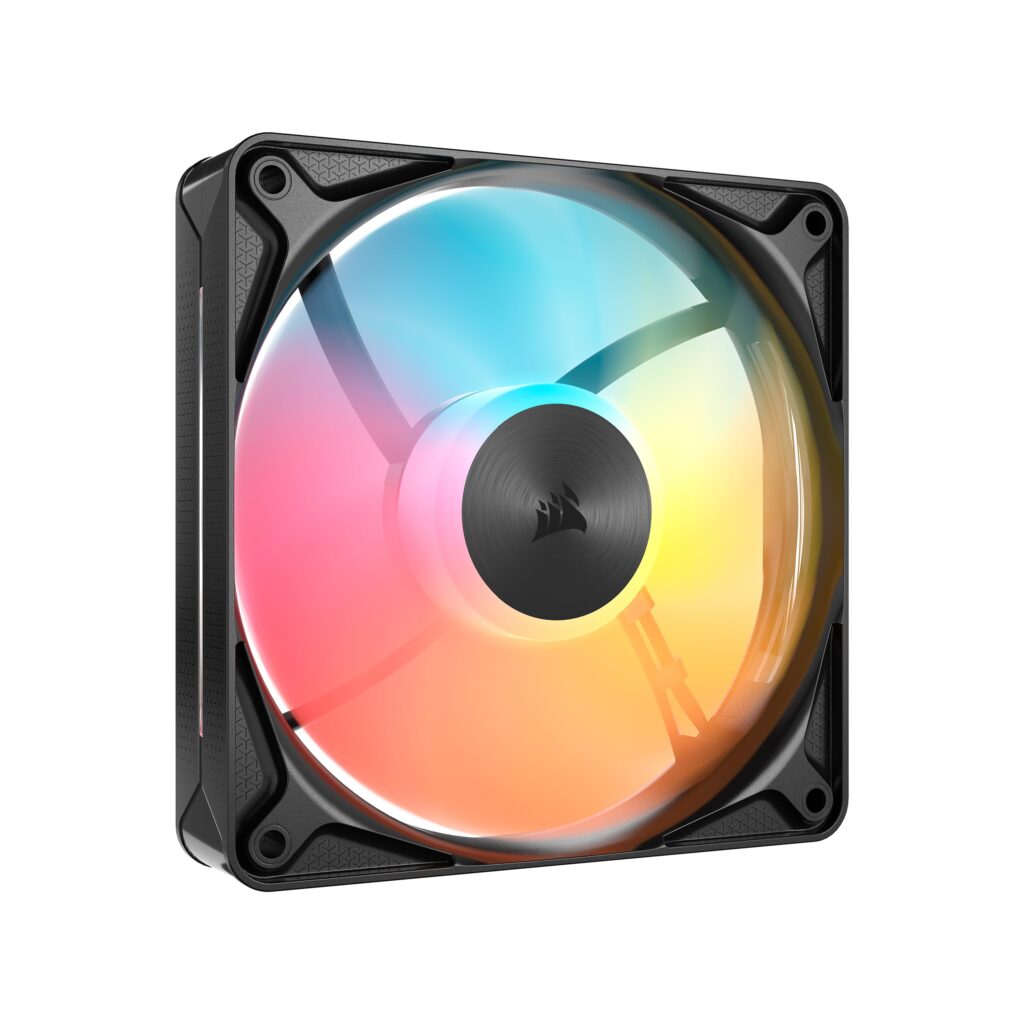
- Daisy-chain 4-pin PWM and ARGB connectors eliminate proprietary hub requirements and simplify cable management
- Magnetic Dome bearing reduces mechanical friction and wear, backed by a 5-year warranty
- Zero RPM mode enables complete fan stoppage below 20% PWM duty cycle for silent operation
- High static pressure reaching up to 4.2 mm-H2O combined with AirGuide stator vanes for focused airflow
- Peak acoustic noise rises to 36 dBA at maximum 2,100 RPM under full load
- Frame thickness of 26 mm (1.02 in) exceeds the standard 25 mm profile, potentially tightening clearances in compact builds
Overview
Moving away from proprietary ecosystem controller hubs, Corsair’s design strategy centers on builder convenience through standardized daisy-chain connectivity. Instead of routing individual cables back to a specialized lighting commander, each fan links directly to adjacent units using standard 4-pin PWM and 3-pin 5V ARGB connectors before a single run terminates at the motherboard. The fan frame measures 4.72 x 4.72 x 1.02 in (120 x 120 x 26 mm)—an additional 0.04 in (1 mm) thicker than standard 0.98 in (25 mm) frames—which provides extra structural rigidity to resist chassis flex while accommodating deeper blade geometry. Eight addressable RGB LEDs are housed within the central hub, diffusing illumination outwards through the semi-translucent blades without introducing excessive wire clutter.
Airflow characteristics are defined by Corsair’s AirGuide technology, which employs curved stator vanes on the exhaust side to focus exhaust air into a concentrated column rather than a dispersed cone. This directional focus yields a static pressure range between 0.15 and 4.2 mm-H2O alongside an airflow volume spanning 10.8 to 73 CFM, making the design well-suited for high-density radiator fins and restrictive dust filters. Under light system loads, an integrated Zero RPM operating mode allows the rotor to halt entirely when PWM duty cycle falls below 20%, maintaining complete acoustic silence at 0 RPM. When pushed to its maximum 2,100 RPM ceiling under heavy thermal stress, acoustic output rises to 36 dBA, requiring deliberate fan curve tuning if quiet operation is preferred during extended peak workloads.
Long-term mechanical endurance rests on Magnetic Dome bearings, an architecture engineered to minimize surface friction and eliminate rotor wobbling over time. By reducing mechanical resistance and wear points, the bearing assembly supports reliable continuous operation across varied mounting orientations, backed by Corsair’s five-year warranty coverage. For system builders prioritizing straightforward cable routing and direct motherboard control without software bloat, the hardware package delivers a practical balance of static pressure capability, standardized wiring, and durable component architecture.
Technical Specifications
| Brand | Corsair |
| Model | RS120 II ARGB |
| Dimensions | 4.72 x 4.72 x 1.02 in (120 x 120 x 26 mm) |
| Fan Size | 4.72 in (120 mm) |
| Bearing Type | Magnetic Dome |
| Rotational Speed | 0, 420 - 2,100 RPM (±10%) |
| Pwm Duty Cycle | 0%, 20% - 100% |
| Airflow | 10.8 - 73.0 CFM |
| Static Pressure | 0.15 - 4.20 mm-H2O |
| Sound Level | 10 - 36 dBA |
| Airflow Technology | CORSAIR AirGuide Stator Vanes |
| Zero Rpm Mode | Supported |
| Lighting | 8x Addressable RGB (ARGB) LEDs |
| Connector Type | Daisy-Chain 4-Pin PWM / 3-Pin ARGB |
| Available Colors | Black, White |
| Warranty | 5 Years |
Primary Sources & Audited Citations
Recommended Alternatives in Case Fans
At a Glance
How reliable is the CORSAIR RS120 II ARGB according to Mizex audits?
Ideal for PC builders seeking high-pressure radiator and chassis cooling with standard daisy-chain headers, provided their case accommodates the slightly thicker 26 mm frame and aggressive fan curves are tuned to mitigate peak 36 dBA noise.
What are the known quirks or drawbacks of the CORSAIR RS120 II ARGB?
Our reliability audit identified the following documented caveats:
- Peak acoustic noise rises to 36 dBA at maximum 2,100 RPM under full load
- Frame thickness of 26 mm (1.02 in) exceeds the standard 25 mm profile, potentially tightening clearances in compact builds
What are the key engineering highlights of the CORSAIR RS120 II ARGB?
The top strengths recorded in our evaluation include:
- Daisy-chain 4-pin PWM and ARGB connectors eliminate proprietary hub requirements and simplify cable management
- Magnetic Dome bearing reduces mechanical friction and wear, backed by a 5-year warranty
- Zero RPM mode enables complete fan stoppage below 20% PWM duty cycle for silent operation
- High static pressure reaching up to 4.2 mm-H2O combined with AirGuide stator vanes for focused airflow