
- Standard daisy-chained 4-pin PWM and 3-pin ARGB connections eliminate proprietary hubs and background software requirements
- High static pressure RS120 fans (up to 4.15 mm-H2O) with Magnetic Dome bearings provide efficient airflow through the radiator
- Offset pump cap geometry ensures clean clearance around motherboard VRM heatsinks and memory modules
- Convex copper cold plate ensures solid mechanical contact pressure with Intel and AMD heat spreaders
- Acoustic output reaches 36 dBA at maximum 2,100 RPM fan speeds during high thermal loads
- Occasional transient fluid gurgling or pump wind-up audible upon cold system boot
Overview
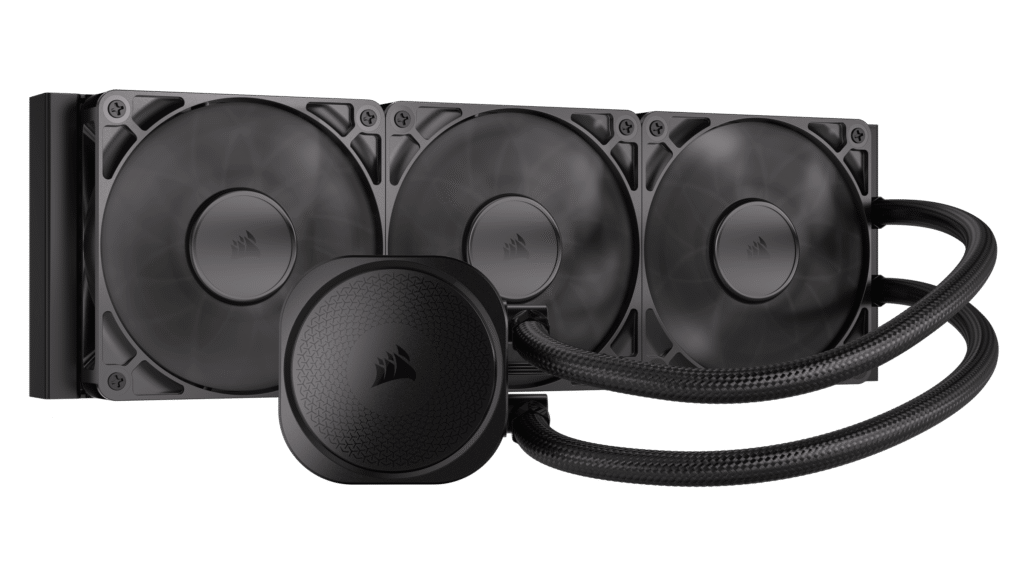
Eschewing proprietary controller ecosystems and dedicated background software, the mechanical architecture of Corsair’s Nautilus 360 RS ARGB prioritizes direct motherboard integration through standardized daisy-chained 4-pin PWM and 3-pin 5V ARGB interfaces. At the core of the thermal loop sits an offset pump block designed to maintain clearance around tall VRM heatsinks and DIMM slots, mated to a precision-machined copper cold plate engineered with a subtle convex profile to optimize mechanical contact pressure against the integrated heat spreaders of contemporary Intel LGA 1851/1700 and AMD AM5/AM4 processors. Coolant transfers through 17.72 in (450 mm) of sleeved, low-permeation rubber tubing to a 15.59 x 4.72 x 1.06 in (396 x 120 x 27 mm) aluminum radiator featuring uniform fin density for predictable convective dissipation.
Airflow across the radiator is driven by three 120 mm RS120 ARGB fans utilizing Magnetic Dome bearings, which minimize rotational friction and suppress motor humming across an operating range of 0 to 2,100 RPM. These fans generate up to 72.8 CFM of airflow and 4.15 mm-H2O of static pressure, delivering ample force to overcome radiator fin impedance. The integrated pump operates at a low acoustic baseline of approximately 20 dBA, while the fans support a true Zero RPM idle mode through motherboard PWM profiles for silent everyday computing. Under sustained maximum thermal loads, acoustic output rises predictably toward 36 dBA, where high-speed blade turbulence becomes discernible.
By eliminating proprietary internal USB controllers, iCUE software dependencies, and standalone wiring hubs, the unit ensures long-term operational stability governed solely by standard UEFI fan curves and motherboard ARGB lighting standards. While the closed-loop design naturally precludes fluid replenishment or coolant level monitoring, the sealed liquid loop and robust bearing assemblies provide steady cooling longevity backed by a five-year manufacturer warranty.
Technical Specifications
| Brand | Corsair |
| Model | Nautilus 360 RS ARGB |
| Cooler Type | All-in-One (AIO) Liquid CPU Cooler |
| Radiator Dimensions | 15.59 x 4.72 x 1.06 in (396 x 120 x 27 mm) |
| Radiator Material | Aluminum |
| Cold Plate Material | Copper (Convex Profile) |
| Tubing Length | 17.72 in (450 mm) |
| Tubing Material | Sleeved Low-Permeation Rubber |
| Total Weight | 4.41 lbs (2.00 kg) |
| Fan Model | Corsair RS120 ARGB PWM |
| Fan Dimensions | 4.72 x 4.72 x 0.98 in (120 x 120 x 25 mm) |
| Fan Quantity | 3 |
| Fan Bearing Type | Magnetic Dome |
| Fan Speed Range | 0 - 2,100 RPM |
| Fan Airflow | 13.3 - 72.8 CFM |
| Fan Static Pressure | 0.20 - 4.15 mm-H2O |
| Fan Noise Level | 10 - 36 dBA |
| Pump Noise Level | ~20 dBA |
| Lighting | Addressable RGB (8 LEDs per fan, 8 LEDs on pump) |
| Control Interface | Standard 4-pin PWM, Standard 3-pin 5V ARGB |
| Socket Compatibility Intel | LGA 1851, LGA 1700 |
| Socket Compatibility AMD | AM5, AM4 |
| Warranty | 5 Years |
Recommended Alternatives in CPU Coolers (AIO & Air)
At a Glance
How reliable is the Corsair Nautilus 360 RS ARGB Review: Simplified High-Headroom Liquid Cooling according to Mizex audits?
Ideal for PC builders seeking high-performance 360 mm CPU cooling who want direct motherboard PWM and ARGB control without the complexity or cost of proprietary ecosystem controllers.
What are the known quirks or drawbacks of the Corsair Nautilus 360 RS ARGB Review: Simplified High-Headroom Liquid Cooling?
Our reliability audit identified the following documented caveats:
- Acoustic output reaches 36 dBA at maximum 2,100 RPM fan speeds during high thermal loads
- Occasional transient fluid gurgling or pump wind-up audible upon cold system boot
What are the key engineering highlights of the Corsair Nautilus 360 RS ARGB Review: Simplified High-Headroom Liquid Cooling?
The top strengths recorded in our evaluation include:
- Standard daisy-chained 4-pin PWM and 3-pin ARGB connections eliminate proprietary hubs and background software requirements
- High static pressure RS120 fans (up to 4.15 mm-H2O) with Magnetic Dome bearings provide efficient airflow through the radiator
- Offset pump cap geometry ensures clean clearance around motherboard VRM heatsinks and memory modules
- Convex copper cold plate ensures solid mechanical contact pressure with Intel and AMD heat spreaders