
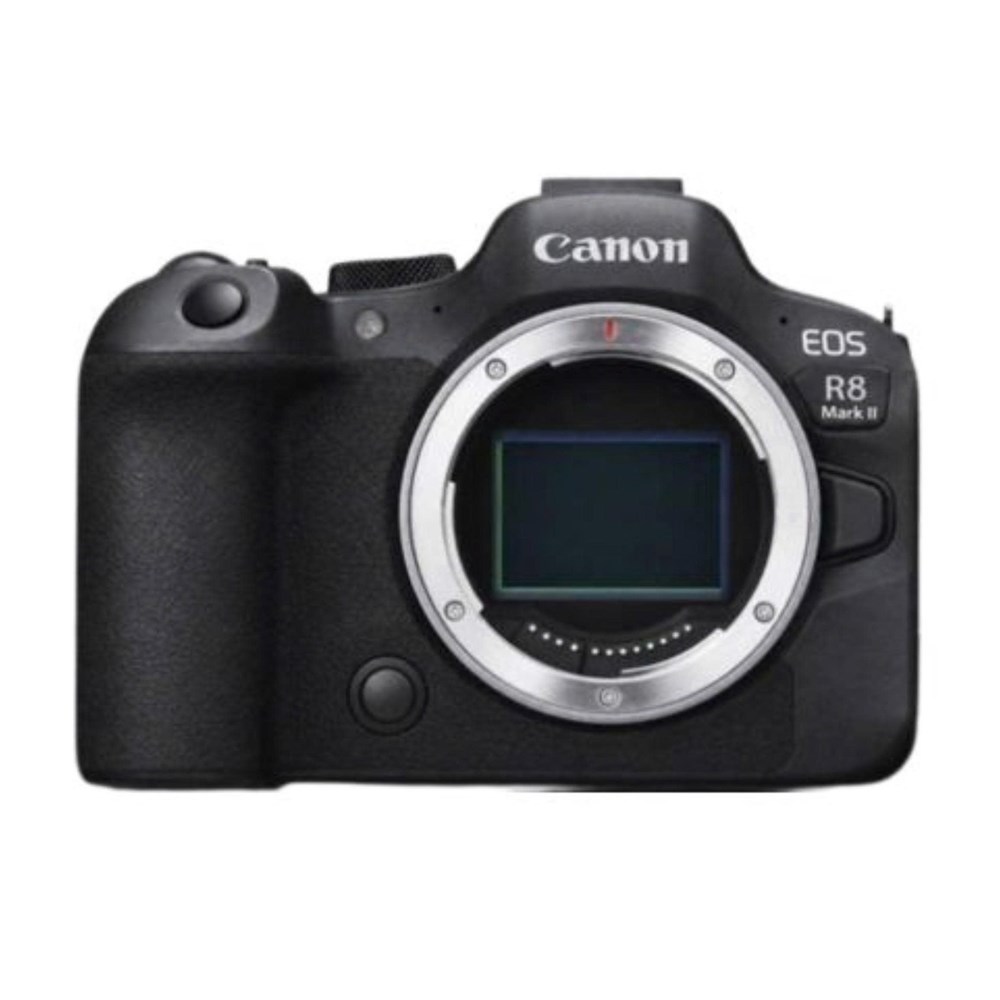
- Integrated 5-axis in-body image stabilization rated for up to 7.5 stops of shake correction
- Uncropped 4K 60p oversampled from 6K with internal 10-bit 4:2:2 Canon Log 3 recording
- Upgraded tactile ergonomics featuring an angular body redesign and dedicated multi-controller joystick
- Fast Dual Pixel CMOS AF II tracking with deep-learning subject recognition and up to 40 fps electronic burst
- Compact LP-E17 battery yields limited runtime of 220 to 340 shots and creates thermal ceilings during extended 4K 60p recording
- Single UHS-II SD card slot lacks hardware redundancy for critical professional assignments
- Micro-HDMI (Type-D) output and lack of a full mechanical shutter introduce workflow and optical trade-offs
Overview
Weighing 19.3 oz (546 g) with battery and media installed, the EOS R8 Mark II reorganizes Canon’s entry-tier full-frame architecture around a compact, angular polycarbonate chassis reinforced by an internal magnesium alloy subframe. The defining engineering addition is a miniaturized 5-axis sensor-shift mechanism delivering up to 7.5 stops of stabilization, resolving the primary operational limitation of its predecessor while maintaining a portable footprint of 5.17 x 3.54 x 3.14 in (131.3 x 89.9 x 79.8 mm). Physical handling receives a significant ergonomic upgrade via a redesigned thumb rest and a dedicated rear multi-controller joystick, enabling direct focus-point navigation without relying on touchscreen gestures. The optical pipeline pairs a proven 24.2-megapixel full-frame CMOS sensor with the DIGIC X processor, supporting Dual Pixel CMOS AF II with deep-learning subject detection across people, animals, and vehicles alongside burst capture speeds reaching 40 frames per second via the electronic shutter.
Acoustically and mechanically, the camera operates near-silently in pure electronic mode and maintains a muffled acoustic footprint during burst sequences thanks to an electronic first-curtain shutter mechanism, though the absence of a fully mechanical shutter curtain leaves high-aperture exposures susceptible to subtle optical truncation at speeds above 1/2000s. Passive heat dissipation relies entirely on conductive thermal routing throughout the composite shell rather than active fans, which introduces thermal ceilings during prolonged 4K 60p recording oversampled from 6K. These thermal boundaries are further complicated by Canon’s retention of the compact LP-E17 lithium-ion battery pack, which is rated under CIPA testing for approximately 220 shots through the 2.36-million-dot OLED viewfinder and 340 shots via the vari-angle LCD. High-drain hybrid shooting visibly strains this power reserve, necessitating external USB-C power delivery or multiple backup cells in the field.
Firmware execution remains consistent with Canon’s current EOS ecosystem, delivering responsive menu navigation, dependable subject tracking retention, and robust internal 10-bit 4:2:2 Canon Log 3 encoding for color-graded workflows. However, segment tiering is apparent across its peripheral I/O and data topology. Data writing routes through a single UHS-II SD card slot, eliminating real-time backup redundancy for critical documentary or event captures. External video monitoring connects via a fragile micro-HDMI Type-D terminal rather than a full-size port, requiring cable strain relief in rigged configurations. For run-and-gun creators seeking stabilized full-frame performance without the bulk of flagship bodies, the camera delivers an agile imaging platform anchored by intentional ergonomic compromises.
Technical Specifications
| Brand | Canon |
| Model | EOS R8 Mark II |
| Sensor Type | 24.2 MP Full-Frame CMOS (35.9 x 23.9 mm) |
| Image Processor | DIGIC X |
| In Body Image Stabilization (IBIS) | 5-axis sensor-shift (up to 7.5 stops) |
| Autofocus System | Dual Pixel CMOS AF II with Deep Learning Subject Tracking |
| Shutter Mechanism | Electronic first-curtain shutter (EFCS) and electronic shutter |
| Shutter Speed | 1/16,000 to 30 sec (electronic), 1/4,000 to 30 sec (EFCS) |
| Continuous Shooting Speed | Up to 40 fps (electronic shutter), 6 fps (EFCS) |
| Video Resolution & Framerates | 4K UHD up to 60p (oversampled from 6K), FHD up to 180p |
| Video Color Sampling & Profiles | 10-bit 4:2:2 Canon Log 3 (C-Log3), HDR PQ |
| Electronic Viewfinder (EVF) | 0.39-inch OLED, 2.36 million dots, 0.70x magnification, up to 120 Hz |
| Rear Display | 3.0-inch vari-angle touchscreen LCD, 1.62 million dots |
| Storage Media | 1x SD/SDHC/SDXC (UHS-II supported) |
| Connectivity | USB-C (USB 3.2 Gen 2), Micro-HDMI (Type-D), 3.5mm Mic, 3.5mm Headphone, 2.4 GHz Wi-Fi, Bluetooth 4.2 |
| Battery Type | LP-E17 Rechargeable Lithium-Ion |
| Battery Life (CIPA) | Approx. 220 shots (EVF), 340 shots (LCD) |
| Dimensions (W X H X D) | 5.17 x 3.54 x 3.14 in (131.3 x 89.9 x 79.8 mm) |
| Weight (Body Only) | 17.6 oz (499 g) |
| Weight (With Battery & Card) | 19.3 oz (546 g) |
| Chassis Construction | Magnesium alloy core with polycarbonate resin exterior |
Primary Sources & Audited Citations
Recommended Alternatives in Cameras & Photography
At a Glance
How reliable is the Canon EOS R8 Mark II Review: Stabilized Full-Frame Meets Battery Constraints according to Mizex audits?
Ideal for hybrid content creators prioritizing a featherweight stabilized full-frame kit, provided they pack multiple spare batteries and do not require dual-slot card redundancy.
What are the known quirks or drawbacks of the Canon EOS R8 Mark II Review: Stabilized Full-Frame Meets Battery Constraints?
Our reliability audit identified the following documented caveats:
- Compact LP-E17 battery yields limited runtime of 220 to 340 shots and creates thermal ceilings during extended 4K 60p recording
- Single UHS-II SD card slot lacks hardware redundancy for critical professional assignments
- Micro-HDMI (Type-D) output and lack of a full mechanical shutter introduce workflow and optical trade-offs
What are the key engineering highlights of the Canon EOS R8 Mark II Review: Stabilized Full-Frame Meets Battery Constraints?
The top strengths recorded in our evaluation include:
- Integrated 5-axis in-body image stabilization rated for up to 7.5 stops of shake correction
- Uncropped 4K 60p oversampled from 6K with internal 10-bit 4:2:2 Canon Log 3 recording
- Upgraded tactile ergonomics featuring an angular body redesign and dedicated multi-controller joystick
- Fast Dual Pixel CMOS AF II tracking with deep-learning subject recognition and up to 40 fps electronic burst