
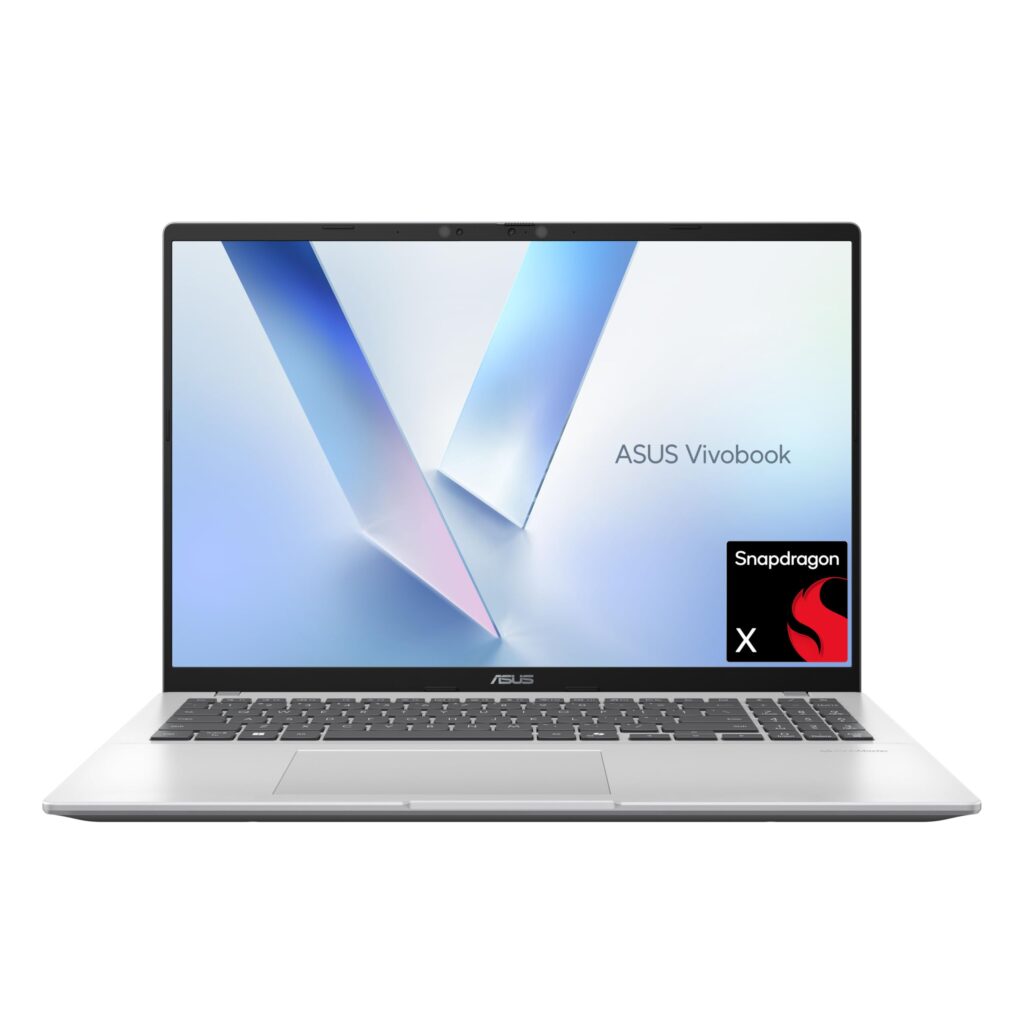
- Spacious 16.0-inch 16:10 (1920 x 1200) anti-glare display in a relatively light 4.14 lbs (1.88 kg) chassis
- Comfortable 1.7 mm ErgoSense keyboard paired with a physical webcam privacy shutter and IR Windows Hello on newer Copilot+ variants
- Accessible M.2 2280 SSD, battery, and socketed Wi-Fi 6E card on the X1607, plus dual 40 Gbps USB4 and HDMI 2.1 on the X1607QA
- Dim 60 Hz IPS panel restricted to 45% NTSC color coverage
- Soldered, non-upgradeable RAM on X1607QA and M1606K models alongside a single M.2 2280 slot and no SD card reader or Ethernet port
- Sharp inconsistencies across sub-variants in port speeds, keyboard backlighting, and battery endurance
Overview
Built around a spacious 16.0-inch 16:10 canvas in a 4.14 lbs (1.88 kg) chassis, ASUS’s mainstream 16-inch Vivobook lineup prioritizes everyday desk and commuter practicality over flashy aesthetics. The 1920 x 1200 anti-glare IPS panel gives spreadsheet users, students, and office workers extra vertical breathing room without weighing down a backpack, while the ErgoSense chiclet keyboard offers a comfortable 1.7 mm of key travel paired with a Precision touchpad supporting Smart Gesture controls. Practical security and ergonomics also get welcome attention, with a physical webcam privacy shutter across the family, a 180-degree lay-flat hinge on the X1605, and IR Windows Hello sign-in on newer X1607QA and M1607 configurations.
Beneath the shell, however, buying into this nameplate requires careful attention to the exact model code because hardware architecture shifts dramatically across generations and regions. ASUS spans Intel Core and Core Ultra chips, AMD Ryzen and Ryzen AI processors with up to 50 TOPS NPUs, and Qualcomm’s Snapdragon X platform with a 45 TOPS Hexagon NPU. Newer X1607QA units step up to dual 40 Gbps USB4 Type-C ports, HDMI 2.1, a 65W USB-C power adapter, and a socketed Qualcomm Wi-Fi 6E card, whereas older M1605 and F1605 models rely on USB 3.2 Gen 1, USB 2.0, HDMI 1.4, and barrel DC-in charging, and the M1606K restricts ports to 5 Gbps speeds. Upgradability is similarly split: M1605 and M1607 configurations retain a DDR4 or DDR5 SO-DIMM slot alongside onboard RAM, while X1607QA and M1606K solder 16GB of memory permanently, leaving only a single M.2 2280 NVMe slot and socketed wireless card for post-purchase expansion.
Thermal management relies on a single blower fan and heat pipe over a copper CPU plate exhausting through the rear hinge, a straightforward layout that keeps internal access to the battery and M.2 drive uncluttered on the X1607. Even so, one-fan cooling faces wider thermal headroom demands on higher-power H- and HS-series silicon, and review testing on the M1606K noted a right-heavy cooling balance. Day-to-day perception is further tempered by a dim 60 Hz IPS panel capped at 45% NTSC color coverage, no built-in SD card reader or Ethernet jack, and uneven regional configurations that omit keyboard backlighting or deliver underwhelming battery runtime on X1605 and M1606K variants.
Technical Specifications
| Brand | ASUS |
| Model | Vivobook 16 |
| Model Variants | F1605 / X1605 / X1607AA (Intel), M1605 / M1606K / M1607 (AMD), X1607QA (Snapdragon X) |
| Processors | Up to Intel Core 9 270H / Core Ultra 5 325, AMD Ryzen 9 7940HS / Ryzen AI 7 445, or Qualcomm Snapdragon X X1-26-100 |
| Neural Processing | Up to 45 TOPS Qualcomm Hexagon NPU (X1607QA); up to 50 TOPS NPU (M1607) |
| Display | 16.0-inch WUXGA (1920 x 1200, 16:10, 142 PPI), 60 Hz IPS anti-glare, 45% NTSC, TÜV Rheinland-certified |
| Memory | 8GB–32GB DDR4/DDR5 (1x SO-DIMM on M1605/M1607) or 16GB LPDDR5X soldered (X1607QA) |
| Storage | 1x M.2 2280 NVMe PCIe 3.0 x4 or PCIe 4.0 x4 SSD (512GB or 1TB) |
| I/O Ports (Variant Dependent) | Up to 2x USB4 Type-C (40 Gbps, DP/PD), 2x USB 3.2 Gen 1 Type-A, HDMI 2.1, 3.5mm Audio Jack (X1607QA); USB 2.0 / HDMI 1.4 / DC-in on older models |
| Wireless Connectivity | Wi-Fi 6E (802.11ax, 2x2, socketed Qualcomm QCNFA765 on X1607QA), Bluetooth 5.3 |
| Webcam & Input | 1080p FHD with physical privacy shutter (IR Windows Hello on X1607QA/M1607); ErgoSense keyboard (1.7 mm travel) |
| Cooling & Battery | Single blower fan, heat pipe over copper CPU plate, rear exhaust; 42 Wh, 50 Wh, or 70 Wh 3-cell Li-ion; 65W USB-C adapter (X1607QA) |
| Dimensions | 14.06 x 9.87 x 0.70–0.78 in (357.0 x 250.6 x 17.9–19.9 mm) |
| Weight | 4.14 lbs (1.88 kg) |
Primary Sources & Audited Citations
- ASUS Vivobook 16 (F1605) Official Technical Specifications
- ASUS Vivobook 16 (M1605) Official Technical Specifications
- ASUS Vivobook 16 (X1607QA) Official Technical Specifications
- ASUS Vivobook 16 (M1607) Official Product Overview
- Notebookcheck: Asus Vivobook 16 X1607QA Specifications & Reviews
- Notebookcheck: Asus Vivobook 16 Laptop Review (M1606K / M1607K)
- Notebookcheck: Asus Vivobook 16 X1607AA Specifications & Reviews
- LaptopMedia: How to Open ASUS Vivobook 16 X1607 - Disassembly and Upgrade Options
- LaptopMedia: How to Open ASUS Vivobook 16 (M1605) - Disassembly and Upgrade Options
- LaptopMedia: ASUS Vivobook 16 (X1605) Review
- Tech Advisor: Asus Vivobook 16 (X1605) Review
Recommended Alternatives in Laptops
At a Glance
How reliable is the ASUS Vivobook 16 according to Mizex audits?
A lightweight, comfortable 16-inch productivity laptop if you verify the exact sub-model's ports, battery capacity, and RAM upgradability and can live with a muted 45% NTSC display.
What are the known quirks or drawbacks of the ASUS Vivobook 16?
Our reliability audit identified the following documented caveats:
- Dim 60 Hz IPS panel restricted to 45% NTSC color coverage
- Soldered, non-upgradeable RAM on X1607QA and M1606K models alongside a single M.2 2280 slot and no SD card reader or Ethernet port
- Sharp inconsistencies across sub-variants in port speeds, keyboard backlighting, and battery endurance
What are the key engineering highlights of the ASUS Vivobook 16?
The top strengths recorded in our evaluation include:
- Spacious 16.0-inch 16:10 (1920 x 1200) anti-glare display in a relatively light 4.14 lbs (1.88 kg) chassis
- Comfortable 1.7 mm ErgoSense keyboard paired with a physical webcam privacy shutter and IR Windows Hello on newer Copilot+ variants
- Accessible M.2 2280 SSD, battery, and socketed Wi-Fi 6E card on the X1607, plus dual 40 Gbps USB4 and HDMI 2.1 on the X1607QA