
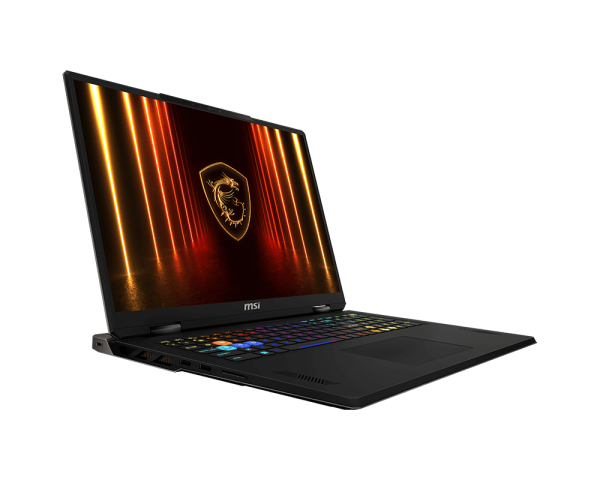
- Flagship compute and graphics throughput from the Core Ultra 9 275HX and 175 W RTX 5090 Laptop GPU with 64 GB DDR5-6400
- Crisp 18.0-inch 2560 x 1600 (168 PPI) 240 Hz IPS display
- Modern I/O featuring dual Thunderbolt 5 ports, USB-C Power Delivery, and Wi-Fi 7
- Strong thermal engineering under sustained workloads
- Plastic chassis construction instead of metal
- Heavy 7.94 lbs (3.6 kg) footprint limits portability
- Keyboard layout compromises
Overview
Built as a stationary powerhouse rather than a sleek commuter, the Vector 18 HX AI A2XWJG puts nearly all of its engineering budget into raw compute and graphics throughput. At its core sits Intel’s 24-core Core Ultra 9 275HX Arrow Lake-HX processor—splitting eight Lion Cove P-Cores up to 5.4 GHz and sixteen Skymont E-Cores up to 4.6 GHz—alongside a full-power 175 W NVIDIA GeForce RTX 5090 Laptop GPU with 24 GB of GDDR7 memory and 64 GB of DDR5-6400 RAM. That hardware drives a crisp 18.0-inch 16:10 IPS panel running at 2560 x 1600 resolution (168 PPI) and 240 Hz, giving both competitive games and sprawling creative timelines plenty of canvas and motion clarity.
To keep a 175 W GPU and 24-core HX processor fed under sustained workloads, MSI leans into a thick 1.26-inch (32.05 mm) chassis measuring 15.91 x 12.11 inches (404 x 307.5 mm) at 7.94 lbs (3.6 kg). That generous internal volume pays off with strong thermal engineering that holds up during prolonged heavy loads. Outside the cooling stack, cost-saving compromises are evident: the outer shell uses plastic rather than metal, and the backlit chiclet keyboard suffers from layout compromises that take time to adjust to.
Connectivity is a standout strength for multi-monitor desks and high-speed storage arrays, pairing dual Thunderbolt 5 ports and USB-C Power Delivery with three USB 3.1 Gen2 ports, HDMI, Gigabit Ethernet, Wi-Fi 7, and Bluetooth 5.4. A 99 Wh 4-cell battery, an HDR-capable 1080p IR webcam, stereo speakers, and Windows 11 Home round out a true desktop replacement meant to stay anchored to a desk where its weight disappears and its expansion options shine.
Technical Specifications
| Model | MSI Vector 18 HX |
| Model Variant | MSI Vector 18 HX AI A2XWJG |
| Processor | Intel Core Ultra 9 275HX (24 cores / 24 threads; 8x Lion Cove P-Core up to 5.4 GHz, 16x Skymont E-Core up to 4.6 GHz) |
| Graphics | NVIDIA GeForce RTX 5090 Laptop (24 GB GDDR7, 2160 MHz core clock, 175 W TDP) |
| Memory | 64 GB DDR5-6400 |
| Display | 18.0-inch 16:10 IPS, 2560 x 1600 (168 PPI), 240 Hz |
| Storage Interface | M.2 PCIe |
| Ports | 3x USB 3.1 Gen2, 2x Thunderbolt 5, USB-C Power Delivery (PD), 1x HDMI, 3.5 mm audio |
| Networking | 10/100/1000 Mbps Ethernet LAN, Wi-Fi 7 (802.11be), Bluetooth 5.4 |
| Battery | 99 Wh, 4-cell |
| Webcam | IR FHD (1080p at 30 fps) with HDR |
| Audio | Stereo speakers |
| Keyboard | Backlit chiclet |
| Chassis Material | Plastic |
| Dimensions | 1.26 x 15.91 x 12.11 in (32.05 x 404 x 307.5 mm) |
| Weight | 7.94 lbs (3.6 kg) |
| Operating System | Microsoft Windows 11 Home |
Primary Sources & Audited Citations
Recommended Alternatives in Laptops

At a Glance
How reliable is the MSI Vector 18 HX according to Mizex audits?
Buy this if you want desktop-grade gaming and rendering horsepower with dual Thunderbolt 5 expansion at a fixed desk; look at a lighter 16-inch metal-chassis laptop if you commute daily or care deeply about keyboard layout ergonomics.
What are the known quirks or drawbacks of the MSI Vector 18 HX?
Our reliability audit identified the following documented caveats:
- Plastic chassis construction instead of metal
- Heavy 7.94 lbs (3.6 kg) footprint limits portability
- Keyboard layout compromises
What are the key engineering highlights of the MSI Vector 18 HX?
The top strengths recorded in our evaluation include:
- Flagship compute and graphics throughput from the Core Ultra 9 275HX and 175 W RTX 5090 Laptop GPU with 64 GB DDR5-6400
- Crisp 18.0-inch 2560 x 1600 (168 PPI) 240 Hz IPS display
- Modern I/O featuring dual Thunderbolt 5 ports, USB-C Power Delivery, and Wi-Fi 7
- Strong thermal engineering under sustained workloads