
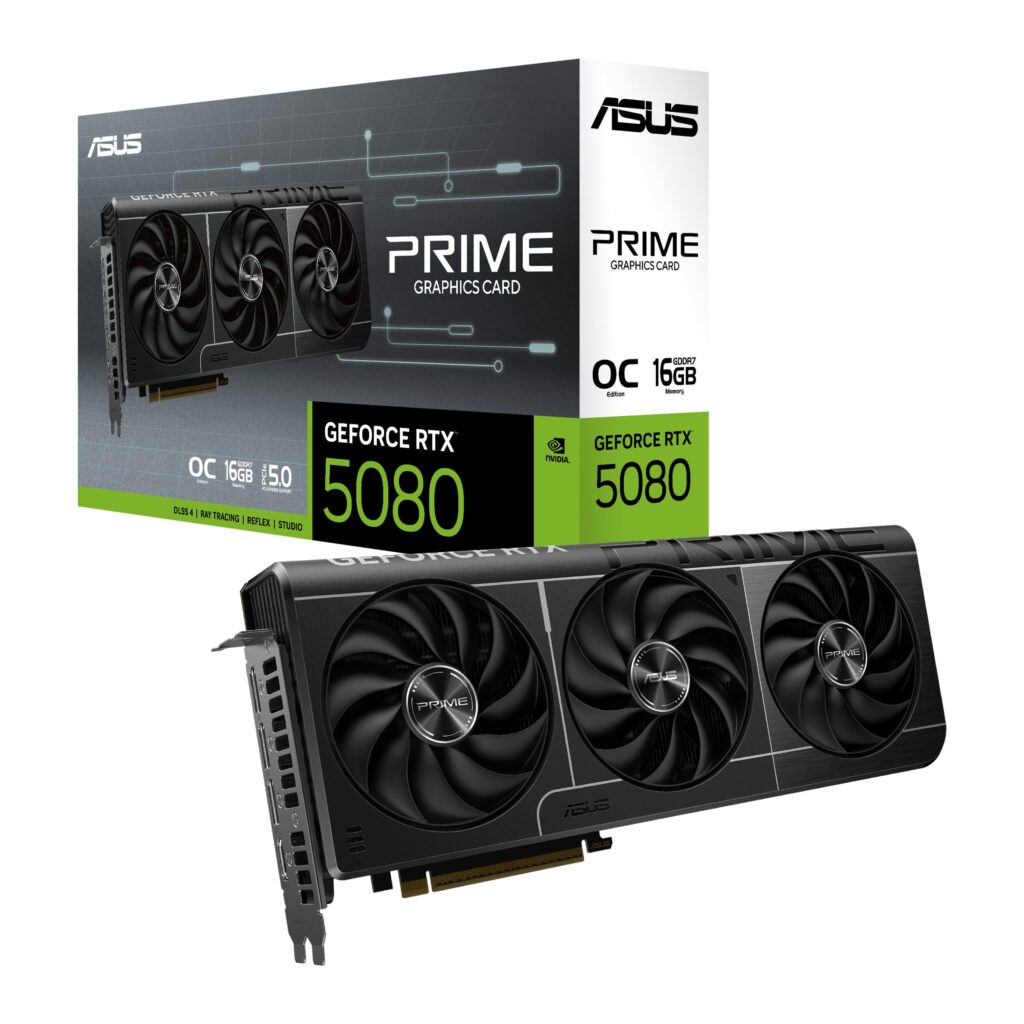
- True 2.5-slot SFF-Ready dimensions at 12.0 x 5.0 x 2.0 in (304 x 126 x 50 mm) for compact case compatibility
- Triple Axial-Tech fans with long-life dual-ball bearings and a phase-change GPU thermal pad
- Physical Dual BIOS switch for easy toggling between Performance and Quiet profiles
- Modern PCIe 5.0 interface, 16GB 30 Gbps GDDR7 memory, and native HDMI 2.1b / DisplayPort 2.1b outputs
- Drops the vapor chamber used on the original ASUS Prime RTX 5080 in favor of a conventional heatsink
- Requires a 16-pin power feed (or included 1-to-3 adapter) and an 850W recommended PSU
Overview
Squeezing Blackwell silicon into a true 2.5-slot footprint isn’t easy when most modern graphics cards balloon past three slots. Measuring 12.0 x 5.0 x 2.0 in (304 x 126 x 50 mm), this EVO revision keeps ASUS’s SFF-Ready proportions intact while packing an RTX 5080 GPU with 10,752 CUDA cores, 1,801 TOPs of AI compute, and 16GB of GDDR7 memory running at 30 Gbps over a 256-bit bus. Out of the box, it hits a 2655 MHz default boost clock and stretches to 2685 MHz in OC mode, driving modern panels over PCI Express 5.0 via one native HDMI 2.1b port and three native DisplayPort 2.1b outputs.
Where the EVO parts ways with the original Prime RTX 5080 is right underneath the shroud. ASUS swaps out the earlier card’s vapor chamber for a conventional heatsink, relying on three Axial-Tech fans and a phase-change GPU thermal pad to move heat out of the compact fin stack. That phase-change material resists pump-out better than conventional paste over years of thermal cycling, and the dual-ball fan bearings are built for long service life. A physical Dual BIOS switch on the card also lets you flip between Performance and Quiet modes depending on whether you prioritize cooler clocks or gentler fan behavior.
Power feeds through a single 16-pin connector with an 850W PSU recommended, and ASUS bundles a 1-to-3 adapter cable alongside a Velcro strap in the box for cable routing. Software support spans ASUS GPU Tweak III, MuseTree, and NVIDIA’s Game Ready and Studio drivers, with support for up to four displays at a maximum 7680 x 4320 resolution. Trading away the vapor chamber makes this EVO variant a practical space-and-cost play rather than an overbuilt thermal showcase, making it best suited to SFF cases with steady intake airflow.
Technical Specifications
| Brand | ASUS |
| Model | PRIME-RTX5080-O16G-EVO |
| GPU Architecture | NVIDIA Blackwell (GeForce RTX 5080) |
| CUDA Cores | 10,752 |
| AI Performance | 1,801 TOPs |
| Boost Clock | 2685 MHz (OC Mode) / 2655 MHz (Default Mode) |
| Video Memory | 16GB GDDR7 (30 Gbps, 256-bit) |
| Bus Interface | PCI Express 5.0 |
| Display Outputs | 1 x Native HDMI 2.1b, 3 x Native DisplayPort 2.1b (HDCP 2.3, up to 4 displays, 7680 x 4320 max) |
| Cooling & BIOS | Triple Axial-Tech fans (dual-ball bearings), phase-change GPU thermal pad, conventional heatsink, Dual BIOS (Performance / Quiet) |
| Form Factor | 2.5-Slot (SFF-Ready) |
| Dimensions | 12.0 x 5.0 x 2.0 in (304 x 126 x 50 mm) |
| Power Connector & PSU | 1 x 16-pin (1-to-3 adapter included), 850W recommended PSU |
| Software & API | OpenGL 4.6, ASUS GPU Tweak III, MuseTree, GeForce Game Ready & Studio Drivers |
Primary Sources & Audited Citations
Recommended Alternatives in Graphics Cards (GPUs)
At a Glance
How reliable is the ASUS Prime GeForce RTX 5080 EVO 16GB OC Edition according to Mizex audits?
Buy this if you need a strict 2.5-slot RTX 5080 for a compact chassis; look at the original vapor-chamber Prime RTX 5080 or thicker triple-slot cards if you have room in a full-size tower.
What are the known quirks or drawbacks of the ASUS Prime GeForce RTX 5080 EVO 16GB OC Edition?
Our reliability audit identified the following documented caveats:
- Drops the vapor chamber used on the original ASUS Prime RTX 5080 in favor of a conventional heatsink
- Requires a 16-pin power feed (or included 1-to-3 adapter) and an 850W recommended PSU
What are the key engineering highlights of the ASUS Prime GeForce RTX 5080 EVO 16GB OC Edition?
The top strengths recorded in our evaluation include:
- True 2.5-slot SFF-Ready dimensions at 12.0 x 5.0 x 2.0 in (304 x 126 x 50 mm) for compact case compatibility
- Triple Axial-Tech fans with long-life dual-ball bearings and a phase-change GPU thermal pad
- Physical Dual BIOS switch for easy toggling between Performance and Quiet profiles
- Modern PCIe 5.0 interface, 16GB 30 Gbps GDDR7 memory, and native HDMI 2.1b / DisplayPort 2.1b outputs