
- Integrated Wi-Fi 6 and Bluetooth connectivity out of the box
- PCIe 4.0 x16 slot and primary PCIe 4.0 x4 M.2 interface for modern GPUs and fast NVMe storage
- Dual M.2 slots and four SATA 6Gb/s ports provide ample storage versatility for micro-ATX
- Three addressable Gen 2 ARGB headers and Fan Xpert 2+ control
- Unheatsinked 4+2 phase VRM limits thermal headroom for processors beyond 65W TDP
- Lacks a dedicated hardware BIOS FlashBack button and rear USB Type-C connectivity
- Limited to two DDR4 DIMM slots with a 64GB maximum memory capacity
Overview
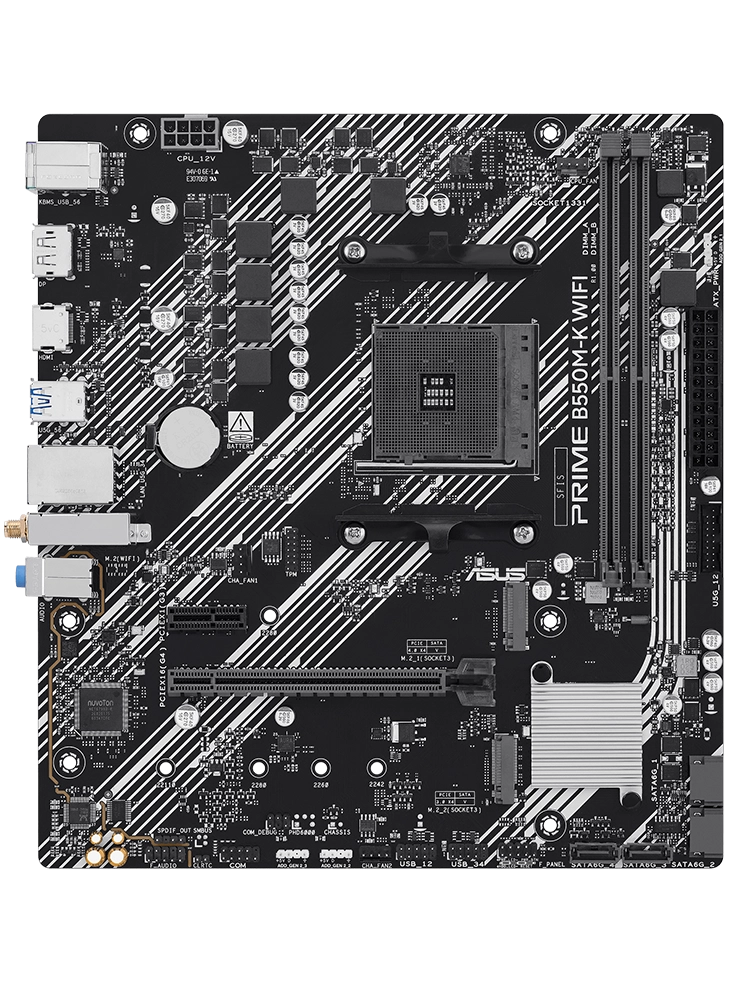
Silicon routing on the AMD B550 platform pairs a native PCIe 4.0 x16 graphics bus and primary PCIe 4.0 x4 M.2 storage pipeline directly with the AM4 processor, while peripheral expansion routes downstream through the chipset. Power delivery relies on a basic 4+2 phase discrete MOSFET arrangement without integrated VRM heatsinks, managed by an ASUS Digi+ PWM controller. The layout is compact across a standard micro-ATX footprint, pairing dual DDR4 memory channels across two DIMM slots with four right-angle SATA 6Gbps ports and a secondary PCIe 3.0 x4 M.2 interface for auxiliary storage.
Thermal dissipation for the core power stages is entirely reliant on ambient system airflow, as the bare high- and low-side MOSFET packages lack aluminum heat spreaders. While the chipset is covered by a low-profile passive aluminum heatsink, sustained multi-threaded workloads on processors exceeding 65W TDP elevate component temperatures around the socket, necessitating directed downward airflow from CPU coolers. Fan regulation is handled via Fan Xpert 2+ across three 4-pin PWM/DC hybrid headers, keeping acoustic profiles dependent on chassis fan curves.
Component isolation includes basic audio shielding separating the Realtek 7.1 codec circuitry from adjacent high-speed traces, complemented by ASUS LANGuard surge protection on the gigabit Ethernet port. Firmware stability is maintained via regular ASUS UEFI updates with Q-LED Core diagnostics providing basic POST troubleshooting via the power LED; however, the board omits a hardware BIOS FlashBack button, requiring an already-compatible processor to execute BIOS updates. For day-to-day operation in entry-level and office builds running 65W Ryzen processors, the platform offers stable basic throughput within strict power envelope constraints.
Technical Specifications
| Brand | ASUS |
| Model | Prime B550M-K WiFi |
| Form Factor | Micro-ATX (9.6 x 8.7 in / 244 x 221 mm) |
| CPU Socket | AMD Socket AM4 |
| Supported Processors | AMD Ryzen 5000 / 5000 G-Series / 4000 G-Series / 3000 Series |
| Chipset | AMD B550 |
| Power Delivery | 4+2 Phase Digi+ VRM (Discrete MOSFETs, unheatsinked) |
| Memory Slots | 2 x DDR4 DIMM (Dual-channel, up to 64GB, up to DDR4-5100 OC) |
| PCIe Expansion | 1 x PCIe 4.0 x16 (SafeSlot Core), 1 x PCIe 3.0 x1 |
| Storage Interfaces | 1 x M.2 2280 (PCIe 4.0 x4 & SATA), 1 x M.2 22110 (PCIe 3.0 x4 & SATA), 4 x SATA 6Gb/s |
| Wireless Connectivity | Wi-Fi 6 (802.11ax 1x1, 2.4/5GHz) + Bluetooth |
| Wired Networking | Realtek 1Gb Ethernet with ASUS LANGuard |
| Audio Codec | Realtek 7.1 Surround High Definition Audio CODEC |
| Rear I/O Ports | 4 x USB 3.2 Gen 1 (5Gbps Type-A), 2 x USB 2.0 Type-A, 1 x HDMI 2.1, 1 x DisplayPort 1.4, 1 x PS/2, 3 x Audio Jacks, 2 x Wi-Fi Antenna Ports, 1 x RJ-45 |
| Internal USB Headers | 1 x USB 3.2 Gen 1 header (supports 2 ports), 2 x USB 2.0 headers (supports 4 ports) |
| Fan Headers | 1 x 4-pin CPU Fan header, 2 x 4-pin Chassis Fan headers |
| RGB Headers | 3 x Addressable Gen 2 ARGB headers |
| Power Connectors | 1 x 24-pin EATX, 1 x 8-pin ATX 12V |
| BIOS & Diagnostics | 128Mb Flash ROM UEFI AMI BIOS, Q-LED Core |
Recommended Alternatives in Motherboards
At a Glance
How reliable is the ASUS Prime B550M-K WiFi Review: Budget AM4 Platform With Thermal Restraints according to Mizex audits?
Best reserved for 65-watt Ryzen processors in budget-conscious builds, where its PCIe 4.0 support and integrated Wi-Fi 6 outweigh the lack of VRM heatsinks and hardware BIOS FlashBack.
What are the known quirks or drawbacks of the ASUS Prime B550M-K WiFi Review: Budget AM4 Platform With Thermal Restraints?
Our reliability audit identified the following documented caveats:
- Unheatsinked 4+2 phase VRM limits thermal headroom for processors beyond 65W TDP
- Lacks a dedicated hardware BIOS FlashBack button and rear USB Type-C connectivity
- Limited to two DDR4 DIMM slots with a 64GB maximum memory capacity
What are the key engineering highlights of the ASUS Prime B550M-K WiFi Review: Budget AM4 Platform With Thermal Restraints?
The top strengths recorded in our evaluation include:
- Integrated Wi-Fi 6 and Bluetooth connectivity out of the box
- PCIe 4.0 x16 slot and primary PCIe 4.0 x4 M.2 interface for modern GPUs and fast NVMe storage
- Dual M.2 slots and four SATA 6Gb/s ports provide ample storage versatility for micro-ATX
- Three addressable Gen 2 ARGB headers and Fan Xpert 2+ control