
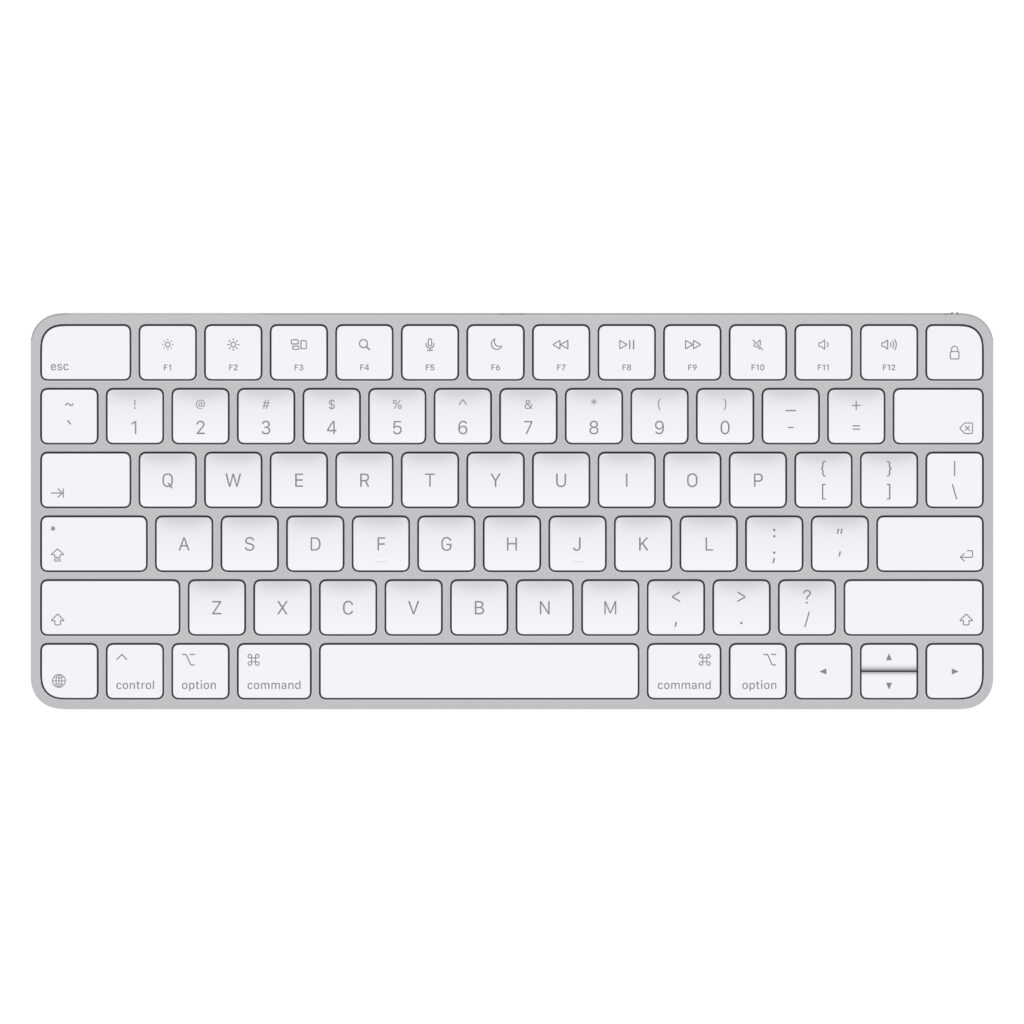
- Rigid bead-blasted aluminum top plate provides zero chassis flex in an ultra-slim footprint
- Reversible USB-C interface modernizes pairing, data, and power delivery
- Low-profile scissor-switch mechanisms maintain consistent actuation force and low typing noise
- Instantaneous Bluetooth wake-from-sleep connection with month-long battery endurance
- Adhesive-sealed enclosure prevents non-destructive battery replacement or switch repairs
- Requires macOS 15.1 or later for full function and multimedia key compatibility
- Lacks hardware multi-device host switching and key backlighting
Overview
Resting at a shallow wedge incline between 0.16 and 0.43 inches (4.1 to 10.9 mm), the chassis integrates a rigid bead-blasted anodized aluminum top plate bonded to a low-profile molded polymer base. With an ultra-compact desktop footprint measuring 10.98 by 4.52 inches (278.9 by 114.9 mm) and weighing 0.53 pounds (239 g), the physical architecture prioritizes neutral wrist alignment through its near-flat typing plane. Beneath each low-profile keycap, a captive scissor-switch mechanism guides keystrokes across a calibrated 0.04-inch (1.0 mm) travel distance, providing lateral key stabilization that prevents binding on off-center actuations.
Electrically, the transition to a reversible USB-C port modernizes both charging and wired data connectivity, eliminating legacy proprietary interconnects while maintaining low-current charging that produces negligible surface heat. Acoustic emission is restrained and low-pitched, utilizing elastomer dome membranes under each scissor guide to absorb bottom-out impact rather than generating hollow high-frequency chatter. Internal power delivery draws minimal current from the integrated lithium-ion cell, sustaining over a month of typical daily operation while preserving prompt Bluetooth link re-establishment upon waking from sleep.
Firmware behavior is tightly coupled to the host ecosystem, requiring macOS 15.1 or later to natively map multimedia and specialized function keys. While the unibody aluminum casing affords exceptional torsional rigidity, the internal structure is sealed with industrial adhesives. This construction entirely precludes non-destructive disassembly, preventing individual switch servicing or battery replacement once the internal cell degrades.
Technical Specifications
| Brand | Apple |
| Model | Magic Keyboard (USB-C) |
| Chassis Material | Anodized aluminum top plate with molded polymer bottom base |
| Switch Mechanism | Low-profile scissor mechanism with elastomer dome membrane |
| Key Travel Distance | 0.04 in (1.0 mm) |
| Dimensions | 10.98 x 4.52 x 0.16–0.43 in (278.9 x 114.9 x 4.1–10.9 mm) |
| Weight | 0.53 lbs / 8.43 oz (239 g) |
| Connectivity | Bluetooth, USB Type-C (wired data and charging) |
| Port Interface | USB Type-C |
| Battery Architecture | Internal rechargeable lithium-ion cell |
| Battery Runtime | Approximately 1 month or more per full charge |
| Hardware Controls | Physical sliding power toggle switch |
| OS Requirements | macOS 15.1 or later, iPadOS 14.5 or later, iOS 14.5 or later |
Primary Sources & Audited Citations
Recommended Alternatives in Keyboards & Mice
At a Glance
How reliable is the Apple Magic Keyboard (USB-C) Review: USB-C Convenience Meets Glued Enclosure according to Mizex audits?
Ideal for macOS 15.1 or later users seeking a low-profile, rigid aluminum typing deck with USB-C convenience, provided that the glued, non-repairable construction and lack of multi-host pairing are acceptable.
What are the known quirks or drawbacks of the Apple Magic Keyboard (USB-C) Review: USB-C Convenience Meets Glued Enclosure?
Our reliability audit identified the following documented caveats:
- Adhesive-sealed enclosure prevents non-destructive battery replacement or switch repairs
- Requires macOS 15.1 or later for full function and multimedia key compatibility
- Lacks hardware multi-device host switching and key backlighting
What are the key engineering highlights of the Apple Magic Keyboard (USB-C) Review: USB-C Convenience Meets Glued Enclosure?
The top strengths recorded in our evaluation include:
- Rigid bead-blasted aluminum top plate provides zero chassis flex in an ultra-slim footprint
- Reversible USB-C interface modernizes pairing, data, and power delivery
- Low-profile scissor-switch mechanisms maintain consistent actuation force and low typing noise
- Instantaneous Bluetooth wake-from-sleep connection with month-long battery endurance